" "

Saturday, February 19, 2022

Trips along softly on the tongue this way...

As always, one odd blog project (bloject?) breeds another. So it is that only days after thinking about the elegant syncopations in "Why it's good old reliable NAAAthan, NAthan, NAthan, NAthan Detroit," my middle school music class had made it to the "Gary, Indiana" scene in The Music Man

Well, just as Frank Loesser delights in placing "Nathan" on various parts of the meter, Meredith Wilson literally describes his own metrical play as a series of "elegant syncopations" within the lyrics themselves. The idea is the same, though at a gentler pace. 

Here's how I distorted Nathan, with Nathan starting in four different places within the 2/4 meter:

In the middle of "Gary, Indiana," (a part not included here), Harold Hill sings: "If you'd like to have a logical explanation / how I happened on this elegant syncopation." You can see the syncopations below. The first "Gary" is on beat 1, the second on beat 4, and the third on beat 3. 
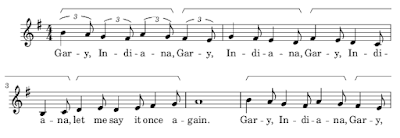
The logical, elegant extension of this idea would be to add one more "Gary, Indiana" starting on beat 2, and then the cycle can repeat itself for as long as desired. (My new little melodic phrase is shown in red. Would be nice to end it on A-sharp to keep everything stepwise, but that was trickier than I'd hoped.)

As with the "Nathan Detroit" post before, a lot of the appeal of projects like this is finding a way to re-mix the original multimedia. In this case, I found that Harold doesn't sing many of the notes in red on the correct pitches, so a little pitch-shifting wizardry was required (partly why the A-sharp was tricky to achieve), and then loop/syncing the video is its own challenge. Unlike the unpredictable Nathans, in this case I simply prepared one long video for your enjoyment:


Incidentally, because I needed to have a version of the video going backwards, I ended up with this odd half-Scandanavian version of the song - which also happens to bring out the "rag" in "Gary":

Still haven't finished (or started!) this week's fugue though, so enough about this.

Tuesday, February 15, 2022

Just how reliable is Nathan Detroit?

This is just a little diversion from the ongoing fugue series. I'm music-directing an upcoming school production of Guys and Dolls, which means for the first time I'm playing one of my favorite songs: "The Oldest Established." I've always enjoyed the way Frank Loesser syncopates the name Nathan in this song, hitting almost every possible position in the meter.


Though I'm not sure when it began, it has long seemed to me that this pattern could happily repeat ad infinitum:
So, as I've done with Stravinsky, Haydn, Satie, and my own blog, I thought the best solution was to create a page in which each re-load creates a surprise number of repetitions. Enjoy!

Good Old Reliable


UPDATE: I somehow forgot to mention, even in the middle of a big fugue-writing project, that Guys and Dolls opens with the well-known "Fugue for Tinhorns," which of course is really more canon than fugue. Perhaps it would be a fun challenge to write an actual "Fugue on a Fugue for Tinhorns," though would be hard to tie that in with Sunday morning... 

Sunday, February 13, 2022

Epiphany Fugue 6/8 (in 5/8)

This week's fugue was inspired in part by a quirky twist of words, which is one of my favorite kinds of inspiration. When I wrote my post last week about the fifth in this series of eight planned new fugues for Epiphany, I gave the post the generic title: "Epiphany Fugue 5/8." Only when I posted about it on Facebook did I notice the possible double-meaning in the title, so I wrote: 
Fugue 5/8 is in the books. (No, it's not in 5/8 time which, come now to think about it, is a little disappointing.)
But of course, the seed was planted. As it happens, I'd encountered and recorded an unusual fugue in 5/8 time a couple of years ago. That had come about due to a strange confluence of puns as well, feeding off the connection of "May the 4th be with you" with the date 5/4. Memes about Dave Brubeck and his 5/4 "Take Five" had led me to make other memes about other music in quintuple meter, and this somehow led to friends letting me know about Anton Reicha's unusual little fugue. I mention all of this because thinking about a fugue in 5/8 time immediately seemed liked a realizable and desirable goal. So this fugue is connected in various ways to Star Wars, Dave Brubeck, Anton Reicha, and the use of fractions.

I'd already settled on using the classic Welsh hymn tune HYFRYDOL as my subject this week. I was walking along absent-mindedly on Monday, and it occurred to me that I could easily fashion a 5/8 fugue subject by condensing some rhythms in the tune, which otherwise might've been suitable for a nice jig fugue. It's worth noting as well that, whereas most of the fugues I've written so far this year have been conceived as preludes, this one was scheduled as postlude, so it needed to be lively.

I was so motivated by this idea that, unlike in previous weeks when I did most of my work on Friday/Saturday, I actually had this one mostly finished by Wednesday. I think it came out pretty well as a kind of experiment in asymmetrical perpetual motion - and having it done early was good since this required a bit more practice. The fugue subject, because of the condensed rhythm, is admittedly not the most distinctive, though the countersubject (which is a continuation of notes from the original hymn tune) has a dotted quarter which helps establish the 5/8 groove. It would probably be more accurate to say that the subject is four bars, including that dotted eighth, but the answer comes in halfway through the subject, another factor which gives this piece a sense of forward momentum. 


I tried to stretch the whole fugue out to two minutes, but losing that extra 8th note every measure really keeps things moving!


This is my second 2022 fugue with a subject that is all 8th notes. In the first case, using the Gregorian chant Ubi caritas, I was intentional about not having a clear metrical feel so that the music would flow more like chant. In this quite opposite case, I found it important to establish a clear 5/8 pattern early on (partially using that rhythm which starts the countersubject) since here I wanted the meter to be quite apparent. 

I was also intentional this time about writing music which works as well on organ as piano and which broke out of the slow/contemplative lane I'd fallen into for most of the previous fugues in this series. Although I don't have the pedal technique to play the bass clef voice without a LOT of practice, this quick before-church run-through on manuals give a sense of how it works that way. (It would also sound pretty snazzy on harpsichord!) 


Live Organ

Synth Harpsichord


Sunday, February 6, 2022

Epiphany Fugue 5/8

Staying on schedule! I'm happy with how this one came out. There are definitely some similarities in tone and technique among these fugues, but I think that's to be expected. If nothing else, it makes me feel like I have some sort of consistency of style, even as I hope each week to find a more distinctively new approach. The writing continues to be sort of improvisatory, not in the sense that I simply sit down and make things up - I'm not really able to do that sort of thing well - but rather that I don't plan things out all that much, letting the ideas take me wherever they lead. 

This is a very familiar tune which, as used here, makes for a very simple fugue subject. For that reason, even though the hymn's emphasis on the Trinity might've been a good excuse to stick with three voices, I thought this would a good opportunity to go back to four voices. 


Sunday, January 30, 2022

Epiphany Fugue 4/8

Well, I'm halfway there. A fugue series which I imagined as a way to make myself do something to start the year has now resulted in four fugues which didn't exist a month ago. 

Although all of these fugues are to be based on hymn tunes, today's tune, O Waly, Waly, is probably best known as a folk song. It happened that we had two soloists singing an anthem based on this tune today, so that's how I ended up choosing it as a subject. It's a beautiful melody, although it's possible that by shortening its long notes, I've take a bit of the longing out of the effect. The original melody is a good example of music in a major mode that still can sound sad (as is more often associated with minor mode). Benjamin Britten certainly leaned into that aspect. 

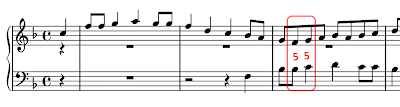
As with all of these fugues, I haven't been overly scrupulous about traditional voice-leading rules. In this case, I realized soon that the countersubject I'd devised (I had in mind a sort of winding river idea) results in immediate parallel fifths (though the note in the countersubject is just a little lower neighbor). 

But after trying other things, I decided I liked this version best, so that's how I'm rolling. I'm on a deadline!

Fugue #4:


Updated Hymn Fugue Archive