


I have not yet received much feedback about my most recent post, in which I combine a serious Sondheim song with a silly song about Barbie; but on a Facebook Sondheim forum, a commenter wrote: "I don't know whether to love this or to be horrified." I suspect this comes from a point-of-view which holds Sondheim's works to be somewhat sacred. I don't even completely disagree with that notion, but I think I've proven over and over here that playing around with greatness doesn't have to diminish the greatness. Meanwhile, this kind of play can yield all sorts of discoveries.
Obviously your milage may vary, but I find that this kind of connection making (which comes from logically trying to find common ground between "The Ladies Who Lunch" and "Barbie Girl") is rich with learning possibilities. Incidentally, I'm currently in the middle of reading a book about learning styles called Range. An early chapter makes the case for analogical thinking as one of the best models for developing a flexible, creative problem-solving skillset. I've written about analogical thinking here a lot, especially when discussing the work of Douglas Hofstadter. ← That hyperlink will take you to many, many blog posts in which his ideas have surfaced here. Hofstadter's core idea from his decades of experience researching artificial intelligence (way ahead of the current AI boom) is that analogical thinking is one of the essential aspects of real human intelligence. Merging two songs like this is an exercise in finding/creating connections.

So what did I learn by inviting Barbie into Sondheim's society? Well, first of all, the thematic connections between the two texts are actually pretty interesting. If the core theme of "Barbie Girl" can be summed up with the lyric "life in plastic," that closely aligns with the kind of emptiness beneath a shiny surface that Joanne is seething about. The ladies she skewers are focused on appearances ("off to a gym...claiming their fat"), and they are bored by their own superficial pursuits ("rushing to their classes in optical art / wishing it would pass."). The classes are a way of collecting cultural cachet, like "catching a Pinter play" or "a piece of Mahler's" as opposed to truly engaging with the culture. When Barbie sings "I'm a blonde bimbo girl in a fantasy world," it's not so different - she's reducing herself to an empty-headed figure lacking substance. (I've always enjoyed the factoid that Elaine Stritch, the legendary originator of the Joanne role, did not know who Mahler was when handed the lyrics. She thought "a piece of Mahler's" sounded like a pastry.)
Because "Barbie Girl" has less lyrical richness (it's very repetitive and the Ken stuff is crass), I decided I would structure the mashup by following Sondheim's lyric structure and filling it with Barbie-style variations on the same theme. Working this out gave me a deeper appreciation for how Sondheim carefully builds the song, beginning with lighter complaints which are more like casual asides and hitting deeper as it goes along. This made me realize it wasn't wise to fill each stanza with as many Barbie references as possible, no matter how tempting that might be. It seemed important to let the existential angst simmer and emerge fully only at the end.
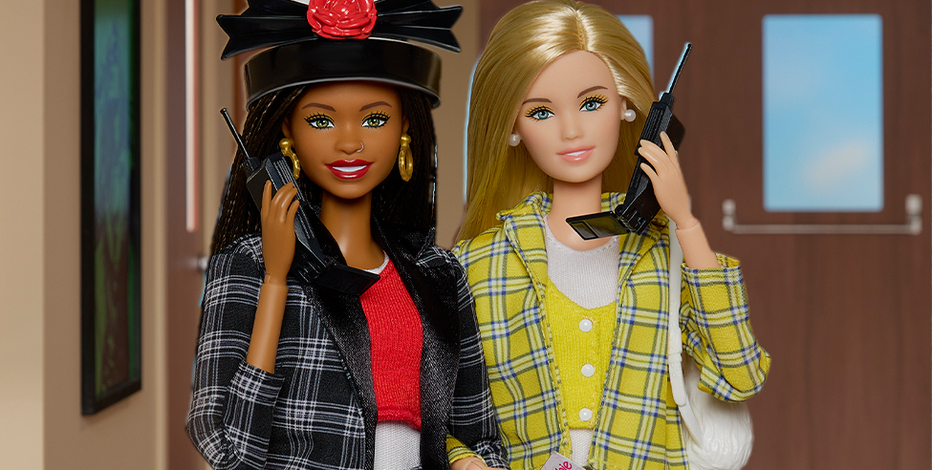
The first openly bitter hit in Sondheim's song is over halfway through with "Too busy to know that they're fools / Aren't they a gem?" which I countered with "Too clueless to know that their jewels / don't contain a gem." Clueless-ness is a fun late 90's updating of basic foolishness. The movie Clueless came out in 1995, only two years before "Barbie Girl." Mattel even sold Barbie versions of characters from the movie. Switching from "fools" to "clueless" is one of many ways that plastic Barbie's barbs are not as bitter as flesh-and-blood Joanne's.
In the final verse, Sondheim hits even deeper with "Look into their eyes and you'll see what they know: Everybody dies." Here it was fun to play with the fact that Barbies don't really die because they never really live. So I stole directly from Sondheim except for the reversed punchline: "Look into their eyes and you'll see what they know: Their eyes never close." This makes the substitution of "Smile" for Sondheim's "Rise" at the end pretty satisfying. All the Barbies can do in the face of the empty void is smile.
Now there's one feature of Sondheim's song I've definitely noticed in the past, but had forgotten when I was crunching words. He has some very elegant internal rhymes which I wasn't thinking about when at work. Check out this great series of triple rhymes in the first half of each verse. Note how in every case, the internal rhyme is hidden as part of a two-syllable word.
Here's to the ladies who lunch—
Everybody laugh.
Lounging in their caftans And planning a brunch
On their own behalf.
...
Here's to the girls who stay smart—
Are-n't they a gas?
Rushing to their classes in optical art
Wishing it would pass.
....
Here's to the girls who play wife—
Aren't they too much?
Keeping house but clutching a copy of Life
Just to keep in touch.
....
And here's to the girls who just watch—
Are-n't they the best?
When they get depressed, it's a bottle of Scotch
Plus a little jest.
My verses don't do this, although there is a satisfying internal rhyme thanks to Aqua (plastic/fantastic):
Here's to the Barbies who brunch
in a Barbie World
(life in plastic) It is fantastic, it's such
fun to be a girl.
For the record, I did go back and create matching internal rhymes after I'd already posted the video, but I felt each "fix" made the lyrics weaker otherwise. Since I was already indulging in pop-style slant rhymes (world/girl; friend/men) of a type that Sondheim would never, I figured I could consider my slightly looser rhyme scheme to be more pop-ropriate. Not to mention that, though this might offend some Sondheim truthers, I'm not sure that caftans and Aren't they a gas? are the best of choices. They feel a little forced. The latter is the kind of the thing that definitely dates the show, although dated-ness has always been part of Company's charm.
Nevertheless, I emerged from the experience simply having to tip my hat to the master. If it's true that I desecrated his work, I also learned to love it more.
I wouldn't say I learned as much from Aqua's song, although I came to admire some ways its giddy momentum builds in part from some unexpectedly shortened phrase lengths. It is mostly laid out in pairs of 4-bar phrases (like Sondheim's song), but the first "C'mon, Barbie, let's go party" from 'Ken' is only two bars (at 0:24 here) before the chorus kicks right back in. When we get to the little pre-chorus ("You can touch, you can play...") the first time, it is only a single 4-bar phrase (at 0:56 here) leading right back into the chorus, so again, this provides some forward propulsion. These might seem like trivial details, but they do change the character of the song, and it adds a bit to the overall trippy quality.
I also learned that Mattel originally tried to sue Aqua for defaming the good Barbie name - only to come back 25 years later to endorse a remix of the song used in Greta Gerwig's Mattel-approved Barbie movie. Perhaps in 25 more years, the world will be praising the way I let Barbie express herself in full Sondheimian glory. Here it is, once again:
UPDATE: It has occurred to me how strange it is that I've spent so much headspace in a Barbie World over the past week. This has made me reflect that, though I've never had any particular interest in Barbie, I have the following points of contact with her world:
- Growing up with four sisters (older and younger) who all had lots of Barbie dolls and accessories.
- Seeing Barbie presented as a character in the Toy Story universe.
- Having two daughters who had a fair amount of Barbie dolls and accessories.
- More importantly, those two daughters have both watched more than a dozen of the animated Barbie movies, which many (including me) find creepy due to Uncanny Valley experiences. I don't like these movies, but appreciate that 1) my daughters find them deeply nostalgic, 2) the movies often feature classical music in interesting ways, 3) the movies do attain a sort of entry-level musical theater quality in some of the songs.
- The Greta Gerwig Barbie movie, which I find overrated. It has some clever things, and I appreciate Gerwig's creative spirit, but the movie tries too hard to be message-y.
- Being vaguely aware of the Barbie Girl song for years.







No comments:
Post a Comment