" "

Saturday, August 6, 2022

An Aug 6 for Aug 6 in an August 6tet

Once again, Aug 6 has snuck up on me and I didn't get you anything. Well, at least not anything new or original, but I'll see if I can reignite the blog with a couple of observations. First of all, it happened to dawn on me that today is August 6 not long after dawn while on a long morning walk. And quite by coincidence, I had already listened to perhaps my favorite-ever Augmented 6th (Aug 6) chord while walking as I'd been revisiting a recording from last summer of the first movement of Brahms' Sextet No. 1 in B-flat. I even re-listened to the marvelous Aug 6 moment a couple of times while unaware that today is Aug 6.

Actually, let's back up and remember that I first "discovered" Augmented Sixth Day exactly ten years ago today when I saw that a student's harmonic analysis entered into an Excel spreadsheet had the abbreviation "Aug 6" automatically converted by Excel's internal logic to "8/6/12." The fact that this discovery happened on August 6 still blows my mind. This also reminds me of a clever bit of memery I saw just this past week online:
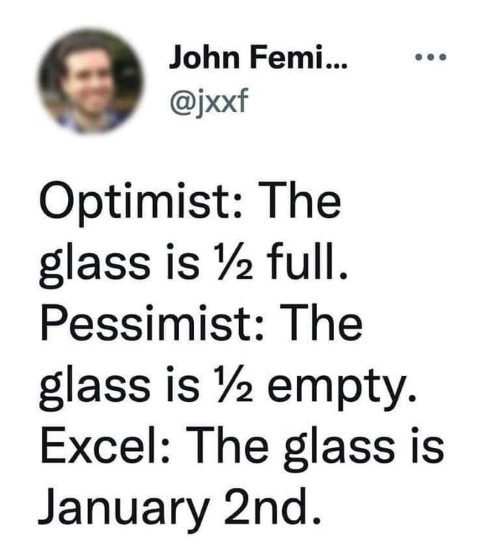

Yes, Excel will interpret anything it can get its hands on as a date, and this can actually be quite annoying at times, but it's worth it to know about Augmented Sixth Day.

Since I'm short on time here, I'll just quote from this post from last October about Aug 6th Chords in Mendelssohn, Brahms, and Haydn. Have a great Augmented Sixth Chord Day!

==========================

from the post Augmented Reality, 10/16/21, beginning after a discussion of an Augmented Sixth chord in an early Mendelssohn string symphony:


...So it was that a few weeks after starting my re-exploration of Mendelssohn's augmented-sixth-based modulation in this Andante, I heard my 14-year-old cellist son play the extraordinary first movement of Brahms' first sextet at chamber music camp. (To be honest, this music was a bit over the heads of these campers musically and instrumentally, but they did a great job with the challenge, and managed to present it with confidence and a convincing overall shape.) It's music I've heard often enough, but didn't know super well, yet as the Recapitulation approached, I remembered that something special was going to happen. (Side Note: this kind of musical memory-based recognition/anticipation is one of the most satisfying things about listening to familiar music; this is surely one reason people who love classical music enjoy returning to old favorites.)

As the dramatic texture unfolded and suddenly the opening theme returned in a harmonically arresting way, it occurred to me that this sounded a lot like what happens in Mendelssohn's Andante. The two musical passages (Mendelssohn and Brahms) are different in so many ways, but that makes the analogical connection all the more meaningful. (I've been writing about my love for and fascination with analogical thinking since the blog began.) Hopefully I'll get around to writing about the Brahms sextet more in a future post as there is SO much to say, but for now just listen to the way the music moves from G-flat Major to the home key of B-flat Major. These are not closely related keys (they only share three common pitches), but Brahms uses a German Sixth chord as a sneaky way to get from one key to the next. The video below should begin at 6:35, where the cresc. is marked in the score.


The most important thing to listen for is that, in m.233, the first violin (highest instrument) goes from E-natural to F (up a half-step) at the same moment the 2nd cello (lowest instrument) goes from G-flat to F (down a half-step). G-flat and E-natural are an augmented sixth apart - not an interval that shows up if sticking to one key - and the resolution of those distant notes outward to an octave is the fundamental thing about how augmented sixth chords work. (There's something else unusual going on in this case which I'll get to in a later post.) 


Back here in 2022, I'll leave you with this glorious recording, and of course I recommend listening to the whole sextet, but the BIG MOMENT starts at around the 10:38 mark.

Sunday, March 20, 2022

Slicing Pi

It's highly likely I'm the only one who's been bothered by this, but my 3/14 post stretching a familiar 3/4 minuet into 3.14/4 time has stayed on my mind since the notation system I devised was a bit sneaky. I knew each 3/4 bar needed 0.14 extra beats, and I found a way within Lilypond to multiply note values in a way that achieved that (at least for playback purposes). But I cheated with the time signature. I just made my own time signature sign that showed a 3.14 over a 4 and then used Lilypond's "cadenza" function, which allows the user to place barlines wherever one wants. Essentially, this means the internal calculations act as if there is no time signature, so as long as the various parts line up rhythmically, the musical output will sound right, even though the barlines aren't generated by time signature calculations.

During idle moments this week, I tried to imagine a way to create a time signature which is precisely three beats plus 0.14 beats long. At some point, the old use of 22/7 as a fraction which approximates Pi came to mind, and that helped me to think about this a different way. After flirting a little with the idea of an irrational time signature like....well, 22/7, I realized that what I really need to do was add a single septuplet note to the three quarter notes in each 3/4 bar. 

It's a curious and sometimes forgotten (by me, at least) fact that our names for note values are really just ways of dividing a whole note. So a quarter note means nothing more specific than that it is 1/4 the duration value of a whole note. I finally realized that dividing four quarter notes into septuplets means that it would take 28 septuplet notes to equal one whole note, so a septuplet value could also be called a 28th note.* One doesn't see a lot of 28th notes out in the wild, though curiously the name sounds a lot like a 128th note, which is a thing. (There are 32 128th notes in a quarter note.) But that's basically just a coincidence. 

For my initial "Minuet in Pi" video, I used a special notehead with a pi symbol inside to indicate values which need to be stretched. It's now clearer to me this symbol could be defined as meaning the basic note value is stretched by 1/7. (This is similar to how a dotted note value extends the duration by 1/2.) This makes the notation pretty simple, but that's because I invented a sign to smooth things out.

Anyway, I finally realized that using Lilypond's wonderfully logical design, I could create a composite time signature of 3/4 + 1/28. Since each quarter note beat contains seven 28th notes, the signature could also be written as 22/28, but that doesn't show the additive process as clearly. Of course, one could notate more or less the same thing using 22/16 time, but that wouldn't allow the use of quarter notes to show simple beat values. Using 28 as denominator allows the use of quarter notes more or less as they'd be used in 3/4 time except on the third beat which requires stretching. (I don't think there's a truly elegant way to handle the ties required for that stretched beat.)

Is this all a little more than you want to think about? That would be fair, but I have found this a good challenge to help me think more clearly about how time signatures work. The two videos below are thus more precise than what I posted last week, though also a little less elegant. The first one is probably a little more proper, though the second one is maybe a little easier to read as it preserves more of a 3/4 look. [UPDATE (3/21): See also important footnote version in 22/7 below!]

Minuet in 3/4 + 1/28 Time, version 1


Minuet in 3/4 + 1/28 Time, version 2


* If you're like me and have flirted occasionally with irrational time signatures (which basically have denominators that aren't multiples of 2), you might be tempted to think a time signature with 7 on the bottom is the way to use septuplets as a primary division; but remember that a 7 would just mean a whole note is divided into 7, so that would provide a pulse which would be notated as quarter note septuplet. This would not fix my problem of needing a nice way to show standard quarter note beats which look like the way this minuet is usually notated. I needed a septuplet division of the quarter note itself, which is how we end up with 4 x 7 = 28. 

In other words, although a 22/7 time signature would look cool, it would only work if the primary beats in each bar were indicated as whole notes like below. And, whaddya know? Having added this as a "day after" footnote, I now think this is my favorite way of notating this meter!

Minuet in 22/7 Time


Monday, March 14, 2022

Minuet in π

Somehow, I only realized mid-day that today is Pi Day (3/14). Soon after, I had the idea of a dance in 3.14/4 time, but not so much time to work on it. However, I didn't want to wait a year! So I did get something roughed out in time to post it here, unvarnished as it is.

If you're a clumsy dancer like me, you might find that 3.14 beats per measure is just what you need. That extra 0.14 beats give you time to think about what comes next. I invented a quick notational symbol in which the pi-noteheads indicate notes that are stretched out to extend the third beat of each bar by 0.14 beats. And that's all I have time to say today!

[Quick research confirms as I expected that others have had this kind of idea, although I like how easy it is to hear here.]


UPDATE (on boring ol' 3/15): If you'd like to hear this with the downbeat stretched, this was my first effort. However, I found that this sounds too much like simple downbeat emphasis since 0.14 of a beat is not very much. I ended up preferring the idea of 3/4 time with the 0.14 essentially added at the end, although a case could be made that I should only have lengthened the final 8th note of such bars rather than the final two 8th notes.

Sunday, February 27, 2022

Epiphany Fugue 8/8: The Lasst one

This post will be brief after a busy weekend, but I did meet my goal of writing eight new fugues for each Sunday of Epiphany. This is the last Sunday Alleluias are sung until Easter, so I had the tune Lasst uns erfreuen on my radar for a while as it is associated with multiple hymn texts ending in Alleluias. A few weeks back, I’d considered the Old 113th (known to Lutherans as O mensch, bewein) as a fugue subject, and it happens to begin with the same opening phrase as Lasst uns erfreuen. Thus, one could theoretically write a fugue which serves equally well for each tune, though I decided to allude to the latter’s Alleluias in the countersubject here.

(I also realized while working on a diminution of the subject that the opening phrase is the same as that of Simple Gifts minus its pickup notes.)

I wanted to end the series with a grand postlude style suitable for organ, so this achieves that, although it’s pretty short. I ran into that curious composer problem where I’d written a good bit of a fugue early in the week and tacked on a temporary ending. The temporary ending grew on me, I was short on time, so it became more or less the ending. (It's amazing how powerful repetition is as a means of making something sound 'right.')

Perhaps later I’ll come back and write more about this fugue set. One of the ongoing challenges was to deal with the tension of not wanting to write the same fugue every week while also wanting to develop some consistency of style. Among others things, I realized after a few weeks that I wanted to avoid always using the same opening formulas. This week, the fugue answer comes in at the Dominant (very normal), but in minor (not normal). The most common procedure would then be to have the next voice back in Tonic, but I have it enter in the Submediant (which is naturally in minor, meaning the two middle entries of this major key fugue are minor) so that the entry of the bass voice in tonic has a strong sense of arrival. Thus, the entries are in: D Major, A Minor, B Minor, D Major.


THE HYMN FUGUE ARCHIVE
(25 total / 8 new in '22)

Thursday, February 24, 2022

15

What a boring blog post title! Today is indeed the fifteenth anniversary of MMmusing, but I haven't come up with a clever angle on this. I've realized that 15, though roundish, is actually a pretty uninteresting number. I thought of posting a list of Top 15 Posts or Top 15 Videos or whatever, but 15 seems like too many for a well-curated list. 

So, here's just a quick "State of the Blog" spiel. Let's see...2007 was a pretty long time ago, so I guess I've been doing this a while. The past year was relatively slow after a strong January/February start to 2021, but I've had another busy start to 2022 with seven (soon to be eight) new fugues, some syncopated loops, and some general rambling. The future is bright.

Though it still may not be totally clear why I keep doing this in fits and starts for a fairly small audience, I am grateful to have so many half-baked thoughts and unique proof-of-concept videos and webpages archived. It's been long enough and I'm now old enough that I can find posts I'd completely forgotten about. I think that's the main reason I do this. I walk (drive, sit) around a lot thinking about these sorts of things - might as well preserve those ephemeral thoughts in....whatever this is.

I was thinking this week about a competition that took place around 2011 or 2012 for "best classical music blog." Blogs were still a good bit more hip and relevant then, but I remember being struck by two things (for what admittedly was a pretty gimmicky contest). Because the judging was to be based on a series of writing challenges, 1) the competition was stuck with the idea that a blog is just like an informal version of writing for print (newspaper, magazines) and thus fundamentally about words, and 2) the competition was really only about a limited series of exercises, not the building of a unique, long-term brand. 

Meanwhile, I as I've said and emphasized way too many times but will say again, the attraction of a digital platform for me is not just the free, unedited publishing (though I enjoy not being edited as evidenced by parenthetical diversions like this), but rather the idea that writing about music can be seamlessly integrated with audio and other multimedia illustrations. I love to read and can even enjoy the imagination required to look at printed musical examples or read a description of some musical process. But here's an example of a video I'd forgotten about which makes several complex points quickly and efficiently; I'd rarely want to be stuck merely with words, even though I love words. I absolutely did not set out to create a multimedia-themed blog, but that's the shape things have taken, and I've done so many cool things I'd never have imagined without taking that first step.

I suppose one of the many reasons blogs have lost a lot of influence is that talking-head videos are now the preferred, more likely viral medium for this kind of work. Adam Neely gets millions of views for his very well-conceived and multimedia-rich videos. He's a very sharp thinker who zeroes in on topics really well, so I'm not suggesting I could match his abilities if I tried. I have thought of trying my hand at the talking head thing (though I hate hearing my own voice), but generally I still prefer the asynchronous experience which reading allows, with links and multimedia provided to let the reader explore as needed. Though this is clearly not the best way to get views, I'm content to continue documenting whatever I'm thinking about at the pace it naturally happens with good ol' old-fashioned Blogger as my home base.

As always, you're encouraged to try the Magical Multimedia Musing Machine to see where the winds take you. Hope to be back here next year when I can title the post: "I am sixteen, going on seventeen."

And, ok, after all of that, here is a quick list of fifteen - not necessarily the Top 15, but a post from every year featuring a fairly wide variety of things. Compositions, Arrangements, Mashups, Performances, Programming, Animations, Words, etc. I intentionally tried to avoid some of the things I've already promoted over and over. (Some of these, like the first five listed, involved a lot of work, so as lighthearted as the tone here generally is, I'm proud of the investment of time and problem-solving that goes into projects like these.)
  1. The Birth of Coulenc (2021)
  2. Chaconne at a glance (2020)
  3. Haydn a Surprise (2019)
  4. Barber: Guitar Concerto (2018)
  5. Alternative Facts (2017)
  6. Sundays at the Improv (2016)
  7. What it the great composers wrote the music for the closing credits of 80's TV shows, Part I (2015)
  8. The Luigi Rag (2014)
  9. Moonlight Mashup (2013)
  10. Ballade Blogging (2012)
  11. Atonality on Ice (2011)
  12. Reflections on a Two-Part Invention (2010)
  13. Name that bassoon (2009)
  14. Ambigramania (2008)
  15. Hyperspace (2007)