A little over a week ago, I wrote about a new string quartet movement I'd written more or less using the 12-tone "method." Although I didn't think it needed to be any longer on its own, as its internal argument works pretty well for me, it does seem as if it could be the beginning of something bigger. Since this "opening movement" is a mostly solemn, fugal structure, the logical next step was a lighthearted scherzo. (I'll admit I had in mind the opening two movements of Beethoven's Op. 131 as a kind of template.) I started experimenting by taking an ostinato figure from the climactic buildup of the "first movement" - that ostinato is really just a fast statement of the 12-tone row: 12 sixteenth notes in 3/4 time.
I thought it might be even more twelve-y to start this new movement in 12/8, so it does indeed begin with the 12 notes of the row split up equally amongst all four instruments in a 12/8 bar. (I've dispensed with alto clef below so as not to confuse any violists.)
But then a funny thing happened on the way to the dodecaphony. As the example above neatly illustrates, 12/8 really means there are four beats to the bar, and I realized the first notes of each beat could fit fairly nicely into a very simple C Major context; true, the last beat (cello) is more C Minor (or C Phrygian), but those chromatic notes go by so quickly that they don't seem so out of place when this kind of thing starts happening:
[Yes, I know there are parallel fifths between soprano/bass.]
When I created this row (to go with the oh-so-serioso words "When Jesus Wept..." as described here) I hadn't noticed that the wraparound notes 12, 1, and 2 create a C Major triad, but it suddenly seemed very lighthearted to have a 12-tone piece break into this simplest of keys, especially given Schoenberg's famous quote, "There is still plenty of good music to be written in C Major." Plus, to be honest, I'd been struggling to summon a jolly mood sticking strictly to 12-tone ways. So the die was cast: this movement would be aggressively tonal comic relief, while still using the row as a basic building block.
The rest took shape pretty quickly, although I still consider this very much a work-in-progress. It has a basic ABAB structure in which the trio-like B section is darker and features the primary row as an extended lyrical melody (mm.26-42) passed among the upper three instruments. The B section is introduced by the most stridently 12-tone harmonies in mm.24-25 (and later, mm.69-70) in which the 12 pitches of the row are deployed across three successive chords. Otherwise, the row is used in a much breezier manner, with the "accidentals" functioning more as chromatic decoration than tonal disruptions.
The 12/8 meter led pretty naturally to a fiddly jig tune, and though the bass line is quite primitive most of the time, there's a sort of funhouse passage starting at m.54 in which the cellist suddenly plays the row in retrograde; for three bars, all four parts are cranking out versions of the row, but things snap back into place just as quickly, the exception having proved the tonal rule.
The recording is again, of course, played by horribly unsatisfying virtual string players (especially in the more lyrical parts) so one has to use one's imagination, but if there's one thing I can say for this piece...it's short.
The strongly contrasting "first" movement, in case you missed it:
P.S. Did I consider titling this post "A Phony Thing Happened on the Way to the Dodecaphony?" Yes, yes I did. I've also realized that my instinct is always to spell Dodecaphony as Dodecacophony (as in dode-cacophony).
Just a bit of follow-up to recent activity here, with links aplenty.
In response to yesterday's post about "hearing four symphonies at once," the wittily wonderful Will White, conductor/composer/etc, tweeted about this epic mashup of ALL FIFTEEN Shostakovich symphonies. I'd heard of John Oswald's legendary experiments in audio re-arranging, including his layering of 24 Also Sprach Zarathustra recordings atop each other, but this Shostakovich pile-up (not by Oswald) is both zonkers and surprisingly listenably Shostakovich-y; his music often has openly spaced textures and enough spiky orchestrations that various elements come through with surprising clarity, even with so much clashing. (He also likes clashing!) The assemblers of this "performance" stretched and compressed the various movements to make them fit together, so there's yet another layer of distortion at work. I made it through the entire first movement, and though it certainly has a generally cacophonous effect, one does experience something of the intensifying progression of a symphonic structure. Sort of.
While we're on the topic of Shostakovich, I'd just like to note that when a Facebook friend posted a picture of a birthday bon-bon presented to her cryptically by DSCH (Shosty's own signature cryptogram), I deduced that Shostakovich would probably order a Double Shot Caramel Hazelnut latte for his daily Starbucks fix. A Double Shot Coffee Hot would perhaps suit his personality better, but I don't think that represents proper ordering protocol.
Finally, having cited Radiolab yesterday, I need to mention that one of the most recent episodes features my hero, Douglas Hofstadter, talking about Le Ton beau de Marot*, which is only my favorite book in the history of books. Alas, it was only a brief segment introducing a show devoted to translation, but it did offer a chance to hear the author himself reading a series of translations of the little Clément Marot poem that inspired Hostadter's enormous book. And this reminds me that, of all the dozens of Marot translations arrayed throughout the book, I'm not convinced that any are as good as my own humble effort, which I've featured here before and will point you to again.
* Le Ton beau de Marot is subtitled "In Praise of the Music of Language." That subtitle is what first attracted me to the book. I thought of it last week when I was puzzled by Terry Teachout's expression of disdain for the semicolon. (Teachout has written more about this here.) I, of course, am an inveterate user/abuser of semicolons, em-dashes, commas, parentheses, etcetera, etc. My basic defense would be that such tools make it possible to modulate written prose in a way that helps the reader follow the musical elements of a verbal composition - the rises and falls, hesitations, summations, etc. Though I resist more every year the notion that music is a language (for reasons I won't go into here), I have no hesitation in thinking of language as a kind of music, which is why the subtitle of Hofstadter's opus was and is so appealing to me. This inspired me to create my own little aphorism, which is perhaps more insightful than true:
A former student sent along a link to a fascinating Radiolab episode, "Inner Voices." I have a bit of a reputation for liking mashups, and the student astutely observed that the final segment would thus interest me. In "A Head Full of Symphonies," we meet an unusually gifted pianist, Bob Milne, who convincingly claims to be able to "hear" four completely different musical works at once - all in his head. They test this out by having him get to know four recordings well (music by Beethoven, Schubert, Mendelssohn, and Brahms) and then start "playing" them in his head. When stopped at random intervals, he's able to identify exactly what's happening (with perfect pitch, of course) in whichever work he's asked about, pretty much down to the second.
This is obviously remarkable, not least because Milne's internal clock is metronomic, but also because the idea of making sense out of so much unsynchronized simultaneity is daunting. Actually, from the way Milne describes it, it's not so much that he's making sense of the mashed-up sounds as that he's able to keep track of all of them separately - though I hope you notice there's a lot of slippage between those two possibilities. Part of the joy of listening to a symphony or fugue is making sense of sounds that are individually perceptible and yet meaningfully related. So, it's not totally clear to me what Milne is "hearing" when he's hearing four symphonies, but here's how Jad, the affable host, responded to such sounds produced out loud:
Noisy, yes, but noise? Cause I kind of like it! This might not have been the best example for them to play because the cadence from the Schubert "Unfinished" Symphony is coming through so clearly that it's pretty easy to make sense of that as the central musical idea, with the other stuff serving to intensify the proceedings. At least, that's what I immediately heard - far from nonsense, and kind of exhilarating. I'm not claiming to have anything like Milne's abilities, but I have come to love more and more the mental game of juggling multiple musical streams at once. (I also enjoy it when familiar things get mangled!) As I've observed many times here, that's basically what counterpoint and rich symphonic writing are all about, though each is historically focused as much on unity of purpose as diversity. What seems to intrigue me more and more each passing year is that strange periphery where bits of unity, or at least satisfying simultaneity, emerge from cacophony.
[I wrote about some early experiences of this here, here, and here, though all of those examples are more about finding delight in chaos itself. Note that, for me, that delight comes in being able to pinpoint ordered elements within the chaos such that it becomes more complex to the ear than an irreducible mass of sound. Like Glenn Gould in this fabulous scene.]
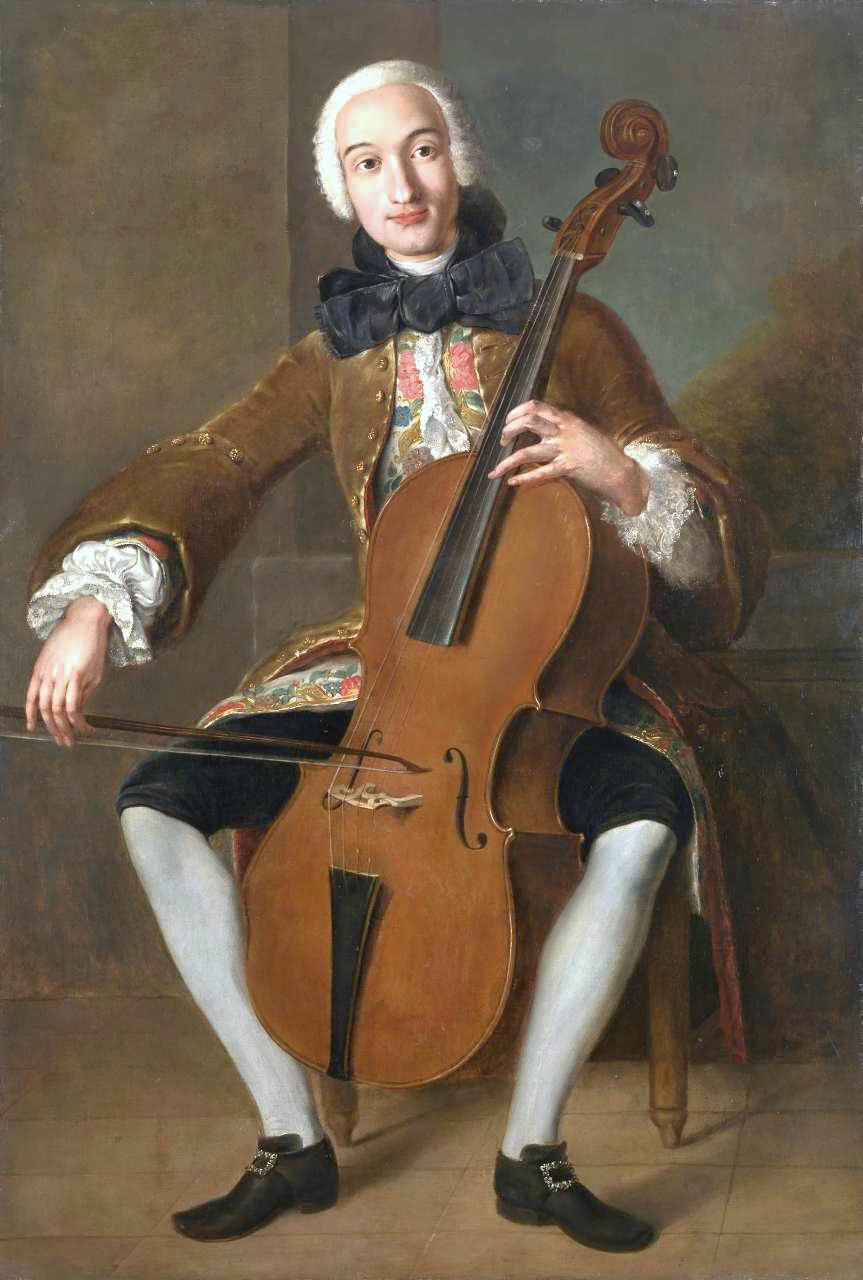
Getting back to Bob Milne for a second, he was introduced on the program as one of the "best ragtime piano players in the world," and much was made of his ability to play simultaneous rhythmic patterns (a basic feature of ragtime, or "ragged time") with ease while also holding conversations, etc. This came back to me when, a couple of days ago, I happened to throw together a little mashup of a "celebrated" minuet and the famous theme from "Super Mario Brothers." [That idea, like The Rite of Appalachian Spring, was a musical pun inspired by a verbal pun: a Facebook friend, who happens to play the cello, posted a picture of himself dressed as Luigi (Mario's brother) for Halloween, and this made me think of the famous cellist/composer, Luigi Boccherini. Cue mashup.]
What surprised me is that, once I got the two Luigis to play nice with each other, the result sounded kind of like: ragtime! Yes, rags are usually in duple meter (though there are ragtime waltzes), but there's something about the strongly grounded rhythm of the Boccherini left hand (which, in the MIDI file piano version I'd downloaded, uses a ragtime-like style of single bass notes on the beats and chords on off-beats) against the pervasively syncopated Mario Brothers theme that delivers a pretty convincing ragtime experience. (The Mario theme doesn't sound particularly raggish on its own because it doesn't have the regular, steady accompaniment.)
I think the new "Luigi Rag" actually works pretty well - it has the advantage of uniting two over-exposed pieces which are familiar enough to most listeners that keeping each in view isn't so difficult. [On a completely different topic, perhaps to be explored later, I found myself realizing that both the Boccherini minuet and Koji Kondo's theme are SO well-known that it seems almost impossible to judge either on "purely musical merit" (as if such a thing even existed) - I'm tempted to say neither is really all that special on its own, but who can say when one can't help but hear each as a kind of icon that both affirms and overshadows itself?] I'm also kind of crazy-proud of my silly little animation above, but it occurred to me that making available a playable violin/piano arrangement (in the original and more standard key of A) might coerce some brave accompanist to break out the ragtime at a Suzuki play-in somewhere. So, you can download the score here and see/hear it in action, with my house violinist helping out, below:
P.S. I hope you notice how elegant the music engraving is in that video (and in the downloadable PDF.) After two decades of relying on Finale, I've finally dived into the Lilypond. Learning to use it is a heady challenge, but it sure does put out pretty notes! I started a blog post about that this summer and never finished it, but hope to return to the subject soon...
P.P.S. If you're new to the blog, here's a helpful Youtube playlist of various MMmusing multimedia mashups from over the years: Classical Mashups.
Kind of disappointed I didn't think of the title above for the post in which I actually created a program for manipulating 12-tone rows, but I feel like I am on some sort of longterm program in how I think about 12-tone technique. Like many music students, I had virtually no use for this notorious compositional method when I first learned about it, and on the whole, I'm still something of a skeptic; I suspect the 20th century might've been better off if this way of doing business had remained on the periphery or, perhaps more importantly, been allowed to evolve more naturally and gradually instead of being taken SO seriously so soon and for so long.
But I suppose an inevitable result of teaching about this method for many years, and thus being compelled to make a fair case for its merits, is that I've become more sympathetic to its possibilities. As I explored in my 12-tone Sandbox project (the "real" 12-step program), I think it would be fruitful to have students approach this seemingly severe system in a more playful manner. As I further explored in my 12-tone Satie Generator, there's also an advantage to hearing 12-tone material used in fairly conventional, otherwise familiar contexts. For me, at least, it's made the 12-tone palette seem more appealing and less forbidding. [Listen here.]
So when I was asked recently to make a little video birthday greeting for a musician friend, and knowing that this musician friend (and former student) has little use for atonality and other 20th-century innovations, I thought it would be fun to throw together a 12-tone greeting. This also meant I wouldn't have to see or hear myself on video, since I enlisted the help of my virtual singers to do the honors.
In this case, the familiar rhythmic structure and melodic shapes help to orient the listener. I'll admit the ghostly presence of the "real tune" means this also becomes a bit of a "wrong note" exercise. That's interesting enough in itself, but not really the point of 12-tone music, in which all of the notes should seem equally right - or equally wrong.
When I say above that 12-tone technique didn't evolve naturally enough, one of my complaints might be that Schoenberg and many of his followers seemed intent on underlining the disorienting experience of losing a tonal center by also exploiting disjointed rhythms and, especially, by preferring jarring accents and disjointed melodic shapes, with leaps larger than an octave common. I found myself thinking about this last week and, having developed more of an attraction to the lovely sound worlds that can be evoked in a 12-tone context (especially via the Satie connection, about which more blogging soon), I thought about writing a 12-tone piece designed to sound as coherent and "follow-able" as possible.
My goal was NOT to write a tonal piece that happens to feature 12-tone rows, though there are surely ways to cheat and make that happen. I suppose my main preliminary goals were 1) to keep the melodic shapes relatively conjunct and "hummable," and 2) to avoid the harshest kinds of harmonic dissonances. Minor seconds (a staple of so many 12-tone compositions) were especially to be avoided, but I also hoped to stumble into fleeting moments of pleasing sonorities.
I started out with the idea of writing a piece for church choir that would somehow sound both exotically disorienting and yet not too threatening for a fairly conventional congregation. In thinking of possible texts, the simple words of William Billings' famous canon, "When Jesus Wept," came to mind, and then came the sudden "moment of discovery" that really set things in motion. The opening line - "When Jesus wept, / a falling tear / in mercy flowed / beyond all bound" - has exactly 12 words, which also happen to divide up nicely into four 3-word chunks.
I came up with a row I liked pretty quickly; it's most notable for having a good 'ol descending minor triad occupying the second 3-word chunk - text painting, yes, but also part of a series of falling thirds which I figured would come in handy, although it turned out that most of the harmonies in the piece arise from the row heard against itself in counterpoint (as opposed to deploying row pitches vertically into chords). Note that the four 2-syllable words (one per chunk) each result in the repetition of a pitch, which might seem like rule-breaking, but I hear them functioning more as re-articulations than "new" notes, plus there really aren't any hard and fast rules in 12-tone music. I'm the boss here.
[Incidentally, Anthony Tommasini, in this 12-tone intro video, only manages to get around to a couple of actual 12-tone pieces, and the one that's featured is this charming little Schoenberg musette which happens to feature repeated pitches all over the place AND a constantly repeated pedal tone throughout! Yes, I understand that a musette implies a bagpipe-like drone style, but the presence of a constant pitch anchor absolutely orients our hearing in a way that makes this a very strange "Exhibit A" for 12-tone music. While I'm in this bracketed paragraph, I might as well mention that online 12-tone tutorials are just a big mess, full of misinformation and misleading assertions that confuse more than enlighten (not that there's anything wrong with that), but this white paper by Mark DeVoto is pretty cool-headed and informative.]
I'm the boss, and yet, following the rules is part of the fun/challenge. It's probably better to think of whatever rules one chooses as self-imposed constraints anyway since that's really the point, and that's really what set me on my way with my own double constraints: 1) use 12-tone technique, 2) make the music sound melodic and somewhat conventional. So, I liked my "when Jesus wept" row (I hope it wouldn't "make the baby Jesus cry"), especially because it seems like a melody that a good choral singer could internalize pretty quickly. As first presented, it all falls within a single octave and only features two intervals larger than a third.
"Making music sound melodic" suggests helping the listener to identify a pitch set as something recognizable on return, so although 12-tone technique is so often associated with non-repetition (of pitches), my new little piece is very much about using repetition strategically - as is most music, I suppose, since musical structure usually boils down to varieties of statements, repetitions, contrasts, and embellishments. But again, I think the history of 12-tone music has been dominated too much by music in which repetition is hard to perceive.
I thus began with the kind of imitative, contrapuntal texture that focuses right away on the row as melody. In conventional tonal contexts, harmonic support actually helps to reinforce our perceptions of a melodic idea, but 12-tone "harmony" tends to pull focus from the individual lines, so I let things evolve slowly so that one doesn't hear all four parts at once until well into the piece. I also made the choice to repeat the brief "exposition," both for the benefit of the listener and also because I was thinking of ways to help the singers feel grounded.
Except that somewhere along the way, I abandoned the idea of singers altogether (though I may return to it) and the piece morphed into a string quartet. I suppose I was worried about finding singers who'd want to take the time to learn a 12-tone piece, but I also just don't really like strongly dissonant music in an a cappella context, which means I'd already kind of failed in my original goal. I think as much as anything, I found that thinking in instrumental terms provided more opportunities for developing ideas through different registers and gestures, even though the finished-for-now product doesn't really push the strings very much.
For now, I've left those 12 words in the opening 2nd violin statement (not to be sung, though!) as a sort of historical marker, and as a subtle guide to melodic inflection. I chose a more generic title, Lacrimosa, as it still references tears, but generalizes the theme in a way that better suits what takes shape. (Also, there's a lovely tradition of instrumental Lachrymae pieces from Dowland to Britten, which also generalize from more specific vocal tears.)
[Obviously, better viewed in full-screen (and HD) on YouTube.]
And what took shape was genuinely unexpected - it's only three and a half minutes, but includes a fairly dramatic climax that just kind of happened. 12-tone technique has a long history of producing very compact musical structures, which makes sense given the intensity of the material and the relative economy with which ideas can be developed. No worrying about modulations and establishing new key areas. It's almost surprising that the 3-minute 12-tone standard didn't become classical music's answer to the 3-minute pop song. Almost.
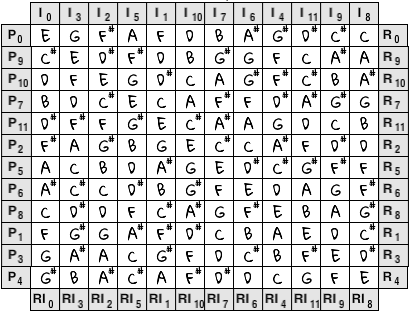
Obviously, the recording provided above is a very unsatisfying synthesized rendition. (It would almost be more unsatisfying if synthesizers could do the music justice.) I've also included annotations for every use of the row, because I was making note of them along the way anyway, and they make it clear what processes I used. [You can see the row matrix at the bottom of this post.] Although many people mistakenly think of 12-tone technique as insisting that no single pitch can re-sound until all 12 have been heard, the unfolding of this piece depends on various transformations of the row sounding against each other and thus creating all sorts of passing harmonies and even a few unisons. For example, in this passage, the two violins end up on three unisons in m.51, including on the first and third beats. (It's the kind of passage that I don't think would sound as effectively sung because the big leaps would stick out too much - it's much easier for instruments to deliver gestures like this in an even-keel manner.)
In fact, it is at only at the two most climactic moments that the rows are distributed vertically into chords, at m. 32 and m. 68. Actually, in the second instance, the first violin plays the prime version of the row as a melody, but the other parts are accompanying not with their own versions of that row, but with sets of pitches deployed such that every chunk of three notes in the top voice is accompanied by the other nine distinct pitches below - and, each of the other parts plays its own 12-tone set going horizontally. These tightly chosen parameters made this passage the most vexing for me compositionally, and I'm still ambivalent about the results. There's a big, purple major seventh chord that happens right at the climax of this climax and I'm a little embarrassed about it - but it felt like that's what the music wanted to say. I'd certainly never have arrived at that solution without those constraints in place. So, whether or not you find this music meaningful or worth hearing (my own jury is still out as I now work on establishing some distance), I think this does say something about the creative process.
A few more details about the process: Without fully intending it, I found the three parts converging on a long held A at m.53 (to be fair, the 2nd violin and cello have just played the same row successively, with each lingering on the final pitch) and that set in motion a pedal tone passage in which this A is repeated in the cello part for 12 (!) bars while the viola turns the prime row into a frenetic ostinato figure, which finally explodes into all four parts playing the ostinato in unison four times. This is actually a very classical technique, distilling all the parts in a texture to a single musical line, never used more thrillingly than by Mendelssohn at the 10:38 mark here.
Note that (as in Mendelssohn) this most manic presentation of the melody is immediately followed by the climactic recapitulation mentioned above in which the first violin triumphantly re-states the prime row as a "big tune." Again, the use of conventional structural technique is intentional as a way of helping the listener make sense of the row as melody. The music then collapses into a final, fragmented statement of the row with ghostly counterstatements haunting it.
So, now I've got this piece. If I end up liking it, I could imagine it as the first movement of a string quartet (the chromatic, fugal opening is vaguely reminiscent of the opening of Beethoven's Op. 131), maybe letting the 12-tone chains fall away as the movements progress. Or maybe I could pair it with a re-imagined choral version of "When Jesus Wept." Or maybe it will sit in a forgotten virtual desk drawer for several centuries and then be rediscovered as the work of a visionary genius - or not.
The decision to post it here (unperformed and all) is as much as anything an exercise in what blogging can be - thinking out loud not just in words, but in notes, or images, or videos, or whatever. Several years back, I imagined embarking on a regular series of "piano blogging" posts, in which informal recordings were posted as ways of "saying something." Spontaneous composition makes even more sense in this regard. In fact, this entire post was originally just going to be about the 12-tone "Happy Birthday" (as a follow-up to my two previous posts in which I was blogging about silly creative things done in response to former students), so the Lacrimosa can legitimately be thought of as part of the blogging process.
One of my first favorite music blogs was Matthew Guerrieri's Soho the Dog, and though he's since gone on to blog less while writing actual critically acclaimed books, I always loved how he'd blog not only brilliant cartoons, but also little compositions he'd written. I've never been able to get "Bring Us In Good Ale" out of my head, and hope to convince some choir to learn it some day. Perhaps you too will struggle to get my little Lacrimosa out of your head - and hopefully it won't produce the wrong kind of tears. (There are at least two wrong kinds, in this context: tears of pain and tears of laughter.)
P.S. I've realized there are lots of nice video links embedded in this post for reference, so I thought I'd make a little YouTube playlist of all of them, which you can view here.
P.P.S. If you're curious, here is the row matrix which makes it easy for the composer to find the various transpositions, inversions (I), retrogrades (R), and retrograde inversions of the pitch set. This matrix was generated by my own little 12-tone Sandbox. The prime row ("When Jesus wept") is the 12 pitches across the top. (Note that whether a pitch is ID'd as flat or sharp makes no difference.)
LYRIC POET: Are we embarking on a study of the meaning of meaning? YOUNGER BROTHER: I sure hope not. (from Leonard Bernstein's The Joy of Music)
NOTE: There are more than 550 possible outcomes.
About Me
MICHAEL MONROE
I'm a pianist and professor in the Boston area. This is not me. Neither is this. Curiously, these most Googleable Michael Monroe's are each musicians. This IS me.