" "

Thursday, October 31, 2013

Boo Review

Two years ago, I posted a set of creepy videos (many mine) for Halloween, and it's coming back from the dead here. So, my work for today is mostly done, but I'll just begin by adding this (from last month) to the mix.


...and now, let's revisit the past:


Boo (originally posted, 10/31/11)

I'm giving myself only five minutes to write this Halloween post, relying as it does on already existing multimedia:

For quietly scary fun, there's this mashup I created a couple of years ago, combining the final two movements of Chopin's Piano Sonata No.2. It features the most famous funeral march ever with the terrifying ghostly echoes of the whirlwind finale:


So, that's to set the mood.

Then there are these two videos which I regret to say I didn't create. But they're frightening visual companions to Schoenberg's Pierrot lunaire. First...


The companion video is no longer on YouTube, but you can still view it on Facebook here.

So, no, I didn't make those, but they did inspire me to make this, which is pretty unsettling: (Check out the look on the sun's face.)


Now, let's pause for an ad from J. Peterman.


Here's my own little take on Pierrot lunaire, combined with some Stravinsky. Creepy clown!


And if you like Stravinsky jabbing at you unexpectedly, you might give this a try. [Click on image below.]


Finally, in light of the surprising intersection of wintry snow cover and October we're having here in the Northeast [remember, this was 2011], you can find all manner of creepiness in these various versions of Schubert's "Der Leiermann," from his song-cycle Winterreise. (None of these are mine: this is just a little playlist I put together for Twitter-based reasons a couple of days ago.) I'll embed one here, but you can find the others by following the link just above:


Enjoy the day!

Sunday, October 13, 2013

Tangential Perspectives

Daughter of MMmusing is a new member of Ben Zander's Boston Philharmonic Youth Orchestra, which had a stunning series of debut concerts last year - alas, before she joined. I've only just learned that this video is available of their Mahler 2 (!) performances last year at the Concertgebouw (!) in Amsterdam. I haven't watched or listened to all of it (I'm still coming down from a glorious Boston Symphony Orchestra performance of the same work under Christoph von Dohnányi a couple of weeks ago), but it is mind-blowing stuff coming from a youth orchestra - or any orchestra. (You can read much more about the Netherlands tour here.)


So, for now I'll just say that Boston-area readers should not miss this group's season opener on November 15 at Symphony Hall - a program to be repeated on December 9 at Carnegie Hall. (I now have the real answer to the old question about how to get to Carnegie Hall: Make your child practice, practice, practice!)

The hefty program will feature the monumental and ever-popular Shostakovich Symphony No. 5 as well as: the Ravel Piano Concerto in G (my "fantasy" concerto, i.e. the piece I wish some orchestra would ask me to play) with the ever-popular Christopher O'Riley at the keys; music from Michael Gandolfi's The Garden of Cosmic Speculation; and the overture to Verdi's La forza del destino. I'll admit that I was least excited about the Verdi - but then I wandered in to the final half-hour of the group's first rehearsal a few weeks back and was immediately drawn in by fragments of music I couldn't immediately identify. I finally realized it was the Verdi (which I played in a much lesser orchestra many years ago), and I was reminded of how powerful and direct Verdi's voice can be. And the music already sounded highly charged and compelling a few hours into the first rehearsal, although I don't know how many opera pits could accomodate an orchestra with 43 violins.

The rehearsals are held in a fairly unique spot, an auditorium at Boston's little-known Benjamin Franklin Institute of Technology. This room happens to have been designed as a 1/3 size replica of Symphony Hall, though it only has one balcony, and the miniature stage, of course, can't hold a huge orchestra, so the orchestra rehearses on the floor. The space is so lively that they've had to do some acoustical work to make it useable, but it has become a favorite place for me to hang out while amazing music is coming together. There aren't a lot of orchestras playing at this level which can rehearse at such a leisurely pace, so one gets to hear the same fragments turned and re-shaped multiple times. (I would've recognized that bit of Verdi the first time except that Zander was rehearsing winds alone, so the familiar, surging string undercurrent wasn't present yet.)


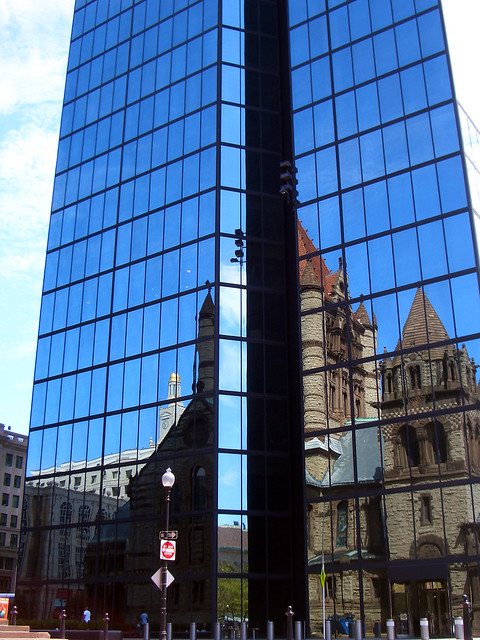
Yesterday, as I was walking up to the building exterior, I looked towards Copley Square (about 5 blocks away) and noticed a view of Boston's tallest building, the John Hancock Tower, that I had never encountered before. The Hancock is a fabulous building, of course, and its mirrored exterior makes it look distinctively different from just about any vantage point, including the way it famously contrasts with its Romanesque neighbor, Trinity Church. 


But that wasn't the new view. From the steps of the Benjamin Franklin Institute, one sees only a narrow side of the trapezoidal tower, so it looks like an odd, two-dimensional plane jutting up from the earth:


If you're curious, that picture was taken from the lower right (purple marker) of the map below, in which the Hancock (and its shadow) can be see in the upper left at letter A:


So there you have it. Not only did making my daughter practice afford me an opportunity to get to Carnegie Hall - it helped me see something new and beautiful about a familiar structure I already loved. I won't be surprised if the same happens with Shostakovich...

Wednesday, October 9, 2013

Recital Revisited I: Moonlight Mashup

The MMmusing Recital has come and gone and was, I think, a big success. The audience seemed to enjoy the experimental first half and, though I generally dread the thought of posting live recordings, I think a few excerpts are worth sharing as examples of the innovative goings-on. Let's start with how the first half of musical mashups ended, with simultaneous performances of moonlight music by Beethoven and Debussy. The pieces are from two very different worlds (one German Romantic, one French Impressionist), but they have the same tonic, are about the same length, and are both mostly soft and rustling throughout with a regular flow of 8th notes in compound meter (12/8* vs. 9/8). They're also both quite familiar to many listeners, which helps with hearing the "counterpoint" and, yes, they're both associated with moonlight (whether or not Beethoven ever thought of his sonata that way).

I'd written before about combining two existing recordings, but those pianists didn't have to listen to (or ignore) each other. Here's how that experiment came out, with no cuts or tempo alterations, but with some judicious fading up and down of the separate tracks.


I've listened to it a lot and there are many seemingly purposeful moments that I like, including:
  • 0:06 Debussy's second gesture bounces perfectly off of Beethoven's downbeat
  • 0:17-0:24 Debussy waits for Beethoven's dotted figure to land before exhaling
  • 2:00-2:20 Wonderful combined harmonies, with Beethoven sitting on a pedal G-sharp and Debussy anchored first a fifth below on C-sharp (spelled as D-flat) and by the same G-sharp (spelled as A-flat) at 2:14. The R.H. quarter notes in Beethoven weave in and out of Debussy's arpeggios like lost souls on a cloudy night.
  • 2:53-3:03 Both works float about the same V pedal tone (again, G-sharp/A-flat) as they re-transition towards their recaps, reminding us that many works share the basic structural proportions found here.
Still, it was my goal that we pretty much play it straight (as "Joyce Hatto" did in the recordings combined above) and just let the chips/pitches fall where they may. We did rehearse it a couple of times so I could get a sense of how to pace the Debussy, and I'll have to admit I found myself responding to Beethoven's pulses during some of the more free-floating Debussy moments. I also went a bit too fast overall and had to get extra-dreamy at the end so as not to leave Beethoven alone for too long. I love the contrast of Debussy's final, high-register D-flat Major answered by Beethoven's low-register C-sharp Minor. This actually came out almost exactly the same live as in the "recording" above.

So, here it is, with my excellent and good-natured colleague Stephanie Emberley handling the Beethoven. I think it's all really lovely and mysterious. Note that Stephanie chose to add an extra mashup element by following the composer's direction to keep the damper pedal down throughout, so that's Beethoven's own pitches hang around as ghosts to mash up with each other. Over at Wikipedia, someone has opined (emphasis mine):
At the opening of the work, Beethoven included a written direction that the sustain pedal should be depressed for the entire duration of the first movement. The Italian reads: "Si deve suonare tutto questo pezzo delicatissimamente e senza sordino" ("This whole piece ought to be played with the utmost delicacy and without damper[s]."). The modern piano has a much longer sustain time than the instruments of Beethoven's day. Therefore, his instruction cannot be followed by pianists playing modern instruments without creating an unpleasantly dissonant sound.
Let's just say that not everyone has the same definition of "unpleasantly dissonant."


FINAL NOTE: Pianists, of the world: DO TRY THIS AT HOME! I'd love to hear about follow-up experiments with this combination, and it's a good exercise both in concentration and freedom. Feel free to post about your experiences.


* Technically, Beethoven's music is in cut time (2/2), but the constant triplets produce the same effect as a 12/8 meter - in both performances of this moonlight mashup, you can hear how the 8th notes can easily align between the two worlds.

Saturday, September 21, 2013

MMmusing Recital Links

Since tomorrow's MMmusing recital is significantly based on material that's been presented here on the blog, here are some useful direct links to the original posts.


Read more about the entire program here.

Thursday, September 19, 2013

The MMmusing Recital


I've made passing reference to this already, but this Sunday I'll be presenting my first "MMmusing Recital." That's right, some of the unusual ideas presented here on the blog will finally be submitted to a live audience in live performances - not that I consider my readers to be less than alive, but you know what I mean. The idea, as with so many of my blog posts, sprang up kind of accidentally as I'd had another more conventional recital collaboration postponed, but still wanted to do some performing to start off the year. I already had the recital reservation, so all I needed was a program.

I knew I didn't have time to memorize and perform solo repertoire with the pressures of a new semester bearing down, but with Daughter of MMmusing having returned enthusiastically from five weeks of summer music camp, this seemed to offer an excellent opportunity to work again as a trio with her and my cellist wife. (We debuted as "Montrieau" at my faculty recital last September.) We'd all really enjoyed hearing a performance of the opening movement from Mendelssohn's Trio in D Minor at the camp, so my first thought was that we might play that entire trio as the recital's second half. Meanwhile, I started thinking about ways to explore blog-inspired possibilities for a more informal first half.

I'll spare you all the details, but I ended up deciding upon a series of loosely connected "experiments" in musical mashing as a kind of theme. I'm purposefully using the term "mashup" pretty broadly because there is a sense in which most kinds of music (and life!) involve some degree of mashing or another, especially contrapuntal genres. So it is that we'll open with a variation on Bach's most famous chorale-prelude. As genre, chorale-preludes already have mashup-like qualities since such pieces are built around hymn-tunes - except that I'm substituting our own college hymn, A.J. Gordon's "My Jesus, I Love Thee" for the tune most often known as "Jesu, Joy of Man's Desiring." This is what might be termed a negotiated mashup, since I made some significant changes to Bach's famous flowing triplets so that they're now in 4/4 instead of 3/4. You can read and hear more about that here.

As a further illustration of counterpoint as mashup, we'll do a fun little performance of Bach's "Crab Canon" from The Musical Offering. In this case, this is a tune mashing up with its backwards self, though the fact that Bach designed the tune with that in mind is kind of a cheat. That will transition into Steve Reich's Clapping Music, which is basically a canon based on metrical phasing - like the Bach, it's a mashup against itself. This then leads to an inspired mashup suggested by recent graduate Wesley Newcomb in which the two "chords" of Stravinsky's famous Rite of Spring polychord are subbed in for Reich's two clapping parts. It sounds like a 70's TV car chase. 

We'll then turn to a couple of time-bending French concoctions. Wesley has set up a nifty real-time phrase-shifter for Satie's Gymnopédie No. 1 which will allow me to play my Randomnopédie from the same on-the-spot score the audience will be watching. Satie's iconic work is famous for its directionless way of meandering around, so we'll be exploring what happens when the directionless phrases are sent back and forth through time. Next, I'll play my all-time favorite of Bruce Adolphe's radio piano puzzlers, a magical amalgam of Hey, Jude and Messiaen's radiant harmonies in praise of the eternity of Jesus. I know it sounds gimmicky, but somehow it works. The chords move so slowly that Adolphe only manages to get through part of McCartney's timeless tune - probably just as well that it doesn't get to the 19 repetitions of "Na... na-na na-na-na-na / na-na-na-na / Hey Jude," which has its own time-stopping qualities.  

The first half ends with two very different two-piano showdowns with a new colleague, Stephanie Emberley. First up is Mozart's ubiquitous music-box of a sonata (K. 545) heard alongside Grieg's mischievously charming second piano addition. I honestly don't know why there aren't more pieces like this as it reveals such an unstuffy and creative affection for an older style. Some of the happiest music you'll ever hear. Which is just as well, because what will follow (the most truly mashup-y event of the afternoon) will be more disorienting: simultaneous performances of the first movement of Beethoven's "Moonlight" Sonata and Debussy's Clair de lune. You can get a sense of what this might sound like here.

Though inspired first by the punny "moonlight" connection, the works complement each other in several ways. They share the same tonic (C# = Db), they're about the same length, each is mostly quiet and reflective, etc. Still, one is in minor, one is in major, one is Germanically directed and purposeful while the other breathes a French kind of nonchalance, so contrasts abound as well. The fact that Beethoven's work has a regular and insistent rhythm actually makes an excellent foil for Debussy's free-floating harmonies. We've run this "piece" a couple of times, and new things emerge each time - can't wait to see/hear what happens on Sunday.

So, that's the first half - everything that will be played has been featured on this blog at some point or another. These experiments exhibit another general characteristic of my musical interests: though some subversive, outside-the-box things will happen, everything is rooted in (or at least alludes to) the past. The Moonlight Sonata, Clair de lune, Gymnopédie No.1, Mozart's K.545, and Jesu, Joy of Man's Desiring are all iconically overexposed. Not only can they all stand a little jabbing, but the audience will have a better chance of perceiving what's going on since the source material will likely be familiar.

Since I'm pretty unapologetically rooted in the past myself, the recital's second half will be more like a normal chamber music affair, though with a couple of thematic mashups thrown in. First of all, we decided not to program the entire Mendelssohn trio because there just wasn't time to learn it all with school starting, my daughter preparing for some auditions, etc. The second half will thus begin with a striking sacred/profane, cello/violin matchup. The wife and I will play Messiaen's Louange à l'Éternité de Jésus as originally intended (for cello and piano, no Jude), though removed from the Quatuor pour la fin du temps context. Then, Daughter of MMmusing will put her fiddle through its paces in the wild gypsy smackdown that is Ravel's Tzigane. A heartstopping prayer followed by a pulse-pounding hoedown.

Just as the first half ends with a Franco-German conversation, we follow the colorful French soundworlds of Messiaen and Ravel with the passionate German Romanticism of Mendelssohn's first piano trio. (Did I think long and hard about fitting in the finale of Mendelssohn's other trio, which mashes in a famous hymn tune along the way? Yes, yes I did. But I can only throw my family so many curves. As it is, the wife is learning the Messiaen in about a week's time since I only thought to include that last week.) I'm a nineteenth century Romantic at heart, and I've never gotten to play this trio. Since we're only performing the first two movements, they'll be inverted, with the song-like second movement providing a bit of repose before the manic storminess of the first movement closes the program. Ending with an opening movement seems like the right way to go.

View the MMmusing Recital poster here!

UPDATE: Recital-related blog links here.