" "

Friday, April 6, 2012

Child's Play

As if I didn't feel guilty enough that my two daughters have a violin studio recital on Easter Sunday, I heard the almost-seven-year-old tearful in the other room this morning, struggling with Vivaldi. Her tears certainly had nothing to do with my wonderfully patient wife, who just happened to be the one helping with the practice. But, I did feel some satisfaction in being able to diffuse the tears by walking in, taking the violin, declaring that it is indeed difficult to play as well as I do, and then playing in my own inimitable way. (I know just enough from cello-playing to get around on a violin in the most excruciating way possible.)

My stunning playing brought out a big smile quickly, and I don't think the collateral damage to our musical sensibilities was too bad. This also reminded me that I once posted my own special brand of fiddling right here on MMmusing in an effort to show how a musical sequence might be overtextended:


In that clip, I'm playing on the half-size violin of my other daughter, who now plays a full-size violin and full-size repertoire, but I was also reminded that I'd once written a poem for Daughter #1 about stage fright. It is in a more sentimental style than my typical musing banter, so I almost hesitate to produce it, but let's face it, the blog's been gathering virtual dust since my Spring Break series ended, and the rest of the semester isn't offering a lot of daylight. So, I'm releasing these sonnets into the wild.


Belèn's Recital
  
Upon a time, once lived a little
sweet girl who called herself Belèn.
She loved to play her little fiddle,
(which you might call a violin).
She practiced almost every minute,
Each place she went had music in it.
She played while strolling down a path;
she wished she could play in the bath.
Yet anyone could stop her playing,
as sure as nighttime stops the day,
because, you see, she wouldn't play
in front of other people, saying,
"Just seeing people makes me fear
they will not like the notes they hear."

Of course, she'd play songs for her teacher
and she would play for Mom and Dad
and any furry, four-legg'd creature
who'd never think her playing bad.
But for some reason she'd decided
that no one else would be delighted
to hear the sounds that she might make;
What if she made a big mistake?
What if a finger slipped and landed
upon a spot upon on a string
it hadn't in her practicing?
What if the people then demanded
for her to put away her bow
and told her it was time to go.

The problem was, the big recital
at which Belèn was supposed to play
(you might have seen that in the title)
was coming in just one more day.
She'd learned the notes, she'd learned the bowing,
but there was no way she was going
to go up on that frightful stage;
she'd rather hide inside a cage.
"Belèn," her mother told her gently,
"I know that you're a little shy,
and that you don't like any eye
to watch you while you play intently.
But maybe you can just pretend
you're playing for one single friend."

"But even my best friends are scary
when I'm on stage," Belèn declared.
"Except," she said, "for little Mary;
my ragdoll never makes me scared."
"Let's bring her then," suggested mother,
"and then imagine there's no other
distracting person in the room."
Now Mary was the doll with whom
Belèn would sleep to help her sleeping.
And Mary often listened when
Belèn would play her violin.
She thought, "if I can just keep keeping
myself from thinking of the rest
of them, I'll play my very best."

The time at last had come and many
excited people waited for
Belèn, who told herself not any
but Mary had come through the door.
Each seat was filled by someone seated
and yet Belèn said and repeated
to Mary that they were alone.
It wasn't true, of course, she'd known.
But using her imagination
was something that she did quite well.
why, she could smell a not-there smell.
She even once went on vacation
to London, Amsterdam and Rome
while never, ever leaving home.

She looked at Mary who was sitting
in front of her in the front row.
She had a little thought of quitting,
but then she lifted up her bow.
Belèn could hear her Mary cheering.
She started playing with no fearing.
A finger slipped and missed a note,
it sounded kind of like a goat.
She looked and saw the peoples' faces;
she knew they'd been there all along.
And yet, they still enjoyed her song.
They sat and listened in their places
and now Belèn was glad that she
had come to play and they to see.

"Belèn" is the name of an imaginary character we'd been telling stories about for years, so it was handy that her name rhymes with violin. As for the sonnets, they follow the pattern used in Pushkin's novel-in-verse, Eugene Onegin. (I've got another set of Belèn sonnets on the shelf; perhaps they'll appear here some day.)  For those of you keeping score, this isn't the first time that such poetry has bloomed on the blog.
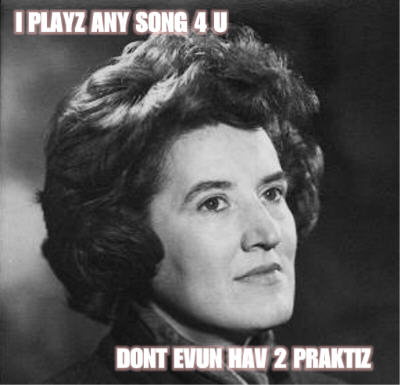
My very first blog post was about the wonderful Joyce Hatto story, and that inspired a six-sonnet scandal summary not long after. (I rhymed "Jocye Hatto'd" with "overshadowed!") By the way, I just read that the Hatto story has been turned into a docu-drama; I'm a little jealous, since I proposed turning that into a movie years ago. I still think my casting choices would be dynamite, although Alfred Molina will make an excellent Barrington-Coupe.
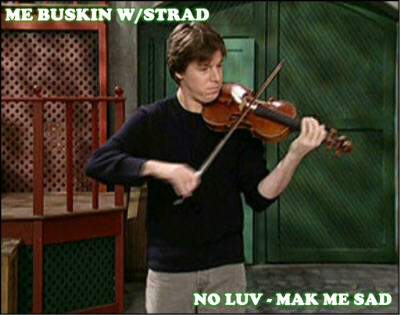


Then, when Joshua Bell made blog headlines with his busking misadventures, I summed it all up in another pair of sonnets.

And, for reasons that I don't have the energy to explain here, I once posted a "Casey at the Bat" send-up related to an NCAA basketball game. It's even got my own soundtrack that combines Ashokan Farewell with One Shining Moment. How is this not the most popular blog on the planet?
Getting back to the children's poetry thing, I've always had this thought that I should write children's books. Goodness knows, I've read plenty that are...not so good. I'm pretty sure I could write children's books that are...not so good. And, I did write Rex the Stickman. Perhaps some day I'll convert Belèn's Recital into book form, but at least now it's out there for the world to see.

Let's review:

Saturday, March 17, 2012

Ballade Blogging..."The Archive"

Yesterday...I did NOT post anything new on the blog. (Well, those who subscribe to my blog feed probably received an awkward little "ballade leftovers" post, which was actually just a draft with lots of notes to myself and half-tried paragraphs, etc. I accidentally posted that draft and it sat atop my blog for about three hours before I realized it. Ugh.)

I do have lots of leftover thoughts that have been drifting in and out (this is the great thing about actually writing blog posts - the process tends to inspire more blog posts), but Spring Break is almost over and I've got a ridiculously busy fourth quad coming up. So, the blog gets a little rest.

But, in case you hadn't noticed, I've set up a little archive for the "Ballade Blogging" series so that you could, if you wanted, read them all at once, almost like they were in a real book. (A book with audio/video!)  Its main special feature is that the posts go down the page in chronological order, instead of the usual "backwards-through-time" blog structure. The archive is here.

Thursday, March 15, 2012

Ballade Blogging, Part 7: Self-reflection


Though I've spilled more than 6,000 words in the past week, I'll have to admit that this "ballade" series has focused only intermittently on Chopin's fourth and final ballade. I've stayed busy practicing it, but I guess I'm more interested in letting the music speak for itself when I get around to recording it - or not recording it. Certainly there are plenty of recordings out there to speak for it. What has interested me is thinking more broadly about the experience of connecting to a piece, in this case a piece I also played about twenty-five years ago.

So, even my specific musical examples have had less to do with musical/technical analysis and more with my relationship to the piece. For example: 1) being genuinely surprised (in a piece I know!) by the way Chopin subtly reprises a theme and 2) finding tension in the way I hear a theme vs. the way it's notated. I've also mused about the 3) vivid way in which a musical re-encounter can awaken very specific memories and even 4) about the degree to which Chopin's ballade allows an introverted person like me to enact something passionate and extroverted - though within 5) a contained sort of context.

One subject I haven't tackled: what's the point in investing so much energy to learn something that's been recorded dozens of times (and performed thousands of times) by more able pianists? To some degree, this question implies a critique of the whole "classical music" mindset - why do we keep going back to the same well? Furthermore, since I tend to define myself as a "collaborative pianist" and my professional life revolves mostly around being an accompanist, music director, and professor, it almost feels selfish to spend so much time on solo stuff. Shouldn't I be working with someone else and being part of something bigger?

There are plenty of easy surface answers to that question. I'm a professional pianist and I teach piano (sometimes), so I should work on challenging repertoire and keep up my memorization skills, etc. If I'm a better musician, I'll do all my other jobs better. There's the possibility that audiences will enjoy hearing me play it live. Playing great music that's been handed down through the ages IS being part of something bigger. But on some level, there is still something a little bit selfish about this, if only because I think I'll get more out of it than anyone else will.

A Chopin ballade is a public piece in some respects, but I'd argue that its greatest rewards are for the person playing - the three-way intersection of the remarkable musical ideas with the countless hours spent internalizing them and the sensual connection with the instrument itself. When I play through the insane coda and most of the notes fall into place, it's an extraordinary meeting of mind, body, and spirit. Fingers are sent on very specific missions [mind], they experience tremendous tension and power [body], and I feel as if I'm flailing about like a madman [spirit]. An argument could be made that the audience gets to enjoy it more since they don't have to worry about the technical stuff - but that's not my experience.

I suspect this is one of classical music's problems. We all say we're doing it for the common good, to bring great art to audiences, to make the world a better place, yada, yada, yada - and all of those might be true, don't get me wrong - but I think most of us do it first because it's just so rewarding. No wonder we have so many students playing at absurdly high levels in the conservatories, even when there's no clear future ahead career-wise. The music and the instrument are incredibly compelling.

There've been times in the past few weeks when I could barely pull myself away from the keyboard. I wish I could say that happens more often in my daily musical life, but as I said in my first post, the solo piano repertoire was my first musical love, and it's really gratifying to re-connect with that part of myself. I enjoy going to concerts and listening to my iPod and the radio (although I don't listen with the passion I did as an avid LP-collector in my formative years), but being at the piano is where my musical center is.

Here's a little confession that's slightly embarrassing. A lot of times with recordings, my most engaged listening happens when I'm imagining that I'm the one performing. I've listened to this Richter recording of the Prokofiev 1st Concerto about fifty times driving down various highways, and often I'm seeing myself at the keys. When I'm listening that way, I'm completely locked in. (Amazing that I haven't gotten a speeding ticket!) I've also found that just about every piece my violinist daughter studies suddenly becomes so much more interesting - at least until she's done with it. For example, I've never had much interest in the Wieniawski 2nd - but when it was on the daily playlist here at Chez MMmusing, it seemed the equal of the Brahms and Tchaikovsky concertos. I guess I'm saying something pretty obvious - that music works most deeply when it's personal.

Of course, "selfish" is kind of a loaded word - there's certainly nothing wrong with learning music for oneself, and there's no question that audiences have received countless gifts from performers who are motivated first by pure self-interest. Lots of stuff in life works that way. I don't really feel guilty about any of this - excerpt, perhaps, that I haven't practiced as much as I'd hoped...

So, here endeth this little series. I'd fantasized about posting my own recording today, but the truth is, there are a couple of pages not yet memorized, and I'll need some time to live with it even once the memory's done. It's a finger-twister! I was at first relieved to find that the ballade seemed easier to play than it did in college (one sometimes fears, at a certain age, that the technique will slip away), but I'm realizing that's partly because I can read and grasp complicated patterns much more readily than I once could, so getting started was a breeze.* The refining part is still just as hard, though. Back to work!

* It's also been kind of cool to see Malcolm Gladwell's "10,000 Rule" in action. I used to hate working in all those back-and-forth boom-chick patterns in Chopin's left-hand writing, but years of playing constantly (all those Schubert songs!) have made that seem effortless.

Wednesday, March 14, 2012

Ballade Blogging, Part 6: The Present Becomes Past


Here's a blog post I started back in November and never finished:
Sometimes I feel like this blog could be called "Varieties of Musical Experiences" - as much as anything else, I'm interested in writing about unexpected ways in which music and the mind intersect. One topic that's been on my mind recently is how a simple musical fragment can transport me back dozens of years. There's nothing earth-shattering about that; it's well-known that music can be a powerful memory connector. I just read this amazing story about a German musician with devastating amnesia who can remember almost nothing about anything - except when it comes to musical experiences.
Last night [remember, this was written in November], I gave my first ever pre-concert talk for an orchestra concert. Earlier that day, I was listening to the first Strauss horn concerto as part of my preparation. It's a work I don't know all that well, although I played it (via piano reduction) with a horn student years ago. (Not a very pleasant reduction, as I recall.) But I also played it about 25 years ago with the great Dale Clevenger on horn - this was back in my college cello-playing days, so in this case I was one of many accompanying Clevenger. While listening to the second movement, the soloist started on a melodic idea that I immediately realized sounded more familiar to me than the rest of the piece....[and that's as far as the post went until now]
Here's that Strauss melody:


As I heard it that day, my mind starting doing that pattern-matching thing a mind does, trying to remember why the tune sounded so much more familiar than the rest of the piece. And suddenly it came to me: the cello section was soon going to have a big soli moment playing that tune near the end of the movement. By the time the music got there, it felt completely familiar:


[Incidentally, it's striking how that little rhythmic figure with the triplet recalls a motif from the slow movement of Beethoven's 5th.]

Of course, cellos don't get the tune all that often, so it's kind of an event when it happens, but it makes me remember how much orchestral rep I "hear" through the cello section. It's likely that for me, at that concert, the big cello moment was the highlight of the concerto (sorry, Dale) - and I imagine I practiced that passage a lot! I hadn't thought of that cello moment for decades, but listening to that recording cued me that my solo was coming up just as if it were yesterday.

The first "real" orchestra concert I ever played featured Beethoven's 1st (still my sentimental favorite of "the 9"), and I can still feel the excitement of playing this little transitional theme. It's not the most important part of the piece, by any means, but for me, it kind of is:


I had another "celli flashback" last Fall when I first started rehearsing Vaughan Williams' The Lark Ascending with a violinist - it's a gorgeous piece, though not all that gratifying to play on the piano. But again, I felt a Proustian moment coming on just a few pages in when I realized my left hand was about to play "THE MOST IMPORTANT LITTLE MOTIF IN THE PIECE." Or so it seemed. This story goes back to a high school "Governor's School" program I attended. (The governor was Bill Clinton, no less!) The program was intended to jolt us innocent youngsters into the modern world, so the orchestra played only 20th century rep. Some Schoenberg Variations, something by Webern, Ives' "America" Variations, Stravinsky's Symphony of Psalms, etc. I even got to play a few Cage sonatas for prepared piano, and I can still remember the conductor playing an LP of the Quartet for the End of Time for just a few of us.

But I was about as conservative as they come in those days and grumbled about a lot of this stuff, so I have to admit that the music I loved the most was...The Lark Ascending. Again, though the cello section mostly does cello section kinds of things in this piece (which, I suppose, is really about the solo violin part), there is this moment (6 seconds in, below) when the cellos leap up to sing a melodic fragment, and I can almost feel myself sitting on that rehearsal stage playing those notes, being so grateful for a nice singable tune.


When the camp ended, I went out and bought a record of The Lark as soon as I could, and I'm pretty sure that's one of the first things I listened for.

So, as I was saying in yesterday's post, there are plenty of different perspectives from which to view/hear a piece - hearing all these works from the cello section perspective is certainly skewed, but it skews happily towards a sense of place and purpose. (I'm sure there's a good joke about a cymbal player who hears someone mention a piece and says, "Oh yeah, that's the one that goes [CRASH!!!]." *)

Not surprisingly, I've had a lot of these experiences in revisiting the Chopin F Minor ballade this week. There are, somewhat vexingly, plenty of spots that I seem to have re-learn from scratch, but there are also passages in which, on first reading, I could feel exactly what my fingers felt like twenty-plus years ago. I don't just mean that the fingers automatically fell into place, but that the sensual connection with the keys made it seem as if the past had become present. It might seem that this opportunity to connect with the past is what inspired me to re-learn something I'd already played before, but these time-travelling moments always take me completely by surprise, which is what makes them so genuine.

In unhappier news, I'm also "remembering" what a difficult piece this is - if I ever end up slamming my fists into the keys in the days ahead, I wonder if it will awaken another connection with my youth....

* That could just as easily be a viola joke, couldn't it?

Tuesday, March 13, 2012

Ballade Blogging, Part 5: Right and Wrong


My son (almost five) has only recently taken an interest in our Wii video-game system. He especially loves playing Mario and Sonic at the Winter Olympics, even though he knows next-to-nothing about winter sports, and, since his reading skills are quite primitive, he navigates the various menus and instructions with the same level of comprehension that I'd exhibit playing video cricket in India. In other words, he really has almost no idea what he's doing, but that doesn't stop him from running up excitedly to tell me he's just opened "Dream Curling" on his account - meaning he somehow did well enough in regular curling to earn this gift from the Wii gods.

Frankly, I don't understand how regular curling works (brooms?), and I certainly don't know what's going on in this fantasy version - so, I can assure you that Son of MMmusing has, at best, only an intuitive/imaginative interpretation of what's happening on screen, but he has the time of his life shaking the controller, pushing buttons semi-randomly, and somehow doing OK. My point is that there are a lot of ways to comprehend an experience aside from the "right way." Clearly, the Nintendo folks have set their games up to be easily playable and even winnable (on the Easy levels), so that the barrier to having a good time isn't so high.

The various ways in which people might listen to and comprehend music are even more varied since, when you listen, you don't even have to push buttons or shake a controller to "win" - although people sometimes choose to shake things. I don't just mean that some will hear a "storm" where others hear "anger" or "my mother." I mean the way in which our minds organize the sounds (parallel to the way my son's mind organizes curling events) are open to all sorts of possibilities, many of which might be seen as "wrong," but interesting and pleasurable nevertheless.

Sometimes, I find that looking back through my own musical life is like looking through geological layers defined by what I understood at a given time. For example, this little Schumann march:

I realize now that, as a young piano student, I heard that dotted figure as an upbeat, so that beat 2 of the first measure becomes the downbeat. In fact, it becomes kind of a diverting way to hear this piece; because Schumann's cadences resolve on beat 2 (m.4, m.8, m.12, etc.), it makes perfect musical sense to re-organize the notes in my youthful way, with cadences on downbeats. (Cadences like downbeats.) The only problem is that, in the original version, the final phrase ends not on 2 but on a downbeat, providing a nice sense of closure. So, if you play it all as I used to hear it, it pretty much works until...the final cadence comes early, landing with a comical thud on the 2nd beat. (Well, I think it's funny.)


Not such a big deal - maybe Schumann even intended this to be ambiguous, but the current "me" would never look at that first version and think of stressing the second beats, because the notation clearly indicates otherwise. Back in the day, though, I had much less concept of what a given meter implied about stresses, and I can remember being confused by the ending. I could easily drag up many other examples of pieces I used to hear differently than intended. (I have a vague memory of trying to work out this 6/8 Schumann piece in 3 beats per bar. Wild Rider, indeed - might have even inspired this.) In some cases, the mis-hearing actually provides a sense of freedom, not to be so constrained by a meter.

In high school, I learned Debussy's colorful showpiece L'isle joyeuse. My fingers could handle it fine, but I was reading through it the other day and remembering that a passage like this left me completely befuddled rhythmically.

What happens in the third bar isn't really all that complicated - the music is in 4, but the sextuplets group melodically into six sets (as shown by the upward facing brackets), so there's a delightful cross-rhythm. Yet what I remember is a feeling of total freedom in that measure - I could sense (probably from listening to Horowitz's recording a thousand times) that something had "happened" to the pulse, but since I couldn't process it, it became a wonderful invitation to just let those bell-like notes toll away. Because I was doing my best to copy Horowitz, I'd guess my tempo wasn't so far off, but I can still almost feel the sensation I had then of free floating. I kind of miss that.

Probably the most famous music that people often hear "wrong" is the opening motif of Beethoven's 5th symphony. Everyone knows it's three shorts and a long ("V" in Morse Code), but it's quite common for people to think of the three shorts as a triplet, implying a slight stress on the first one, when in fact Beethoven wrote an 8th rest followed by three 8ths that lead into the downbeat. Should be " ---buh-buh-buh-BUH," not "Duh-duh-duh-DUH." (The latter rhythmic pattern is featured in the 3rd movement.)
So far I've just shown examples of distorted metrical perception, but shortly after I started relearning Chopin's 4th ballade, I remembered that he notates the main tune (which I referred to as lonely and "searching" in the previous post) differently than I tend to hear it. I'm fairly certain my mis-hearing goes back well more than twenty years, before I'd ever looked at the score. You can see below 1) Chopin's notation, and 2) my own conception:
#1

#2

When I say it's my own conception, I don't mean that I want to argue with Chopin about it or that I think he made a mistake. It's just that, on a more subconscious level, if you asked me to sing the tune (and I hadn't spent all this time thinking about it), I'm sure that version #2 is what would come to mind.

I wondered if this was a common hearing, so I polled my Twitter followers and actually got six replies (from NYC, Virginia, Arizona, LA, the UK, and Australia!) and they all voted against me! Even more curiously, I asked my wife to sing the tune as she heard it, knowing that she only knew the piece through my practicing of it in the past week. She ALSO chose Chopin's version, so I guess it was seeping through in my own playing.

Again, it's important to note that I don't really disagree with Chopin. Probably the best way of looking at this tune is understanding both that the E-natural winds down to the B-flat and back up to the D-flat, and yet our ears also hear a slightly longer range connection from the E to the D-flat. Part of me wonders if Chopin avoided notating it this second way to steer clear of the melodic augmented 2nd, an interval that's frowned upon in counterpoint exercises.

Anyway, that's the connection I find myself most drawn to, which I think explains why I would naturally sing the tune my way. I understand that Chopin's disjunct melody (E-Bb-Db) has a lovely wandering/searching character, but to be really honest, I just find the second version to be more beautiful (not that mere beauty has to be the only goal), and I even think that lingering E-natural is part of what attracted me to the ballade in the first place, twenty-plus years ago. As I hope to discuss tomorrow, one of the great things about living with music is being able to connect with one's own past. Silly as it sounds, that E-Db is an important part of my past, or at least of my relationship to this ballade. And, sometimes (often) the "right" way isn't the only or even best way. (That's a topic for another day as well.)

By the way, hearing it "my way" also turns that poignant E-natural into an appoggiatura (could also be called an "accented passing tone" because it's approached from above); you may recall that the appoggiatura is the musical device credited by the Wall Street Journal with helping Adele make people cry. I don't know if I ever cried hearing this melody, but I'm sure it's given me chills. And, in an uncanny coincidence, the very same Son of MMmusing who opened this post was walking around the house today with an iPod, listening to his sister's Adele album. He probably understands her music about as much as he understands curling, but that's not stopping him from having a good time.