" "

Wednesday, May 7, 2025

Music = Math

Consider these numbers I found myself writing on the whiteboard a couple of days ago:


While it might look like something from math class or some kind of scoring tally, these numbers actually represent notes students were to play on their 64-pad MIDI controllers. The controllers look like what you see below, and the "Bb Aeolian" written at the top reminds students that these very flexible controllers are meant to be programmed for this exercise in rows of B-flat Aeolian, meaning the first and last note of each row is a B-flat (the tonic) and the notes are in the Aeolian Mode, which is basically the same thing as natural minor. [Restricting the pitches to the notes in a given mode simplifies playback for students, although this setup does not allow the use of pitches not in the key - so, in the key of A Minor, this would be like giving students only the white keys of a piano.]
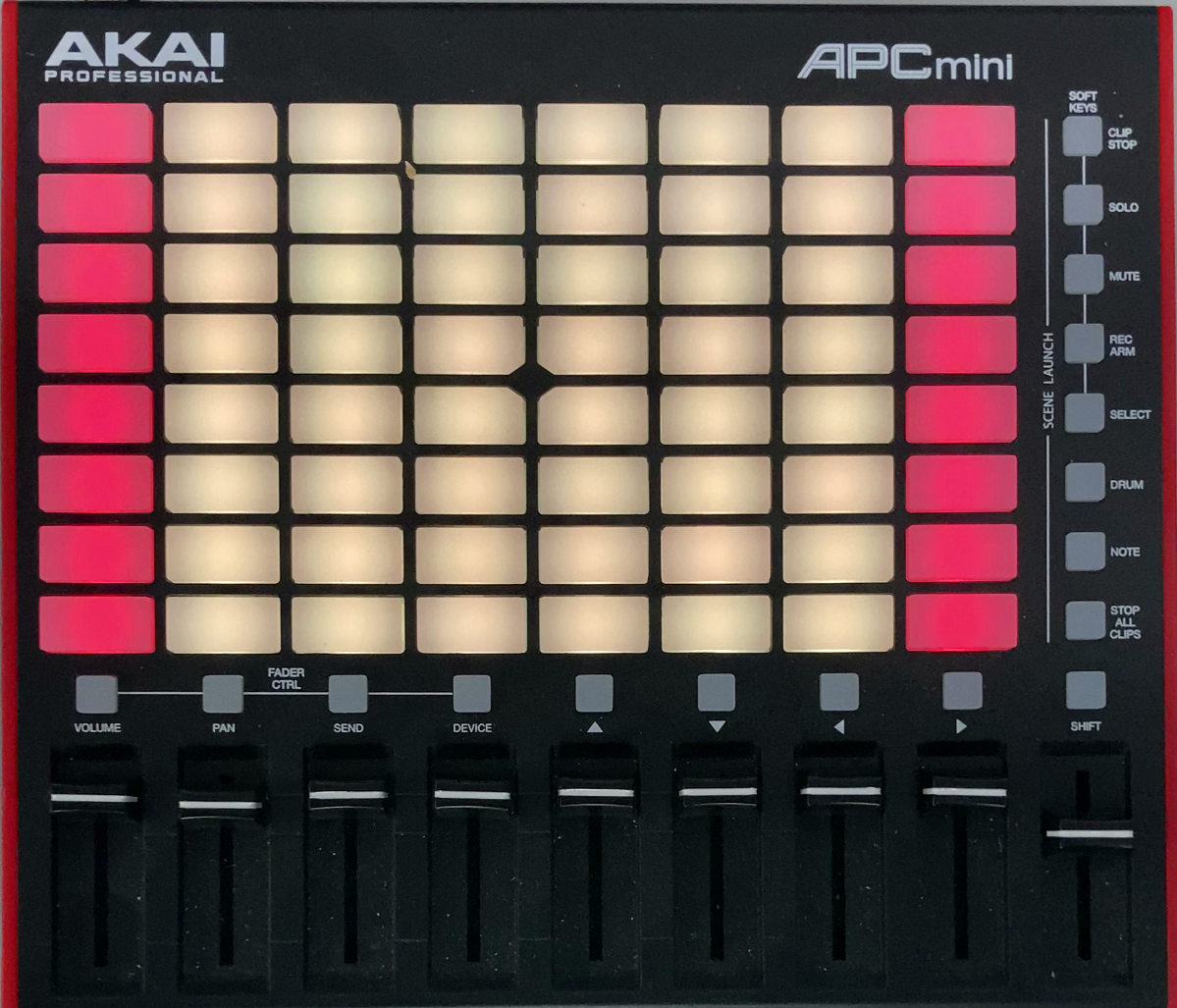

The goal for the students in this Digital Music Production class was to play the very popular right-hand piano hook from Still D.R.E., a 1999 song by the rapper Dr. Dre. I honestly didn't even really know this music (at least by name) until the past few years when it became apparent that a lot of students enjoy learning to play it on the piano - perhaps a modern addition to the "I can sort of play piano" canon of "The Knuckle Song," "Chopsticks," and "Heart and Soul."

For reasons I don't really understand, this intro music has become very meme-able. I remember a few years ago when a student in my high school choir got up and played it spontaneously, and it was clear the whole room of students was more impressed with that than anything I'd ever done. You can find lots of videos where performers get a big reaction by transitioning into this. (A common trick seems to be to take the slow-moving arpeggios from Beethoven's Moonlight Sonata and then speed them up until they become the quickly rolled chords in Dr. Dre's song. Note that the sheet music below does not show the chords as rolled, but that's the way it's played.)


It's not that difficult to play on the piano, though the accidentals required for B-flat Minor make it a little trickier to teach/learn. (Lots of "easy" online versions put it in A Minor in which everything can be played on white keys.) But since our class mostly uses these pad-controllers, this was a nice way to give them something to play that requires some coordination and helps learn about modes and even voice-leading. I don't actually use the term "voice-leading," but the fact the chords change one note at a time with notes changing by step is part of what makes things sound smooth - and fairly easy to memorize. Anyway, here's a demo video I made that shows students how to play it. (My chords are a little out of sync because I tried to use my fingers in a way that makes it easy for students to see which pads to play.)


The next video shows how these chords sync with the simpler bass line - which was recorded separately into a different track. I just put the two videos side by side. You'll notice I did not start the bass line on the upbeat, as happens in the original song, because once the two-bar loop is recorded into MIDI, one can easily loop these two bars while also pulling out an upbeat to start if desired. If you're curious and don't know much about MIDI, the 64-pad controller doesn't make any sounds on its own. It is sending information to software (in this case, the educational platform Soundtrap) which routes the data through virtual instruments. Unfortunately, here my right-hand knuckles do block the camera view a bit.


A Facebook friend (and former student) made the insightful guess that the series of numbers I posted might be related to Chopin's famous Prelude in E Minor, for which the left hand has a series of slowly repeating three-note chords that are not unlike what's shown above. In this case as well, the pitches in the chords almost always change by step, though sometimes two at a time, and also using lots of chromatic notes. Although the controllers we use can be set to show the non-scale pitches, it wouldn't look as cool as the videos above because the chords would not all sit neatly on a single row.

DRE

CHOPIN


In this case, the first eight chords would still be 3-5-8 (first inversion triads), with a switch to 2-4-8 in the next bar. In both the Chopin and Still D.R.E., the chord changes feature lots of suspensions - notes which lag behind changing harmonies, creating extra tension before the suspensions resolve. For example, the downbeat of the second complete bar of Still D.R.E. would be F Minor if the top note (Bb) would just go ahead and move straight to the Ab it's headed towards. But the delay in resolution adds drama and interest. A lot of the emotional power in Chopin's famous one-pager (in which the "melody" often stubbornly sticks to one note) comes from these suspensions and the eerily twisting harmonies they navigate. 

And here's where...well, this is really what always seems to happen. I was writing this post (having prepared everything above), meaning simply to include a passing reference to the Chopin...but then I thought about how to show the connection...and...well...here you...go:


Honestly, I think it's pretty sweet. It's true that Chopin's music dominates, with the high, plunky arpeggios of Still D.R.E. brought into the same middle register as Chopin's chords. I shifted the timing of most of Chopin's mid-measure chord changes to reflect more of the Dr. Dre feel, and of course the octaves in the bass pay tribute there as well.

But to return to the series of numbers with which I started, I always marvel to realize musical sounds which seem so expressive and which can arouse such a strong emotional reaction, can so easily be reduced to numbers. And in this case, distancing a little from each work by viewing them as number patterns helped make the connection between two very different musical worlds clear. I think I may have thought of this Dr. Dre/Chopin connection before, but I love that it was a student's incorrect but insightful guess which led me down this unexpected path.

I would add that working with MIDI and the "Piano Roll" style way in which one interacts with notes and rhythms has also been reinforcing this math-music connection. Obviously, musical notation can easily be interpreted as representing numeral relationships once you know how to read it, but the numberiness gets a little lost in the mix with all the mysterious symbols. I could even compress the information above to make it more elegant: [{3-5-8} x 4 ] +  [ {2-5-8} x 3 ] +  [ {2-5-7} x 5 ]. But I don't suppose anyone is going to bop their head along to that....


UPDATE: In a blog which is obsessed with the principle of interconnected hyperlinks, I can't believe I forgot to mention my previous mashups of Still D.R.E. with music by Vivaldi. I do think there's a touch of the "classic" in this modern hip-hop beat which adds to its old-school appeal among the young. And note that the idea of interconnected thoughts/concepts (in a blog in which just about every post can be linked backwards or forwards to some other post) also played out in how my new Chopin/D.R.E. creation evolved from the interconnected back and forth that happens on Facebook. My former student's guess about Chopin functioned as a sort of hyperlink which led to new ideas which I can now connect back to even older ideas. It's the circle of links.

UPDATE #2 (5/8): I realized I was a little disappointed at how little the opening of this mashup sounds like the original Still D.R.E. - for two* likely reasons. 1) The key is transposed by a tritone (6 half-steps), so even someone without perfect pitch will likely notice a different feeling. 2) The distance between the Still D.R.E. left hand and right hand registers is compressed by two octaves. This a good reminder about how much register spacing can change the music's character. The wide expanse between treble and bass elements in the original Still D.R.E. sets up a particular kind of texture which allows the listener easily to hear each part as distinct. Because I decided I still wanted Chopin's melody on top, I dropped the triads an octave after the short intro, but the bass notes are still an octave lower (relationally) than in the first version I posted. I also began the intro by rolling the triads a bit before they settle into something more like Chopin's version.


* A third factor not addressed here is that the slower tempo also made it less Dre-like.

UPDATE #3 (5/8): And...just like that, a third option which is closer to the original Still D.R.E. tempo.


Sunday, May 4, 2025

May the Fourth Be With You in Five!

This should be pretty self-explanatory. I did have a nice, natural time limit to keep me from losing too much time investing in this. (I only thought to do it on May 4 and wanted it posted by May 4.) The other limit I put on myself is to create this almost purely by cutting and pasting the original audio, although I did add some timpani highlights as well to help clarify the 5/4 time. In retrospect, the opening title theme is probably a better choice for putting into 5/4 time. Curiously enough, I used to think that theme was notated at least partly in 5/4 time - although I was definitely mistaken!


Also, note that this is not my first post about "May the Fourth" and 5/4 time. See HERE.


Sunday, April 27, 2025

Hilarity ensues

There have been multiple times in the past where I've intentionally scheduled a yet-to-be-written composition for a church service, generally with the idea that this will make me write it. This explains better than anything else how I've managed to churn out more than twenty hymn fugues over the years.

Well, the week before Easter I needed to go ahead and submit music choices for the Sunday (today) following Easter since there was so much going on with Holy Week services. As today was both Easter 2 and a celebration of Earth Sunday in the Episcopal Church, I chose a new-to-us hymn written by Richard Wayne Dirksen, a distinguished composer and former choirmaster and organist of the National Cathedral. It's a catchy setting of a 17th setting Easter text and speaks of how God's creation rejoices ("The whole bright world rejoices now"), with interjections of the latin word hilariter which translates as "joyfully" or "cheerfully." The word also, of course, evokes the word "hilarious," and HILARITER is the name Dirksen gave to the tune. As it was to be our recessional hymn, I decided I'd write a toccata to follow. I knew I'd be on school vacation this week, so figured I'd have plenty of time to come up with something. 

Although I've never written a toccata before, and there are certainly some famously intimidating ones, I had in mind the kind of very patterned thing Pachelbel wrote bunches of - something which sort of generates itself with more flash than substance. Mostly I wanted something festive and cheerful which would take some inspiration from Dirksen's festive melody. Actually, come to think of it, I did write one very toccata-like "improvisation" postlude which you may hear at the 4:00 mark here. In general, I had in mind the same kind of thing when I submitted that I'd be playing a "Toccata on Hilariter" as this morning's postlude.

Of course, in spite of vacation, I somehow managed completely to forget about this until about 9pm last night when I was reviewing what I'd be playing this morning - and realized the postlude did not yet exist. So, I set to work and eventually notes did emerge. The structure is actually closer to a chaconne with an 8-bar phrase which is then repeated, embellished, etc. (Pachelbel wrote lots of chaconnes as well.) In addition to devising the opening riff from Dirksen's tune, I had in mind the hymn's references to birdsong and the general idea of good-natured hilarity. So even if you don't like it, you can have a good laugh!

Here is Dirksen's hymn, for reference. (Worth noting that the hymn is actually an adaptation for The Hymnal 1982 of the tune from this vibrant anthem. (Note that in that linked recording, Alleluias are substituted for Hilariters.)) [Here is a simpler digital version of the tune.]


And this is, more or less, what I played this morning (recording is feeble cellphone recording from before church). It's not profound, but now it exists! Hilariter!


CLEARER DIGITAL RECORDING HERE


And here played live after the final verse (actually, the first verse repeated) of the hymn "The whole bright world rejoices now."

Friday, April 25, 2025

Mischievous Mozart

Once upon a time, a wise man tweeted:

There are too many minuets.

This was a Haydn-adjacent remark about my opinion that, among multiple musical practices which became perhaps too formalized in the 18th century, the idea that just about every symphony, sonata, or string quartet should include a "minuet" is just kind of overkill. The minuet is a perfectly fine (if a little bland) stylized dance form, and it had already become a frequent feature in Baroque-era suites; but we just don't need so many of them. I'm fine with most large-scale works featuring fast opening and closing movements and some sort of slower, more lyrical middle movement (those structures invite so many different possibilities), but I simply think we ended up with too many minuets. (My nemesis Haydn even wrote a set of 24 - all minuets!)  

Beethoven, of course, would help push towards replacing minuets with scherzos, and that made life better in many ways (so many great scherzos out there!). I trust Mozart would have gotten there if he'd lived long enough, but in the meantime, he did something marvelously mischievous with the minuet in the Act One Finale of Don Giovanni. In this masked ball scene in which the host Don Giovanni is trying to get the peasant girl Zerlina to himself and thus away from her fiancé Masetto, he has his servant Leporello run interference while also utilizing two small onstage orchestras to play contrasting dances. 

Those contrasting dances are set against the formal, highbrow (boring?) minuet with which the primary dancing begins. The nobles Donna Anna, Donna Elvira, and Don Ottavio (all suspicious of their bad-boy host) sing their suspicions in 3/4 time with the minuet. Giovanni then gets the first on-stage band to play a less elevated Contradanse in 2/4 time to dance with Zerlina, and soon after Leporello has a third band playing a lively peasant dance in 3/8 time in order to distract Masetto. Mozart has each of these bands "tune up" first with some open strings and warm-up gestures. By the end of the scene, all three dances are going at once before a scream from Zerlina sets the rest of the Finale in motion. 

The treatment of this scene is very on-brand for Mozart - fiendishly clever in a way that is also nonchalant and delivered more with a wink than a hammer. The full-on collisions last for less than ninety seconds and everything still harmonizes so that the average listener might barely be aware of how complex it all is - especially given that audience members are more likely focused on the drama.(Notably, there's only one short passage of about five seconds - right before the scream - when we hear only the dances with no singing to distract.) And yet there is a sort of elegant chaos which is quite ahead of its time. I wish there was more of it, but for all the revolutionary underpinnings of Mozart's mature operas, a surface of formality and balance prevails most of the time. 

Back in the very Covid-inflected days of April, 2020, I started work on a project designed to illuminate how all of these elements come together. This was following on a major project I'd recently completed creating a one-page score and interactive site for Bach's legendary Chaconne in D Minor. I made a lot of progress designing my own landscape-format, efficiently laid-out version of Mozart's score, but I think I got lost a bit deciding how to make satisfying recordings and user interactions to match.

A recent look through my blog's draft folder reminded me of this, so about three weeks ago, I dug back in and, slowly, developed a plan for a website which enables the user to hear the clashing dances from different vantage points. This involved: 1) refining the score layout in Lilypond (managing a score with multiple time signatures creates interesting challenges), 2) producing a range of recordings using NotePerformer inside Dorico, 3) editing those recordings and syncing them metrically with a public domain (-ish) 1955 studio recording in Ableton Live, 4) designing little digital "puppet" dancers to - sort of - dance along using Scratch "sprites," 5) creating subtitles and screen-recording the dancers using Camtasia, and 6) using Javascript (along with HTML and CSS) to design a webpage which integrates all of these elements and allows user interaction. 

I mention all of that to...well, yes, to brag a little, but also to say how satisfying it is to bring all of these elements together. Almost like Mozart did bringing three dances together. Almost.

So, though I hope to have more to say about this and will likely keep tweaking the way the website works, with a YouTube version to come later perhaps, you may go here to see how Mozart brings all of these elements together.

VISIT THE NEW "DON DANCES" WEBSITE HERE!


I will add that this project joins a long list of little online "machines" I've built which enable a kind of magical integration of score and audio. Go HERE to find a series of "musical manipulatives" which combine audio, analysis, and scores of works by Bach, Beethoven, Brahms, Mendelssohn, and, yes, Mozart (featured with an even greater finale from another opera*). The Bach Chaconne page features a one-page score in which one may easily jump around. The Beethoven "Eroica" page lets you switch seamlessly back and forth between two very different video performances:
But wait...there's more!
  • This Haydn page offers a variety of alternate surprises for...see if you can guess.
  • A series of Satie sites let you experiment with some semi-random ways to experience his...see  if you can guess.
  • Another Satie site lets you create your own 12-tone Gymnopédie!
  • Here's a Scratch program which lets you interact with the three voices of a Bach fugue as they generate popping corn.
  • This machine is a bit less interactive, but it does provide fresh new syncopations for some famous Stravinsky accents.
As I've said before, creating these machines is a way of performing this music. Of course, it's not exactly the same, but there is something very satisfying about "orchestrating" various multimedia elements so that they allow fluid interaction with a score. Give it a try!

UPDATE (4/27): You may now hear all of the various options for this scene (with the three orchestras spotlighted in different ways) via this YouTube playlist. 


* The Act Two Finale of Mozart's The Marriage of Figaro has perhaps my favorite use of minuet-style in any music as Susanna surprises the Count and Countess by stepping out of a locked closet. Go to this page and find the section marked TRIO to hear. 

Thursday, April 3, 2025

This keeps coming up-ke

More than ten years ago, I tweeted the following:
Student is piano-practicing Office Krupke (quite fast) next door; I keep thinking/hearing parts as Bizet's galop https://www.youtube.com/watch?v=3unfO1yxcfE

This is a connection which has stuck with me even though it's a fairly tenuous one. (I've yet to Google evidence that others have discussed it.) Of course, to some degree, once such a mental connection has been made, it perpetuates itself naturally, but I do think there's an affinity between these manically lighthearted works. For Bernstein's "Officer Krupke," the lightheartedness is meant to relieve the dramatic tension that has been building, with the harmonic instability underscoring how unsettled everything is for The Jets as misunderstood juvenile delinquents. (In the original stage version, the song comes after the disastrous and deadly rumble). For Bizet, a playful chase mood prevails, with surprising harmonic twists suggesting evasions and escapes.

First, if you don't know one or the other of these works, here's Bizet's Le bal, the "galop"-style finale of a 12-movement suite for duo pianists called Jeux d'enfants (Children's Games). [video should start at the 1:08 mark]


And you may head HERE to see and hear "Officer Krupke" as sung in the 1961 movie version of West Side Story

The most obvious connections are:
  • each is in a fast-paced 2/4 time
  • each melody begins with an eighth-note pattern of Do-Ti-Do-Re-Mi (1-7-1-2-3) though with different kinds of upbeats. (This motif is used obsessively by Bernstein, helping our ears adjust to the tonal shifts.)
  • each features a fair amount of chromaticism caused by quickly shifting key centers mid-phrase. This happens through much of the Bernstein, but also a good bit in the middle of the Bizet.
Back in 2013, I made a slapdash little comparison audio which ends in a sort of sloppy back-and-forth between the two. You may hear that here

I was a little dissatisfied on hearing that last night, so I threw the MIDI for both works into a DAW blender, tweaked a few things, and came up with this:


If I'm correct in referring to these works as "manically lighthearted," then this smash-up definitely up-ke's the ante on the manic - perhaps to maniacal. Because Bernstein's tune shifts key centers so quickly, there's a lot of incidental dissonance, but I find my ear can still follow both threads in a way that's satisfying. The "score" I created is pretty bare-bones and not really playable in places, but it's useful for giving your ears something to follow.

If you'd like to see scores for these two works, here's a fun "player-piano" style take on Krupke:


...and here's a recording of Bizet's entire two-piano suite with a score helpfully reduced to one piano. (The original duo-piano score has the two parts on separate pages, so it's a little harder to follow along with that.) This video should begin at the 21:06 mark where Le bal begins. The most harmonically adventurous section - which has a little of that Krupke spirit - starts around 21:40.


I've always loved "Officer Krupke," and have found that students really enjoy it as well. After showing the scene to 8th grade boys some years back, I was a little surprised that they wanted to sing it. Since the lyrics are intentionally a bit provocative, I made my own parody version (one less verse and no modulations between verses (because modulations are provocative?)) which I've used with multiple classes over the years. The character names are based on actual authority figures at my school, including the mysterious Mister Doctor Monroe, a reference to the fact that students love to correct each other about how they should address the music teacher (I honestly don't care). This resulted in the Mr./Dr. double-prefix becoming a thing. The lyrics also address the fact that I did my best to get the students to act out the song as a skit. (This tended to result in many overturned chairs; the rest is a blur.)


If you've followed this blog, you'll know I love mashing things up (as evidenced by this lengthy playlist), but there's a particular subset of mashup - into which today's exhibits fits - where two works are just smashed together with little or no effort put into making things fit. As I already suggested above, I find that my mind loves this kind of listening - it's an extreme kind of counterpoint in which the brain gets to try hearing two conflicting things at once. Here's a new playlist to celebrate such monstrosities.