" "

Tuesday, February 26, 2008

The Neverending Sequence

A few extra points about yesterday's post. First of all, I love the way this picture intersects with the audio of me playing Vivaldi. Too bad the audio doesn't loop endlessly. (Click pic to hear.)


[By the way, I swiped the image from here.]

Secondly, since I'd actually done the audio mash-up of Rachmaninoff and Tchaikovsky back in December, I'd forgotten about one of my favorite little details that my wife pointed out last night - Rachmaninoff's piano arpeggios merge quite gracefully into Tchaikovsky's harpeggios. That was more or less dumb luck.

Finally, speaking of looping endlessly, I thought it would be fun to create an mp3 of the Tchaikovsky sequence that can go on forever. You can download it here. Technically, it only lasts for 2:46, but if you set your mp3 player to repeat, it can keep going, and going, and going . . . I've had it playing for about 15 minutes and I still seem to have my wits about me. Perhaps I should keep a journal. I do feel like something big is gonna happen any second now.

Monday, February 25, 2008

Seamless Sequence Segue

Longsuffering readers of this blog will have learned that I have a weakness for wordplay. (To quote my blogger profile, "I adore alliterations; elegant allusions; absurd nonsequiturs; and buffalo wings.") My own experience of this weakness is that there seems to be a little software-like program running most of the time in my brain which samples incoming words, whether heard, spoken, read, thought, etc. and looks for connections that might produce something punny . . . er, um, funny. For example, mere seconds after publishing a recent post under its original title, "Dancing Adolescents on Line 1," this virus-like program sent up the following information: "The Rite of Spring" + "ringtone" = "The Rite of Springtone." I didn't ask for that bit of wisdom - it just came unsolicited from within, from this bit of renegade mental software. Obviously, this software falls into the "virus" category, as I suggested awhile back about my sonnet "problem."

I've been aware of this inveterate verbal virus for awhile, but it's more recently occurred to me that I'm the same way with music. I suppose most music-lovers are, to some degree or another. The basic principle is one of pattern-matching - the brain hears a tune or other musical idea and then looks for analogues. Musical cognition - in fact, all cognition - has a lot to do with pattern-matching, so this is the most natural thing in the world for a mind to do, but just as I seem to spend more energy finding alliterations than do most other intelligent beings, I find the search for tune connections to be an unusual fixation. All my "tune theft" discoveries, mash-ups, and medleys are variations on the theme of musical puns.

My most recent such discovery is really a rediscovery. My daughter recently danced a small part in a local production of The Nutcracker. [OK, I started this post two months ago.] She was only on stage for a few minutes, but it just happened that her participation as an ornament meant she was dancing to my favorite music in the entire score, the big crescendo when the Christmas tree gets supersized. Tchaikovsky is notorious for using long sequences to build excitement - sequencing a musical phrase may be a simple process, but no one does it as well as 'ol Pete. I've mentioned many times before that I think pedal point passages provide a wonderful way to talk about musical function to inexperienced listeners; the same could be said of sequential passages such as this magic tree music.

So, I was thinking about that passage and suddenly remembered that when I first heard it years ago, it sounded to me like it was lifted from Rachmaninoff's second concerto, a great passion of my youth. Of course, I now realize the thief here would be Rachmaninoff, ripping off his beloved idol. It's an interesting connection, because the passages don't really share a distinct tune, but rather a little motivic kernel (re-do-ti) that steps up by sequence. The leading tone function at the end of each little sequence segment is what drives the music ever upward. As you can see, Tchaikovsky's sequence is more uniform, while Rachmaninoff has a more varied rhythmic and melodic shape, but the idea is clearly of the same cloth.

[Click the musical examples to hear them played.]

Tchaikovsky: The Nutcracker, Act I, Scene 6
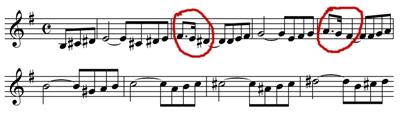

Rachmaninoff: Piano Concerto No. 2, 1st mvt.
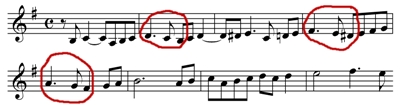

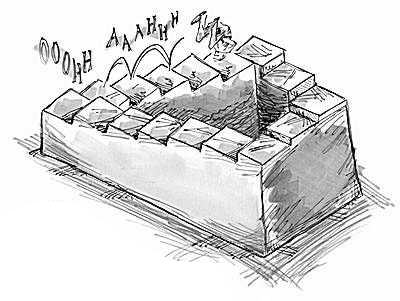
Again, more than a tune borrowing, what Rachmaninoff has imitated is the feel of this sequence. To prove it, I managed to weave the two together; this is cool, because although one is in E Minor and the other in C Minor (the Rachmaninoff is transposed to E Minor above to make comparison easier), each has multiple entry steps; it didn't take long to find a pathway from one to the other. Whereas a pedal tone passage usually provides a sense of direction by creating an expectation of resolution, a sequence is often more open-ended, as evidenced by the fact that I was easily able to double the length of Tchaikovsky's melodic stairway by having it double-back on itself, sort of like an Escher staircase. The segueway from Rachmaninoff to Tchaikovsky and back isn't really seamless, but I think it works. By the way, as always, these recordings feature René Köhler conducting the National-Philharmonic Symphony.


POSTLUDE: Although I'm a decent enough cellist, I know just enough violin to be dangerous: here you can hear me demonstrating on my daughter's half-size violin how a sequence can keep going and going - even when you really want it to stop. I did the recording in one take!
Sunday, February 24, 2008

One down . . .

So I've now been blogging for a year, for whatever that's worth. Here's how it all started. Ah, Joyce Hatto, why have you been forgotten so soon? I tried to immortalize her with sonnets, but my powers of influence are still weak, as indicated by my Technorati authority rating of nada. I'm basically an introverted person, so I have mixed feelings about having people actually pay attention to me, but hopefully I'll get that rating up into actual digits some time this year.

Still, I'm pleased with year one. Here's the basic statistics: 183 posts, 95,000 words, 8 sonnets. I just (I mean, just) realized that's almost exactly one post every two days - a pace I probably won't keep up this year, but I feel less pressure now that there's a body of work. One of the sad things about the typical blogging format is the ephemeral nature of the blog post. Words get lost in the archives, and though that's sometimes a good thing, it would be nice if there was a more consistent way to index the past. I've tried to do this some with my Guide to MMmusing, but I guess one probably still needs to write a book to give words a little more permanence. Still, amazingly good sites like Think Denk and Soho the Dog deserve some sort of table of contents - so many fantastic posts that disappear unless one remembers to look for them again.

The truth is that as much as I hope to be more widely read some day, I often stumble on other little-known blogs that are terrific and worthy of wider audiences. I'm not going to tell you which ones they are! - let's just say that there are a lot of smart and interesting people out there. As for what the year ahead on MMusing holds, I have no idea, but I should probably start by resuscitating some half-finished posts from the past few months. Or not. We'll see.

Friday, February 22, 2008

Let's not take this too seriously . . .

One of my favorite little discoveries in my first year of blogging (anniversary coming on Sunday!) is this exchange between British composers George Benjamin and Luke Bedford:

GB: where do you find your inspiration for new pieces?
LB: I'm still most inspired by the music of the 50s and 60s, people like Stockhausen, Xenakis, and Boulez. But I'm also fascinated by comedy. I find I can learn things technically from shows like Seinfeld and Curb Your Enthusiasm.
GB: My great friend, the composer Oliver Knussen, loves Curb Your Enthusiasm, and he's trying so hard to convert me. Every other conversation we have, he will drop it in. But I'm succeeding so far in resisting him, although it's very hard to resist Olly.
LB: I really love the way the stories converge in Curb Your Enthusiasm.
GB: I find that Fawlty Towers does that magnificently. In the beginning of a Fawlty Towers episode, reality is disturbed. You get about five different types of character, and they all send out their tendrils, and by the end of half an hour, they're all connected in the climax in the most atrocious ways. It's a mix of inevitability and awful, agonising surprise: and that really is a lesson in composition. You set up things that disturb normality in the beginning; by the end it's culminated in something surprising. It's as if in bar five of a piece, you plant a tiny little detail which shouldn't be there, and that little moment grows into the biggest element in the music 10 minutes later.

I thought of this recently when I confessed to rating A Mighty Wind as one of my three favorite movies of all-time. The skill involved in making the best comedy work is inevitably (and, perhaps, happily) underestimated because of the generally lighthearted tone. Bedford and Benjamin are correct to point out the sophisticated "compositional" way in which a comedic scene can weave various strands together, and everyone knows that timing (rhythmic sensitivity) is what makes comedy work. However, there's a different musical point to be made about A Mighty Wind, which is that the best comedic actors and impressionists tend to have amazingly good ears for the subtlest of details.

Yes, such skills can be used for pure silliness (nothing wrong with that), but they also can enable really convincing acting. I honestly believe that Christopher Guest, Catherine O'Hara, John Michael Higgins, Jane Lynch, and Ed Begley, Jr. gave Oscar-worthy performances, so spot-on and believable are the folks they created. Guest amazes me more than any of them, because his Alan Barrow is so beautifully underplayed that the acting disappears; Guest lost himself equally well as Harlan Pepper in Best in Show. That movie is sillier and less realistic than AMW, but even if Fred Willard steals the show, Harlan helps ground it in reality - a very strange reality, but still.

It's surely not coincidental that improv comedians with great listening skills were able to create some of the most convincing musical characters in cinema history. You can't fake being a musician without an ear for music; of course, many of these actors are musicians to some degree or another. The Folksmen (Guest, Michael McKean, and Harry Shearer) even live alternate musical lives as Spinal Tap, and John Michael Higgins, who stars as the leader of The New Main Street Singers, arranged the vocal harmonies for this psycho-happy group. (Having grown up hearing The New Christy Minstrels on multiple Goodyear Christmas albums, I can confirm that Higgins and Co. got the psycho-happy thing down right.) And who knew that Eugene Levy could flat out sing? Granted, becoming a convincing folk musician is easier than becoming Jacqueline du Pré, but you can't fake being musical. (By the way, I can forgive Emily Watson for not becoming a great cellist, but she could learn a lot from Christopher Guest about subtlety in inhabiting a role.)

Finally, as a musician, I value comedy not just because it requires great timing and a great ear, but because it reminds us not to take things too seriously. More and more, I find myself wanting to focus on enjoying music more than treating it as some sort of high-stakes artistic endeavor. I was recently rehearsing a Beethoven sonata with a violinist and I found the inevitable discussions about matching articulations, and subito pianos, and settling on a tempo to be so beyond the point. I know that those things do matter, and having been trained to take them seriously can make music-making more satisfying, but the music is pretty satisfying just played for sheer pleasure. Like in this fabulous deleted scene from A Mighty Wind (although even the Folksmen get bogged down in a little rehearsal obsessiveness):


"Iron law, Alan: nonny before ninny. That's just all you need to know."

[Two posts in one day? Ah, the beauty of a snowed-out rehearsal.]
UPDATE: As if to make my point, immediately after finishing this post, I saw one of the most flawlessly constructed half-hours in TV history, the "Room Service" episode of Frasier. The performance of the waiter ("Ohh-kay...") alone is a pitch-perfect example of perfect timing. He's just a bit player, but Lilith proves to be one of the few characters who can hold her own on screen with Frasier and Niles. If only Roz, Daphne, and Martin had been that virtuosic.

Warhorse Wordsmithing

MMmusing is still trying to get off the ground for 2008. I promise more soon, but I ended up spending way more time than expected this week writing program notes for an upcoming orchestra concert. I volunteered to do it because: I love writing program notes, I believe they can be very effective if done well, and I already knew the two works quite well. Somehow, though, it took forever to get these cranked out, and I'm still trying to tidy up the prose. As you can see below, I like program notes that function as a guide for listening, but it's always difficult to decide how much is too much, not to mention what vocabulary is too technical. For example, I chose not to use the term "trio" to describe the middle of the scherzo because I suspect a lot of our concertgoers might not know what that is, and it didn't seem worth the effort to unpack the confusing usage of that word historically.

By the way, I don't mean that as an insult toward our concertgoers, some of whom will certainly know the works well. Part of my philosophy here is that such listeners don't really need the program notes nearly as much, but I'll bet a good percentage of audience members at any symphony concert could use more help than most program notes provide. One of the ironies of the classical music world is that even the warhorses aren't really that widely known. Yes, the New World Symphony may be numbingly familiar to critics and the most seasoned aficionados, but what percentage of a typical audience really knows it well enough to find a live hearing too familiar?

Anyway, I'm supposed to be doing the grading that I didn't get done while I was writing these notes, so in lieu of a real post, here are my 2000 or so words about the Fauré Requiem and the New World Symphony. Yes, it's a rather odd pairing, although interesting to think that these works were composed around the same time. One thing I enjoyed about the project was remembering how much there is to love about the Dvorak. When I first sat down to listen to it, after not having thought much about it for years, my intitial reaction was a little jaded, but it's really grown on me. Such confident music, and so many great tunes. I didn't need to be reminded of how much I love the Fauré, but I sure didn't mind listening to it again.


The history of Western music up through the sixteenth century is inextricably linked with settings of the Roman Catholic mass and other liturgies. Though interest in more humanistic genres such as opera and the symphony would slowly overtake the leading role of church music, even nineteenth century Romantics still found inspiration in these ancient texts, none more intensely than in the requiem – the mass for the dead. The subject of death, of course, is of great interest to humans; both composers and listeners have been drawn in by the inherent drama of death, judgment, and the promise of eternal rest. Two of the most famous requiems are from the operatic masters Mozart (1791) and Verdi (1873), each of whom forged searingly powerful blends of the personal and the eternal, with particularly vivid responses to the Day of Wrath. Other notable settings include an extravagant creation by Berlioz (1837); the German Requiem by Brahms (1869) in which the composer chose his own, more comforting selection of biblical texts; and Britten’s pacifist War Requiem (1962), which incorporates modern poetry.

Though less grandiose than these titanic works, Gabriel Fauré’s Requiem is surely as beloved as any. Relatively humble in conception, part of its power lies in Fauré’s conscious decision to emphasize consolation and rest; the word “requiem,” after all, means “rest.” The composer reworked the standard text, eliminating almost all of the famous 57-line Dies irae (Day of Wrath) sequence, and inserting texts from other sources. The work has a somewhat complicated history, having been composed originally as a five-movement work for Fauré’s Paris church in 1889. The two movements with baritone solo were added later, and the original orchestration was filled out quite a bit in the version that first became well-known. However, the noted conductor and scholar John Rutter has convincingly argued that Fauré may have had little to do with this thickening of the orchestra, and Rutter’s 1983 reconstruction of the more transparent scoring that Fauré likely intended is what will be heard today. The orchestration is often little more than a subtle augmentation of the central organ accompaniment, but the unusual absence of violins leaves the top of the string section in the hands of divided violas and cellos, providing a distinctively warm aura.

The Requiem opens in an arresting manner, with unified voices pleading for rest in phrases that sound more speech-like than measured; the word “shine” (luceat) is given special emphasis. Though Fauré has a great gift for melody, the writing for chorus is often quite restrained, as if evoking the austerity of Gregorian chant. Soon, the orchestra takes up a richly flowing tune, over which the tenors sing a plaintive melody that is first fixed on a few pitches, but which eventually becomes more expansive. The movement builds to a climax imploring God to hear the prayers (exaudi orationem), and the tenor melody is recapitulated by unison choir in the traditional pleas for mercy (kyrie eleison).

The second movement begins in a more mystical manner, as shadowy visions of eternal torment are intoned by hushed counterpoint in the choir and quietly ominous interjections from the cellos and basses. The baritone soloist takes up the plea for protection of the departed in music that is restlessly optimistic. When the choir repeats the text from the opening of the movement, the counterpoint is both denser and more sustained than before, perhaps the most sophisticated writing for choir in the entire work, though still mostly subdued in tone. As is so often the case with Fauré, the mastery is in the subtlety of his craftsmanship. A radiant “Amen” suggests a hopeful transformation from the darkness that began this prayer.

The Sanctus is pure celestial radiance throughout, featuring a soaring solo violin and harp in the accompaniment. The use of violin is especially striking because of the reliance on the darker viola timbre elsewhere. As with the flowing orchestra tune that supports the tenors in the first movement, the accompanying violin line is more shapely than the simple phrases that are passed back and forth between the women and men of the chorus, as if the voices are transfixed by the heavenly vision. These unhurried melodic fragments range ever wider until a triumphant arrival at Hosanna in excelsis, from which the violin trails off into eternity.

Whereas the Sanctus ripples along continuously, the Pie Jesu is remarkable for its stillness. Though written in 4/4 time, Fauré subverts a strong sense of meter, floating exquisitely tender soprano phrases above the simplest of accompaniments. The orchestra echoes the soloist twice with a gentle rocking motion that gradually becomes a more regular part of the texture; the lullaby-like effect perfectly undergirds the soprano part as it rocks back and forth on two pitches, singing of eternal rest (sempiternam requiem).

The Agnus Dei begins with a sublimely rhapsodic melody in the violas. This becomes a countermelody to the arching tenor entrance that follows, as once again Fauré weaves an intricate instrumental idea around a less ornate vocal line. The full chorus responds more ominously, but the soaring tenor line returns. The previous movement is echoed as the tenors rock back and forth on sempiternam requiem, leading to a magical chord change on lux aeterna (light eternal); the whispered words that follow are bathed in the richest, most harmonically complex choral sonorities heard yet, as if something is gloriously illuminated from a great distance. A climax is reached and suddenly we are back at the starkness of the very beginning of the work, the lights having gone out. Again, the arresting plea for eternal rest is heard; consolation is offered as the rhapsodic viola melody concludes the movement.

There are many satisfying symmetries among the seven movements, including the placement of the intimate soprano solo in the center and the use of baritone solo in the second and sixth movements, which have the darkest texts. Whereas the second movement puts the baritone's music in the middle, the Libera me is framed by solo sections. This movement had actually been written years before, and it features the most melodramatic, least chant-like vocal writing. This is especially true of the baritone solo, which could come right out of an opera with its ringing references to fiery judgment. The chorus responds with appropriately mortified trembling, and the intrusion of tolling horns summons up violent visions of the Day of Wrath. Most melodramatically of all, the chorus then takes up the soloist's tune in grim, trembling unison.

Just as the dark second movement is followed by a radiant Sanctus, the sixth is followed by the even more ethereal In Paradisum. This is music of great delicacy that hardly needs description. The sopranos lead the way throughout, finding rest in the support of the chorus at cadences and an unending bed of arpeggios in the organ. In this year in which Gordon College has been investigating various perspectives on biblical shalom, Fauré's music provides a wonderful framework for thinking about the eternal promise of peace.


Antonin Dvorak actually wrote a very fine requiem of his own, but he's better known as a composer who can make instruments sing, whether writing for small ensembles or full orchestra. Works with a programmatic title always seem to have an advantage in the public eye, but Dvorak's ninth and final symphony, "From the New World," certainly deserves its popularity. Written in the same year (1893) that Fauré was adding the two movements to his Requiem, it is a celebration both of the "old world" ideal of a symphony in the mold of Beethoven and Brahms and of being open to new inspirations. It was written while on an extended stay in America, during which the composer spent a lot of time listening to and advocating for what he thought of as America's music, especially that of Native Americans and African Americans. He strongly believed that American composers should mine these resources, but it's open to speculation how much their influence can be heard in the New World Symphony. There are plenty of folk-like melodies, but that can be said of many of his works; Czechs have folk-songs too. If the work doesn't really sound like the more distinctive American music that sprouted in the twentieth century, there's something about its big-hearted gestures and wide-open spaces that connects with the optimism that a new world promises; just as importantly, the moments of melancholy may suggest a longing for the composer's homeland. In the final analysis, the main point is that the work surely reflects something of Dvorak's experience as a stranger in an exciting land.

The opening of the first movement is shrouded in mystery, beginning in the subterranean depths and echoing in the woodland heights; thus, the sense of a spacious canvas has been created even before the symphony proper has really gotten under way. After a series of violent outbursts, tentative woodwind figures are answered by the first occurrence of the symphony’s primary motto – a rhythmic pattern of long-short-short-long with a syncopated stress on the last note. Finally, a drumroll and tremolando violins announce the arrival of the principal theme, introduced by the french horns. Constructed from a rising triadic pattern in the rhythm of the new world motto, the theme functions like an open-ended question. The working out of the movement is mostly concerned with explorations of this questioning idea, which draws forth a wide variety of responses from across the orchestral palette. There are quieter, chamber-like moments as well, including a gentle transformation of the motto into a sort of prairie tune, but a sense of unrest predominates and leads to a defiant close.

The second movement begins with a striking series of chords from the brass that magically transports us from the turbulent E minor of the first movement to the distant realm of D-flat major. (These chords will return at the end of this movement and, in blazing fashion, near the end of the last movement.) The modulation sets up the english horn to sing one of the most famous of all themes, beautifully tailored to the instrument's plaintive voice. The movement proceeds at a leisurely pace, though a more restless minor-key theme is introduced in the flute, music that could easily be interpreted as a longing for home. This is followed by an unexpectedly merry, dance-like tune in the oboe that suggests happy memories, memories that are soon interrupted by a dramatic reentrance of the new world motto – the outburst sets the stage for the return of the english horn theme. This time, the second half of the tune is taken up by a small group of muted strings – their hushed phrases trail off into several heart-stopping silences, but an even smaller group of soloists leads the way back home.

Whereas the major key of the second movement is tinged with persistent sadness, the minor key third movement is a spirited scherzo in ABA form, full of lively cross rhythms and playful echoes back and forth across the orchestra, with the timpani a featured player. One could say that the symphony as a whole gives lie to the notion that minor key music is always sad. Here, the vigorous main idea of the A section is countered by a more relaxed major key tune that anticipates the kind of cowboy song one might hear in a Western movie; the A section is rounded off with a return to the vigorous minor key music. Cellos and violas then recall the new world motto as a means of connecting to the good-natured B section, featuring yet another free-range cowboy tune. The A section is then repeated, though its ending is briefly interrupted by another dramatic reentry of the new world motto.

The final movement begins in startling fashion with unison strings biting away at the same half-step interval that would later be associated with a great white shark. This rush of excitement ushers in a heroic fanfare theme, first delivered by trumpets and horns. Dvorak’s seemingly endless supply of catchy tunes and dance figures is put to good use in the kaleidoscopic finale, but the fanfare theme is never far away. As if this variety isn’t enough, the heroic trumpet theme is converted into a viola ostinato over which the primary themes of the second and third movements are set dancing. Of course, the new world motto becomes part of this melting pot, and several great climaxes are achieved. One senses that the composer hates to say goodbye to such rich material, as apparent endings are extended several times; after quietly reminiscing on the middle movement themes one last time, the new world motto is combined with the heroic fanfare theme to set up a final race to the finish.