" "

Saturday, September 22, 2012

Teachable Moments

First of all, my recital has come and gone, as things do. It was, I think, a big success in a lot of ways (the program booklet was widely admired), although it's hard for me not to remember the moments that got away (minor, but still...), and it's also something of a letdown to be done. What happened? Where did all that practice and preparation go?

As I get older, I find myself reflecting more on space/time issues - sometimes even in the middle of a performance! At some point in the middle of the 30-minute Brahms "Handel" Variations, I remember thinking that I felt kind of like a prisoner of space and time. I was tired, physically and mentally, and though things were going well enough and I was mostly focused on the music, I found myself reflecting on something rather obvious: I had no choice in that moment but to keep playing this difficult music with pinpoint focus (a focus not helped by my focusing on the need to be focused). I couldn't just stop, perhaps say something to the audience, go get a drink of water, recite a sonnet, or even take an unmusical breath. Yes, to some degree this is true of any situation where one has a job to do, but a musical work like this is particularly unforgiving.

Of course, riding a musical wave is also one of the joys of musical performance, so I don't want to sound like I'm complaining. Anyway, although I have much to learn from this experience (including that I wish I'd worked in a few "days off" leading up to the event since I played through the Chopin four days after the recital and it felt so much easier!), I have more lighthearted teachable moments to share today. In fact, they're lighthearted enough that I've already shared them in that frothy land of Twitter, but now they're getting the blog seal of approval.

The first moment of good teaching fortune occurred on September 5th as I had just exited my office on the way to music history. (I should probably capitalize "Music History," but I like the idea of "being on the way to music history.") We were in the midst of several Bach classes (alas, now passed/past) and that day's main course would be the Chaconne in D Minor, which is only perhaps the greatest example of human creativity ever. I've taught this piece many times, but still can feel at loss for words to describe it, as evidenced by the lame sentence preceding. As it happened, only steps from my office door, I heard none other than the Chaconne in D Minor coming from a practice room nearby. I correctly guessed who the violinist was, and knew her to be an enthusiastic student from the previous year's class, so I knocked on the door and asked if she might want to come play in our little cinderblock classroom. She graciously agreed, and suddenly everything about teaching it was easier because there's just nothing like live performance, right?

There's just nothing like live performance. Of course, we musicians say this all the time in a desperate attempt to maintain a sense of relevance performing music that has been recorded over and over. It's pretty much true, too (I hope) - otherwise, why would I have spent so much time learning music for my recital? Getting back to that space-time thing, there's no question that Chopin's 4th ballade is widely available in recordings and widely performed in recitals, but I still knew that every time I played it (even in a practice room), there was something distinctive about "holding" "it" in my hands in that moment of time. Not the score of course; I barely looked at it in the past month (which is probably bad, by the way, but that's a subject for another day). I mean that having the notes shaped in my hands feels like a "thing," elusive as its thing-ness is. (Are the notes in my hands negative space? No, let's not go there...*)

But back to Bach: because the Chaconne is written for solo violin and the violin-writing often verges on (or crosses over to) harshness, "it" struggles even more than the average musical work to communicate via recording. Violins are notoriously difficult to record. I read somewhere** that the heavy use of vibrato we now take for granted is partly an evolutionary adaptation prompted by the fact that early recording technology made straight-tone violin playing particularly unappealing. Add to this the fact that my cinderblock classroom has a pretty subpar set of speakers, and it reminds me of something I often forget: Recordings of the Chaconne sound pretty bad in this classroom.

Why do I forget that? Because I already know how the piece sounds for real, so I can easily hear the real "thing" through the imperfections. This also explains why opera buffs can enjoy historical recordings that often sound like desperate screeching to me. Once you've heard the real thing enough, you can filter out the limits of technology and hear what's not there. I wrote about this at some length in this post from 2007.

This is really one of the central challenges of teaching and talking about music. When you don't have the real thing there and the students haven't experienced it, words in a textbook/anthology and even recordings can ring as hollow as...well, a violin on a CD. Having this gracious student play extended excerpts for the class made the whole teaching experience so much easier. Plus, the human element of seeing the violinist battling the fiddle is a nice visual/social aid. The students clearly got this music in a way I haven't seen them get it before. So, the lesson is: always bring a real violinist with you to teach the Bach Chaconne. (I have done this before in a more planful way, by the way.)

[A couple of side notes. When I tweeted "Was heading to class to talk about Bach Chaconne; heard student violinist practicing it; she agreed to demo much of it (beautifully). Nice!", a clever follower tweeted back, "Talking about the Bach Chaconne. And next week, dancing about the Parthenon." He, of course, was alluding to the famous saying that talking about music is like dancing about architecture. I mention all this to boast about the newly invented aphorism this inspired from me: "tweeting about music is like twitching about architecture."]

[Side Note #2: Speaking of Bach, the Chaconne, and a failure to communicate, back when the "Joshua Bell in the subway" story was all the rage, I wrote a couple of sonnets to summarize the tale. I can sense that you're not about to follow that link, so let me tempt you with these couplets: "...to mention that a subway station / is really not the best location / for Bach's Chaconne (which I adore / -it's just not made for train decor.)"]

Now to teachable moment #2. For my afternoon "Survey of Musical Masterworks," a one-semester music history class for mostly non-majors, I like to have music playing the five minutes or so before we begin. For example, before yesterday's class introducing opera as the new dramatic kid on the block of the Baroque, I played this hyperdramatic music from Rameau's Hippolyte et Aricie. (Skip to 1:20 if you like, and try to stay to the end.)


Well, later on that very same fortuitous Chaconne day, I got distracted by some computer-related issue and forgot to start anything up for my surveyors. Just as I was about to apologize for this oversight, I remembered that Sept 5 of 2012 happened to be the 100th birthday of John Cage, so the four-plus minutes of silence I'd played were the perfect music for that day.


And I have nothing more to say about that...


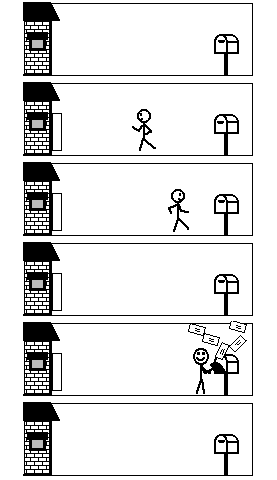
P.S. But, I did have one other felicitous teaching moment recently. I was discussing issues of Historically Informed Performance Practice with students, and the topic of unreliable metronome markings arose. As I talked about the problems of pendulum imprecision and veered off course to  mention Ligeti's symphony for metronomes, a student actually speculated out loud that one might be able to synchronize pendulum metronomes if they were on the right kind of surface. I don't think he did this to set me up for what followed, but THIS, of course, is what followed.

P.P.S. Notice I didn't include an audio link for the great Chaconne, for what should be obvious reasons. Go see if you can find a live performance in a practice room near you...

See also: Augmented Sixth Day

* that's a joke. sort of.

** just realized (20 hours later), via a helpful Twitter follower, that I first read about this violin/vibrato adaptation in Chapter 3 of Alex Ross's Listen to This where he, in turn, cites Mark Katz's Capturing Sound. And, to continue with the coincidence theme of this post, it just so happens that Chapter 3 of Ross's book is assigned for one of my classes for this coming Friday. (I last read the chapter a year ago, and thus the violin/vibrato information had lost its moorings in my mind.)

Final Postscript: It will be some time before I'll feel ready to listen to all of the recital recording (especially the solo stuff), but here are two samples from the second half that featured our new family trio, Montrieau (with my 13-yr old daughter on violin, my child psychiatrist wife on cello, and me doing my Piano Hero thing (meaning I didn't practice it enough!) on piano).

Friday, September 14, 2012

MMrecital - the Program Booklet

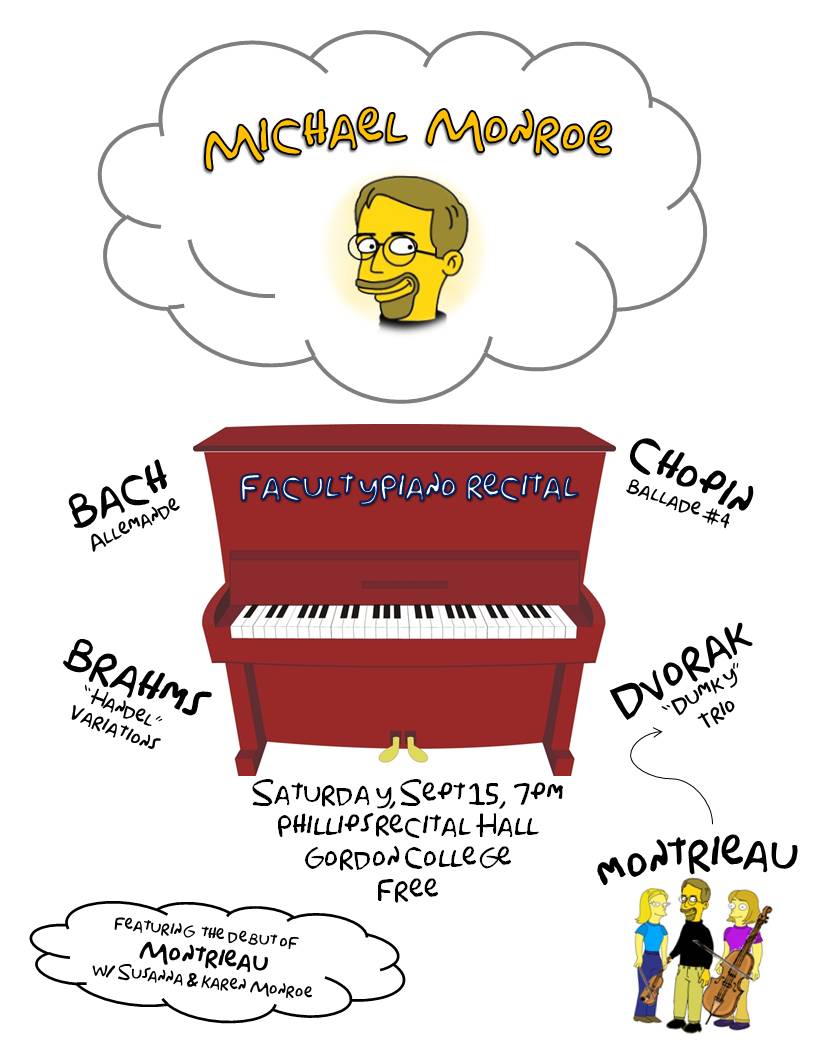
My recital is tomorrow night, so no long-winded blog post for this week, but I thought I'd post the recital booklet I just completed yesterday. (Having a program ready more than 48 hours ahead of the concert must be some kind of record for me.) It continues the whimsical Simpson-y theme I stumbled into for my poster (which just kind of grew out of years of using Simpsonized me as my avatar), which meant: 1) I could be as informal as I like, 2) use catchy titles for each piece, an idea I'd already been thinking about, 3) and use the much-derided Comic Sans font in what I think is its most appropriate context.

It's designed to be printed in a booklet format, so you can better see how the facing pages are supposed to work (sort of) here.


Because I plan to talk to the audience as well, it freed me up not to write too much about each piece. You'll notice I didn't even list the movement titles for the Dvorak, which is maybe a mistake, but since each of the six movements has multiple tempo changes, I think it just invites confusion. I'd rather listeners just go with the "Dumky" flow. On the other hand, I provide a very detailed outline of the twenty-five Brahms variations, partly because I think an audience member can easily follow those, if they so choose. (I'll assure those in attendance that there's no obligation to follow along. I hate for a recital to feel like class.)

Otherwise, although I was rushed as usual, I think this booklet accomplishes most of what I want it to do: set an informal, friendly tone (even though, to be honest, the music is mostly pretty serious), and provide some basic ways to think about what each piece expresses. The central tension for me is that, though the music is often serious in tone, I don't want the recital experience to feel solemn or ritualistic - the seriousness, I hope, is in the depth of the musical expression (though the Brahms and Dvorak pieces each have many humorous, lighthearted passages as well), not in the idea that this music is important. (You see, it's important, of course, but not important.)

Saturday, September 8, 2012

No Danny Elfman on This Recital

It's a good thing it's a Saturday, so I don't have pesky classes and meetings to deter me from practicing for my recital which is due to happen in just over 1 week. (See here or here, or read lots of words about it here.) Yet, somehow I found time to do this:

[click pic to view larger]

I never thought it would go this far when I first Simpsonized myself and Stravinsky back in 2007 (I don't even watch The Simpsons much anymore, though I own seasons 1-8 on DVD), but I feel my identity is slowly merging with that avatar. And at least it hasn't aged in five years.

Also, you'll note that I've given our family trio a pretentious name. If it doesn't quite make sense to you, here's the progression:

 monroe
 montrio
 montrioe
 montrieau

(I thought of going as far as "montrieault" since my wife's surname ends in "-eault," but that would just be going too far. I do love playing in mon trio, by the way.)

And now...yes, more practicing.

Thursday, August 30, 2012

Time-traveling

First of all, I'd better get around to mentioning that I'm giving a faculty recital in just two weeks and two days. This Facebook thing is as far as I've made it with an event page so far, although I hope to update it soon. The program, in case you don't feel like following that link, is:
  • Bach: "Allemande" from Partita No. 4 in D Major
  • Chopin: Ballade No. 4 in F Minor
  • Brahms: Variations and Fugue on a Theme by Handel
  • ----------
  • Dvorak: "Dumky" Trio (with my cellist wife & violinist daughter)
[The recital is on Saturday, September 15 at 7pm in Phillips Recital Hall, Gordon College, Wenham, MA.]

It's a program both conventional and quirky, conventional in its "standard rep"-iness, quirky in its juxtaposition of pieces. There's no real theme other than "these are some pieces I want to play." I suggested in a March blog post that there is something inherently selfish about devoting oneself to this kind of endeavor, no matter how much energy we musicians invest in saying we're all about giving, giving, giving. One can be selfish and giving at the same time, after all. At an rate, I don't mind admitting that I'm doing this partly for my own satisfaction, and since I don't find the opportunity to do solo recitals that often, I'm going to play what I want to play.

It's funny, because I think my reputation among students is as an advocate of the unconventional (I'm always talking mash-ups, trying to get an In C thing going every year, etc.), but I've never been shy about the fact that I have pretty old-fashioned tastes. See my list of "Favorite Music" to confirm. There's nothing on there later than Shostakovich or Britten. There are voices in my head telling me I should be playing something from own century, or at least the one in which I was born - but, again with the selfish thing. (I'm a little surprised no Scriabin made it on the program; there's a wonderful portrait of Scriabin that a student painted for me a few years ago after I told her he's a personal favorite. Every time I look up and see him staring down at my piano, I feel guilty...)

Still, I was a little surprised at how this program came together. I first assumed I'd be reprising Schumann's Kreisleriana from a recital I gave in 2003; that may be my single favorite piano work. But as I reviewed the CD from that recital, on came the Brahms "Handel" Variations, and I suddenly felt "I have to play this again." It was as simple as that. Sometimes the music just tells you what to do. I even considered repeating the entire 2003 recital, but eventually Kreisleriana drifted away, partly due to fear that I wouldn't have time to re-learn it and Brahms-Handel.

I devoted a Spring Break blog series (sort of) to my decision to re-learn the Chopin ballade in a week; I didn't quite finish getting it memorized in those seven days, and then completely dropped it until mid-summer when I thought the thirty minutes of Kreisleriana were seeming like too much. These eleven minutes of Chopin scare me to death, and it's odd to put them side by side with the Brahms since each piece is kind of a closer, but I think it's Chopin's greatest work and there's really nothing quite like it. I want to play it. Whereas the Brahms is a highly ordered, though expansive, structure, the Chopin evolves tentatively and mysteriously, but in compact fashion, so they make for an interesting contrast.

Still, the Chopin is too intense to begin a recital. For a while, I figured the Chopin and Brahms would fall on different halves. Then, early one summer Sunday, as I was doing my fake-organist thing and getting ready to play the morning service, I was looking for a D Major prelude (to go with the opening hymn) and flipped upon the allemande from Bach's D Major Partita. It's a piece I remember well from Jeremy Denk's remarkable 7-part blog series from 2007. Bach wrote many, many allemandes, of course, but none at all like this extended, meandering meditation. I quickly realized it didn't belong on the organ, but was irresistibly drawn to it, so I ended up playing the prelude from the piano that morning. Quite a few parishioners remarked at how beautiful it was, and after dismissing the thought that this was just relief at hearing me not play the organ, I decided the special-ness of this piece would translate to audiences more easily than I'd have thought.

The initial dilemma: "Do I now learn the whole Partita?" which would mean learning six other pieces. The easy answer came back, "No, this piece stands on its own." It's kind of like the Chaconne from the D Minor Violin Partita in that respect. If both repeats are observed, this "allemande like no other" can easily last ten minutes or more. I fear its beauty might be less appreciated in the broader suite context, and I'm of the opinion that Bach's suites are fairly loose connections of pieces - but, let's be honest: I also didn't feel like learning all that Bach. So here we are.

This allemande is also no conventional curtain-raiser, but it's gotten me to thinking about why we so often begin with "loud and fast." Nothing wrong with that, of course, but I hope there's something about this piece which will serve to consecrate the space, calm me down, and usher in a world in which time seems like less of a concern - to prepare us all for this counter-cultural thing we call a piano recital. In fact, this allemande is probably the closest thing Bach ever wrote to a Chopin nocturne, even if it sounds nothing like Chopin; it does feel like a nice way to set up the ballade, which in a more conventional program might be preceded by a nocturne.

Although I'm basically a "collaborative pianist" these days, it's important to me to get a chance to revisit solo repertoire, memorization, and all that. But, it's also a joy to be playing as a family in the second half. As a matter of fact, the "Dumky" Trio is the piece that introduced me to my wife-to-be (we were assigned to the same trio at a summer festival), so it means a lot to us to be playing it with our oldest daughter. I'm feeling a bit guilty about that decision because I'm realizing the violin part is the hardest to bring off in this trio; the cello gets almost all the good tunes, while Dvorak makes the poor violinist play awkward, accompanimental double-stops again and again. But, Daughter of MMmusing is a trooper and she's got chops, so I think we'll get there.

Each of the last two paragraphs referred to ways in which music interacts with time: the way a Bach allemande can seem to make time stop, and the way the Dumky Trio can connect our family's present with its past. One of my Spring Break "Ballade" posts also touched on this, how re-learning the Chopin ballade brought back vivid memories (or something even more present than memories) of learning the same piece as an undergrad twenty-plus years before.

In the last couple of days, I've had another strange music-time experience. Because memorization is such a scary thing, so vulnerable to changes of mental state, I've been revisiting an old trick: playing through these pieces backwards. OK, not literally note-by-note (or sound wave by sound wave!), but more or less phrase by phrase. The Brahms is a pretty easy piece to chunk since it divides up into a theme and 25 variations, each of which has two repeated halves of four bars each. (The fugue is more complicated and less symmetrical, but still pretty easy to break up into groups.) So, after backmasking through the fugue, it's on to part B of variation 25 (with repeat), part A of Variation 25, part B of Variation 24, part A of Variation 24, etc. In some cases, the repeats are varied repetitions, so I try to play the variants first as well.

It's a great mental exercise and makes it so that I feel quite comfortable starting at more than 60 spots within the 30-minute opus. (It also keeps my mind from wandering while I practice ... sometimes.) Hopefully this will be less about giving me a place to start if I fall off the horse, and more about the constant sense that, "oh, yes, I can visualize precisely what's coming up in four bars." But having now played through the piece backwards twice, I was unexpectedly struck by the weird sensation of moving backwards through time. I know the music quite well, of course, so although time is obviously moving forward, each little chunk feels like something more past than what's just happened. (A good set of variations has a sense of building to a conclusion, and this is as good a set of variations as has ever been written. Yep, as good as Goldberg and Diabelli.) This is especially striking when I "end" with the half cadence that concludes the first four bars of Handel's theme.


Each time, it feels like the last bit of the piece has been sucked up into some time-consuming vacuum cleaner - that's not an analogy I went looking for or a thought I dreamed up because I wanted to blog about something. It was a genuine sensory experience. I'd like to try this with more big variation sets at some point, like the finale of the "Eroica" Symphony. (The Goldberg Variations wouldn't work as well since that piece ends as it begins.) But that sounds like another blog post, post-recital.

Last weekend, we heard a final concert for my daughter's music camp at which the orchestra of 9-13 year-olds finished with Vaughan Williams' Fantasia on "Greensleeves," chosen because the retiring camp director had played that same piece as a camper in the orchestra - in 1948! Talk about a time-travelling experience. Listening to these kids play this piece (which was quite new in '48, though the tune was already old) in an old-fashioned (though fairly new) barn in the foothills of the ancient Berkshires to honor a woman who's invested so much time in music and children - well, it made me realize that Einstein's theory of relativity may not be fully understood with respect to music.

Wednesday, August 22, 2012

Gateway to Insanity

There's nothing like a meandering path that takes you somewhere special. For example, many years ago I basically flipped a coin in choosing one musical festival over another, picked a piano trio to play, had my assigned cellist turn out not to be there, and then was assigned a new cellist...who is now my wife. We now have a daughter in music camp out in Western Massachusetts which led us to an afternoon of Sunday shopping in charming Northampton where I came across a book I've wanted to read for years. Vikram's Seth's The Golden Gate is a novel-in-verse set in 1980s Silicon Valley but modeled on Pushkin's Eugene Onegin, especially in its use of the peculiar Onegin stanzas devised by the "Russian Shakespeare." In Le Ton beau de MarotDouglas Hofstadter raves about The Golden Gate, gateway for him to Eugene Onegin which becomes the second most important case study in Hofstadter's wide-ranging study of translation.

I've now read Eugene Onegin a few times in this dazzling translation, and I've intended to read The Golden Gate for more than a dozen years, but somehow never got around to hitting the "buy" button on Amazon or tracking it down at a local library; seeing it on the shelf at The Raven conquered my irrational inertia, and now I'm happily flipping page after page.* My only slight disappointment is that Seth's book (or any good translation of Eugene Onegin) is a perfect candidate for e-book reading on a smartphone or tablet since each sonnet would nicely fill a screen, but it's only available in paper form. Oh well...it's still delightful even only 160 or so sonnets in. My mind is rhyming in iambic tetrameter even when I'm not reading, which is a problem I've had before.

Unfortunately, I also made the mistake of wondering if an Onegin stanza could be fit into a single, 140-character Twitter post. I remember wondering this back in #operaplot days when I successfully tweeted several limericks, but if you do the math, 140 characters divided by 14 lines leaves only 10 characters per line, and that has to include spaces and line breaks. Iambic tetrameter demands 7-9 syllables per line so it's really impossible, right?

However, it occurred to me that using texting abbreviations might make the task just possible, and OMG! (which I'd interpret as "Oh my goodness" since that yields an extra syllable), voilĂ :


It's pretty ugly to look at, but it's Tweetable, although Twitter doesn't really let you use line breaks, so it ends up looking like this:
IOU a tiny sonnet of ≤ 140; In it 14=143 IIRC SRSLY I ineptly had U ROTF LOL once b4 @my TMI No IMO my MO I AKA admiration ≠ U & yet WYSIWYG
I do enjoy the oddly formulaic juxtapositions of 140, 14, and 143 and the 3-line set of "TMI, IMO, MO I," not to mention that any sonnet ending with "WYSIWYG" is pretty awesome.

If you're wondering how to read it, here's a "translation." Note that every line should begin with a stressed syllable and that line 5 requires "remember" to be accented awkwardly on its first and third syllables. "Seriously" should also get a secondary stress on its third syllable.


IOU a tiny sonnet
of ≤
140; In it
14=143
IIRC
SRSLY I ineptly
had U ROTF
LOL once b4
@my TMI
No IMO my
MO I
AKA admiration
≠ U & yet
WYSIWYG

I owe you a tiny sonnet
of less than or equal to
one-hundred and forty; in it
Fourteen equals "I Love You."
If I remember correctly
seriously I ineptly
had you rolling on the floor
laughing out loud once before
at my "too much information."
No, in my opinion, my
modus operandi I
also know as admiration
does not equal you and yet
what you see is what you get.

OK, it's not Shakespeare or Pushkin...or Seth, but it sort of makes sense as a slightly desperate sonnet from a poet prone to ridiculously flowery flights of fancy. It's a bit pitiful since it seems our hero knows his recipient is a harsh critic; he's apparently trying his best to keep this tweet both short and sweet, but he is who he is.

It's also not quite an Onegin stanza since that requires iambic tetrameter which would add an extra unstressed syllable to the beginning of each line, but chopping off those 14 syllables was really helpful. The astute among you will further note that I've interpreted AKA as "also know as" instead of "also known as." So sue me. My first line takes up a luxurious 24 characters, and I had to find as many ways as possible to abbreviate thereafter. Honestly, I don't think I'd have pulled it off without that "less than or equal to" sign. That's six syllables of pure, 1-character gold.

I later realized I hadn't even thought about abbreviated proper nouns like UK, USA, IBM, etc., but textspeak is a perfect fit for Twitter anyway. Still, I think this is my first and last Onegin sonnet of 140 characters or less.

But I also wondered about a trimmer-style sonnet, and fairly quickly managed the following (I was home sick yesterday, so I had a little time on my hands):

A sonnet
in tweet?
I'm on it
A feat!
140
is short. See
each line
assigned
li'l more than
3 beats.
RT's
will pour in
for me.
You'll see.

If tweeted like so:
A sonnet-in tweet?-I'm on it-A feat!-140-is short.See-each line-assigned-lil' more than-3 beats.-RT's-will pour in-for me.-You'll see.
...this actually comes in at a highly efficient 134 characters. Note that I've kept the Onegin stanza rhyme-scheme with its charming variety of masculine and feminine rhymes. For those not in the Twitter know, "RT's" stands for "Re-tweets," which is the Twitter way of sharing posts. Also, you'll note that "140" in this case should be pronounced as "One forty." It's true that this rhyme scheme has quite a different flavor than Eugene Onegin with only 2-3 beats per line; in fact, in this regard the poem is much closer in spirit to Clement Marot's A une Damoyselle malade, the 28-liner beginning and ending with "Ma mignonne" that is the central case study in Hofstadter's book.

My favorite felicitous detail in my "Mignonegin" sonnet comes with the phrase "li'l more than / 3 beats"; I chose "li'l" to create a nice triple rhyme with "will pour in" but was slightly bothered by the fact that none of the lines actually has any more than 3 beats. EXCEPT, one could say that the contraction "li'l" has perhaps a little more than one syllable, meaning the phrase "li'l more than" contains something like pi beats; it thus becomes the very line to which it refers. I realized that while struggling through the last leg of my morning run, and that put a much-needed hop in my step.


* I could quote favorite turns of phrase for days, but here's one of Seth's couplets that I particularly admire:
Thus by default the fault is Phil's.
Jan sets her gaze at Look that Kills.
More MMmmusing Onegin stanzas: