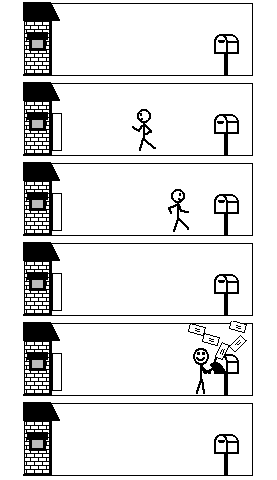
Spending 3-5 hours a day shoveling snow gives one lots of time to reflect. Inevitably, for me over the past week, those reflections turned to ways in which winter has been expressed through music, and though the likes of Vivaldi, Liszt, and Debussy have tried their hand at depicting the harshness of the season in sound, it occurred to me that no one really understood the loneliness of standing out in the freezing cold like Schubert. He wrote a whole song cycle about it. The poignant final song is supposedly about a pitiful hurdy-gurdy player standing out in the freezing cold and providing a nice metaphor for the poet's hopeless love life, but I felt a one-ness with the futility of the hurdy-gurdiest while tackling the white stuff these past fews days - and my time spent moving snow around (as the snow kept falling, and knowing the snowplows would come and push more back into my driveway) provided the mental time and framework for me to re-translate Wilhelm Müller's grim words for the common man. Here you go, winter.
Showing posts sorted by relevance for query metaphor. Sort by date Show all posts
Showing posts sorted by relevance for query metaphor. Sort by date Show all posts
Tuesday, February 3, 2015

Monday, October 1, 2012
Willkommen, Bienvenue...
I've found myself drawn into the orbit of New York City's enterprising operamission several times before, first when I helped tweet the opening evening of "Così fan tutte: Some Assembly Required" back in the summer of 2010, and one year later when I was inspired to create this kooky Schoenberg/Stravinsky mashup. For 2012, the debut of a new "cabaret song" competition seemed but a curiosity to me at first - until the fateful moment when I thought about writing some cabaret lyrics.
I suppose it's as simple as that: I'd never thought about writing cabaret lyrics, so I'd never done it, but once the thought popped up, I couldn't see a way out. To be precise, the overly clever idea that first trapped me had to do with the word "cabaret" itself. I've enjoyed creating "mad gabs" for some time, as I wrote in this 2008 post. (My own favorite do-it-yourself madgab creation is "Dew Witch Horse Elf.") It's a natural extension of a general interest in wordplay - seeing how one set of sounds can sound much like an otherwise unrelated set of sounds. Like, I inadvertently thought to myself: "cabaret" and "cap hooray." And, thus, a song was born:
What will become of these lyrics? Well, I might just try to set them myself, although interested composers are welcome to inquire about a collaboration. Just as composers sometimes work with a "dummy lyric" to compose a tune, I'll admit that I used Britten's "Tell Me the Truth About Love" as a "dummy tune" for the verses, and imagine them to be similarly talk-y, with a more lyrical refrain. Various quasi-tunes have wandered teasingly through my mind. We'll see if I can catch one.
Meanwhile, I happened to notice not long after finishing the above that the contest specifies "for solo voice and piano (or voice and harpsichord)." Since we've been talking quite a bit about Historically Informed Performance Practice (HIPP) in my Music History class, I quickly found myself pulled down the following rabbit hole. What it lacks in the former's geeky phonetic wordplay it makes up for in geeky references to obscure musicological concerns. But I like it. Seems it should be written for harpsichord accompaniment, with a dramatic modulation down a half-step for the first transition to the refrain. (Often, Baroque performance practice calls for A to be tuned to 415Hz instead of the standard 440Hz, which results in music pitched about one half-step lower than usual.)
I suppose it's as simple as that: I'd never thought about writing cabaret lyrics, so I'd never done it, but once the thought popped up, I couldn't see a way out. To be precise, the overly clever idea that first trapped me had to do with the word "cabaret" itself. I've enjoyed creating "mad gabs" for some time, as I wrote in this 2008 post. (My own favorite do-it-yourself madgab creation is "Dew Witch Horse Elf.") It's a natural extension of a general interest in wordplay - seeing how one set of sounds can sound much like an otherwise unrelated set of sounds. Like, I inadvertently thought to myself: "cabaret" and "cap hooray." And, thus, a song was born:
I drowned myself in Cabernet,
then went to hail a cab away,
but though I waved my cap-beret
I could not tempt the cab array.
The subway riders gab their way
through sunken post-nightcap soiree;
when exiting, "mind the gap," they say,
but without you, I can't bear the day.
REFRAIN:So all I do is mind the gap and pray
and hope and wish that you'll come back to stay
until you do I'll live my way without a sky or sober day,
you've left me nothing but the night – and cabaret.
Verse 2: yes, my vocab's OK,
inspired by bottlecaps astray.
The critic tips his cap, "Hooray,"
when I lament in cabaret.
You came along and captiva-
ted all of me; a captive may
be freed and yet still capsized stay;
I might as well recap this way:
REFRAINPerhaps I got too caught up in this attempt to sound out something close to "cabaret" as many times as possible. Perhaps I should've written "chic beret" instead of the awkwardly constructed "cap-beret." Perhaps we should all be grateful I didn't go full-meta and try to shoehorn "mad gab array" into these verses. Actually, I'm more bothered by the mundane refrain, but it's growing on me. I enjoy the transition from "mind the gap" as cautionary subway message to cautionary metaphor for lost love. At least, I think that's what this is about.
What will become of these lyrics? Well, I might just try to set them myself, although interested composers are welcome to inquire about a collaboration. Just as composers sometimes work with a "dummy lyric" to compose a tune, I'll admit that I used Britten's "Tell Me the Truth About Love" as a "dummy tune" for the verses, and imagine them to be similarly talk-y, with a more lyrical refrain. Various quasi-tunes have wandered teasingly through my mind. We'll see if I can catch one.
Meanwhile, I happened to notice not long after finishing the above that the contest specifies "for solo voice and piano (or voice and harpsichord)." Since we've been talking quite a bit about Historically Informed Performance Practice (HIPP) in my Music History class, I quickly found myself pulled down the following rabbit hole. What it lacks in the former's geeky phonetic wordplay it makes up for in geeky references to obscure musicological concerns. But I like it. Seems it should be written for harpsichord accompaniment, with a dramatic modulation down a half-step for the first transition to the refrain. (Often, Baroque performance practice calls for A to be tuned to 415Hz instead of the standard 440Hz, which results in music pitched about one half-step lower than usual.)
I used to vibrate night and day
and tighten up my bow
to make it easier to play
with steely strings in tow.
I loved a chorus hundreds strong
for Bach’s and Handel’s scene,
until one day you came along
and tuned to Four..Fif..Teen…
REFRAIN:HIPP-HIPP Hooray for Historically Informed Performance,
It's not too late to be an early-music gal.
My playing's up to date, whether 1698
or a 19th century musical locale.
I've learned the ways of the days that came before us,
from tired traditions I have been set free.
What once was old is new, and now I'm telling you
the past is where the future lies with me.
I sold my Steinway late last year
cause I prefer to drive
a double-manual clavier:
It makes me feel alive!
I improvise and ornament
and realize figured bass,
and realize I’ve been heaven-sent
back to that time and place.
REFRAIN
I can't count the countertenors
I've had over to my place.
I can't deal with all those sinners
who think wobbling equals grace.
Don't believe that propaganda
the Romantics left behind.
A theorbo or da gamba
is romantic in my mind.
REFRAIN
Notes inégales are just my style
My rhythms fairly dance
I would’ve been so versatile
In 17th century France.
We’ve tuned our hearts authenticallyYep.
to temperaments just and mean;
and now I know that every key
sounds best at 415.
Sunday, November 24, 2013
Shostakovich 5: Mashed-up Memories
So, my daughter's youth orchestra gave a stunning performance of Shostakovich's Symphony No. 5 last weekend in Boston's Symphony Hall, a program which repeats in Carnegie Hall on Monday, December 9. First then, a tip to any NYC readers I may have picked up along the way: DO NOT MISS THIS CONCERT.

That may just seem like proud parental posturing, but believe me, conductor Ben Zander ignites something in these kids (ages 13-21) that is very special. His vision of the Shostakovich symphony is uncompromising and there's nothing jaded about the playing; the students believe him every step of the way. There's also nothing at all compromised about the level of the playing. Daughter of MMmusing is just one among 43 or so violinists, so I'm not pretending she's the star of the show, but this orchestra is fully up to the challenges posed by the most demanding music. (Mahler 5 is on deck for March!) I don't know how often one gets to hear an orchestra of this level which also has the luxury of rehearsing as often and as intensely as they do. (Read here what soloist Christopher O'Riley had to say about the first concert. Here's another review.)
Anyway, the Shostakovich has been a longtime favorite of mine (and of countless others, of course) for well more than two decades. I could say tons about it, but will simply share a few observations for now.
Then the cellos fulfill its cataclysmic potential here at 34:45.
I don't know about everyone, but for me this intersection of past and present, the way that music interacts with memory, is what it's all about - which makes musical experiences particularly ephemeral and unrepeatable. The fact that I both knew the piece deeply and had also forgotten much about it made the listening experience particularly rich in this regard. I might have to wait another 20 years before such a moment can be relived! Broadly speaking, it would be fascinating to determine how much of listening to music is about "hearing backwards and forwards." How often can one really be said simply to be listening to the present moment? Is that even possible without reference to past and future (memory and expectation)?
Still, as listening experiences go, the Symphony Hall performance last week was one of those everything-lines-up kind of experiences when my attention didn't seem to wane for a second during the entire 50 minutes of the symphony, aside from this kind of thinking back and forth through the music. It felt like Shostakovich was speaking quite directly to all of us, and if my attention was enhanced by the knowledge that my daughter was on stage, so be it.
The arc of the 3rd movement is particularly satisfying as a visual, by the way. When I listen to it (which I've done about 6-7 times since the concert), I find myself listening with reference to the evenly spaced outbursts which are easily visible below:

That amazing, time-stopping oboe solo occurs at about 6:15, shortly after the first of the movement's two enormous climaxes. The cello section reprise of the tune happens at 11:00 in the midst of the other great climax (you can actually see the music hit a dynamic wall right before). Looking at the music this way is a nice metaphor for what it's like to listen with a view of the overall structure, although one can't see all the important musical details in such an image. (Here's a post where I reflect on that idea more fully.) One can see, though, that the oboe/celli sections are proportionally spaced in a satisfying way. By the way, the tune returns one last time at the movement's very end [39:00 in the videos above] with the ethereal combination of harp and celeste.*
Though I think most of my listening that night was focused on Shostakovich, I did inevitably get distracted by one unexpected connection (here's where my regular readers will sigh knowingly) - certainly not something I was looking or listening for. There are a few bridge passages in that devastating third movement in which the strings play a simple rocking figure, richly voiced in a way that started ringing bells for me. At some point, I realized that these passages reminded me a LOT of similar bridge-like passages in Vaughan Williams' very different Tallis Fantasia. That famous work predates the Shostakovich symphony by almost three decades, although I have no reason to believe it's a direct influence. A more likely interpretation is that both works are referencing an intentionally old-fashioned kind of choral writing to create a particular kind of stillness in a more troubled modern context. Here are two such passages. Note that each features conventional triadic harmonies with the 3rd on top and the melody doubled by an inner voice.

Naturally, I decided to try merging these two passages. What you hear below begins with the two excerpts shown above and then alternates between six other excerpts, three from each work. Like so many of my mashups, the connections aren't intended to make a perfectly satisfying new whole, but rather to "say" with music how I hear these works conversing with each other. So, enough words. (...except to note that the entire sequence of eight alternating excerpts is looped four times in the audio below, just because I could...)
* Yes, the oboe solo is followed by clarinet and flute turns with the tune, but they feel more like extensions of the oboe moment than new sections.

That may just seem like proud parental posturing, but believe me, conductor Ben Zander ignites something in these kids (ages 13-21) that is very special. His vision of the Shostakovich symphony is uncompromising and there's nothing jaded about the playing; the students believe him every step of the way. There's also nothing at all compromised about the level of the playing. Daughter of MMmusing is just one among 43 or so violinists, so I'm not pretending she's the star of the show, but this orchestra is fully up to the challenges posed by the most demanding music. (Mahler 5 is on deck for March!) I don't know how often one gets to hear an orchestra of this level which also has the luxury of rehearsing as often and as intensely as they do. (Read here what soloist Christopher O'Riley had to say about the first concert. Here's another review.)
Anyway, the Shostakovich has been a longtime favorite of mine (and of countless others, of course) for well more than two decades. I could say tons about it, but will simply share a few observations for now.
- My first memory of the piece comes from when my older sister was home from college for Christmas break and received a birthday card from a sort of intellectual hipster type she had some interest in. In his letter he wrote something along the lines of "my gift to you is the third movement of Shostakovich's fifth symphony." [Just to be clear, the "gift" was not a recording or score; just "the" movement. It's the thought that counts.] I'm not sure I'd even heard of the piece or composer at that point, but this seemed to me (age 15 or so) the most impossibly romantic gesture imaginable and it set the bar high for my expectations about what this music must be like. (It's not clear to me if the Boston Philharmonic Youth Orchestra cleared performance rights with my sister. It is clear to me that this is actually NOT the most thoughtful type of gift, but I still like the idea.)
- A few years later, as a college freshman, I had the amazing opportunity to join the cello section of the Chattanooga Symphony Orchestra at the exact time that a brilliant Russian conductor had just escaped (with Viktoria Mullova!) from the Soviet Union and become music director of this little orchestra that could. For the first concert, we performed Shostakovich 5 and even got a review in The New York Times. (The reviewer is right on about the not-quite-ready-for-prime-time string section. Like Groucho Mark, I look with suspicion on any orchestra that would have me as a cello-playing member.) Vakhtang Jordania was a protege of none other than the legendary Yevgeny Mravinsky, who premiered the symphony in 1937, so this put me in a pretty cool line of Shostakovich descendants. The truth is I remember very little of the musical specifics of that occasion, but it was still an unforgettable experience, even if I was also terrified!
- Since that time, I've certainly listened to recordings of the symphony off and on, but it was more part of my past than present when I first sat in on one of this fall's rehearsals. On that Saturday afternoon, I had one of those marvelous flashback moments which sometimes seem to me the best kinds of moments music has to offer. The orchestra was in the middle of that 3rd movement (the one that now belongs to my older sister) and had just descended from a huge climax. As the violins were scuttling around, I had a strong sense of déjà vu - I knew something special was about to happen and, seconds before it started, I suddenly remembered that the oboe was about to introduce a heartrending new tune. One of those memory "click" moments. As I listened, I remembered that our Chattanooga oboist had played this solo perfectly (he got a nice citation in the Times review cited above), but I also slowly started to remember that this oboe melody was going to be returning later in...wait for it...the cello section! That's right, the cellos are the ones who take the lovely tune and realize its full potential as an anguished lament. Suddenly, all at once I was hearing the melody as new and old, as tender and tortured, as an oboe melody and as MY melody. This kind of slow unfolding of memory and expectation can be very rewarding, especially when connected to notes I've actually played with my own fingers.
The oboe melody makes its first appearance just after the 29:50 mark in the video below:
Then the cellos fulfill its cataclysmic potential here at 34:45.
I don't know about everyone, but for me this intersection of past and present, the way that music interacts with memory, is what it's all about - which makes musical experiences particularly ephemeral and unrepeatable. The fact that I both knew the piece deeply and had also forgotten much about it made the listening experience particularly rich in this regard. I might have to wait another 20 years before such a moment can be relived! Broadly speaking, it would be fascinating to determine how much of listening to music is about "hearing backwards and forwards." How often can one really be said simply to be listening to the present moment? Is that even possible without reference to past and future (memory and expectation)?
Still, as listening experiences go, the Symphony Hall performance last week was one of those everything-lines-up kind of experiences when my attention didn't seem to wane for a second during the entire 50 minutes of the symphony, aside from this kind of thinking back and forth through the music. It felt like Shostakovich was speaking quite directly to all of us, and if my attention was enhanced by the knowledge that my daughter was on stage, so be it.
The arc of the 3rd movement is particularly satisfying as a visual, by the way. When I listen to it (which I've done about 6-7 times since the concert), I find myself listening with reference to the evenly spaced outbursts which are easily visible below:

Though I think most of my listening that night was focused on Shostakovich, I did inevitably get distracted by one unexpected connection (here's where my regular readers will sigh knowingly) - certainly not something I was looking or listening for. There are a few bridge passages in that devastating third movement in which the strings play a simple rocking figure, richly voiced in a way that started ringing bells for me. At some point, I realized that these passages reminded me a LOT of similar bridge-like passages in Vaughan Williams' very different Tallis Fantasia. That famous work predates the Shostakovich symphony by almost three decades, although I have no reason to believe it's a direct influence. A more likely interpretation is that both works are referencing an intentionally old-fashioned kind of choral writing to create a particular kind of stillness in a more troubled modern context. Here are two such passages. Note that each features conventional triadic harmonies with the 3rd on top and the melody doubled by an inner voice.

Naturally, I decided to try merging these two passages. What you hear below begins with the two excerpts shown above and then alternates between six other excerpts, three from each work. Like so many of my mashups, the connections aren't intended to make a perfectly satisfying new whole, but rather to "say" with music how I hear these works conversing with each other. So, enough words. (...except to note that the entire sequence of eight alternating excerpts is looped four times in the audio below, just because I could...)
* Yes, the oboe solo is followed by clarinet and flute turns with the tune, but they feel more like extensions of the oboe moment than new sections.
Sunday, August 12, 2007
Transcription as a Metaphor for Listening
A well-known blogger with a perfectly named blog, Sounds and Fury, has directed a bit of his fury towards the feeble sound quality of iPods and their seriously compressed mp3 files. I've written before that I'm less bothered by this problem than some. Curiously it comes down to my complete agreement with part 1 and complete disagreement with part 2 of the following statement from Mr. S&F: "a live performance is quite literally an irreproducible benchmark, and the only true and fully acceptable means of experiencing classical music." While I might leave the door open for some technological development that could overcome the first problem, I don't even know what it means to say that an experience is only "true and fully acceptable" if heard live. Aside from the obvious authority questions about who decides what is true and fully acceptable, the statement just makes no sense. It's clear from reading the S&F blog that recordings play an important role in that writer's musical experience; in what way are such experiences not true or fully acceptable?
The basic problem here is to assume, as people commonly do, that music can simply be defined as the sounds generated in performance. On one level, that's a fine definition, but to be understood as a meaningful experience, we have to consider what the listener hears and how he/she makes sense of it. If the "true and fully acceptable" sounds of a Mahler symphony fall in a forest and no one hears them, they may as well not have sounded. (Let's forget, for a second, that the live performers producing the music would have to hear the sounds.) If they fall on an audience of listeners with no cultural context in which to understand Mahler, the musical communication will hardly be any stronger than with the empty forest, although certainly something will be experienced. However, it's surely the case that these out-of-context listeners will hear less of the music than a Mahler devotee would listening to a 1940's mono recording played on a scratchy old record player.
The level of "aural authenticity" is just one of many factors that are involved in "experiencing classical music" or any music. The more recordings have become a part of the music world, the more the sound of recorded music has become a part of the natural musical experience - in much pop music, the recorded route IS the experience, as I mentioned here. Sure, there are many uniquely special aspects of live performance, but given that we hear with our minds, it's amazing what one can hear that one doesn't actually hear. As I wrote a while back:
I suppose the more one trains oneself to be concerned about audio quality, the more one is likely to be distracted by its absence. However, I think this again speaks to the fact that music lives in our response to it - not in the sound waves that send it to our ears. This is why a Beethoven was able to compose when he was deaf. Of course it must have been awful for him not to hear what he wrote, but the meaning of the music he could still perceive using the same mental pathways that we use. He couldn't connect them to aural events - but he could, in many ways, still have an aural experience.
Now I would agree that Beethoven was never able to have the ideal aural experience of his own 9th symphony, but it would be absurd to suggest that he couldn't have a "true" experience of it. His experience of it, even in the solitude of his own room, was probably more authentic than that of most listeners. That seems like an odd idea, to suggest that music can happen without sounds, but musical experience can certainly take place in silence. So, why shouldn't music also be truly experienceable when the sound quality is just substandard?
[By the way, a statement like this - "but the music contained in these [mp3] files represents less than 10 percent of the original music on the CDs" - is silly as well. The fact that the digital space used to store the audio is only 10% is far from the saying the resulting audio is only 10%, especially because the compression is designed quite specifically to help preserve the very aural information that we're most likely to interpret. Since the music is "what we hear," it's fair to say that a lot of the lost information isn't "music to our ears" anyway. That doesn't mean nothing is lost, but I can't think of any meaningful way in which that could be called a 90% loss of music.]
All of this has made me think a bit more profoundly about the process of transcription, which is already one of my favorite topics. My love for transcription probably started with the years I've spent "being the orchestra" in countless hours accompanying concerti, choral works, opera scenes, arias, etc. Especially because I generally know what the orchestra part sounds like, it can be amazingly satisfying to simulate that at the keyboard, even though much more sonic data is lost than with the worst mp3 compression. It's often remarked that 2-piano arrangements were the phonographs of the 19th century. Short of getting to a concert, the best way to hear one of those old Haydn, Mozart, or Beethoven symphonies was via such homemade experiences.
Of course, a piano transcription isn't the truest experience of an orchestral piece, although the nature of Western music up until the 20th century is such that melody, harmony, and rhythm are arguably much more essential to a work's identity than timbre issues. A piano transcription of a Haydn symphony makes much more sense than one of Prélude à l'après-midi d'un faune (although piano versions of the Debussy exist!); a piano transcription of Poème électronique makes almost no sense, but most common practice music allows a piano to present a "compressed" reduction of orchestral music in a quite meaningful way.
What I'd never thought of is that our ears are, in a sense, transcribing everything we hear. Just as a Liszt version of a Beethoven symphony does its best to keep the essentials intact, and just as an mp3 does its best to keep the e-ssentials intact, our ears do their best to make the most sense out of whatever comes through. Even when the sounds are live, the information might be "compressed" because of a noisy neighbor, a passing fire-engine, a bad cold - or by the mind's inability to parse everything that's coming in. For certain listeners, a Beethoven symphony and a Debussy tone poem might sound more similar than a Beethoven symphony and its piano transcription. To more culturally conditioned hears, the two Beethoven's would have much more in common with each other than the Debussy. The mind is always translating what the ear provides into a listening experience.
Yes, there's nothing (yet) to match the thrill of hearing a live performance (not to mention the thrill of being there in the moment), but the sounds are only part of the experience. There are all sorts of arguments to be made about the adverse effects of turning classical music into a recorded phenomenon, but decrying the widespread use of iPods is really going after a fairly innocuous byproduct of all this. I, for one, am thankful that mp3 compression allows me to cart many days worth of music with me in the car. Even if the experience isn't "fully acceptable," I know I'm getting much more than 10%, and sometimes I get musical experiences that make my day or even change my life. And you know why? Because the mind is a pretty darn good compressor as well. It can take infinite sensory stimuli (road noise, honking horns, air conditioning, stupid bumper stickers) and compress them into just me and Poulenc's Fleurs. I can live with that.
[UPDATE: I should have added to that last paragraph that the mind doesn't just compress (or distill) what it hears - it also can add all sorts of information to what is heard, filling in the blanks so to speak. "Hearing what's not there" may be the best summary of what I find intriguing about transcription.]
Subscribe to:
Posts (Atom)