In my last post exploring the connection between a Chopin nocturne and Richard Rodgers' Cinderella, I promised another Rodgers & Hammerstein tune connection. It looks like I first wrote about this on Twitter in August of 2013 (just a few months after the May '13 Cinderella-Chopin connection), although I think I'd felt this one for years before that. It should be pretty obvious how these two tunes are related.
Saturday, May 24, 2025

Tuesday, May 20, 2025
Cinderella Chopin (Emptying the Desk Drawer #6)
Back in late 2024, I started a series of "Emptying the Desk Drawer" posts as a way of writing about smaller multimedia projects I've made over the years which haven't been archived here on the blog. My two recent Chopin-related posts (here) and (here) reminded me of something I'd created back about a dozen years ago. Like my fairly recent mashup of Bernstein and Bizet, I was prompted by hearing a student practicing in the next room. A Chopin nocturne, specifically the middle section starting around 2:00:
Monday, May 12, 2025
Was the Star Wars theme born free?
In this relatively fertile spring on the blog, once again we find one post leading to another. In our last episode, we considered the famous Roger Williams arrangement of the jazz standard Autumn Leaves, focusing on the seemingly unacknowledged debt Williams owes to Chopin.
That little project has led me down a few Roger Williams rabbit holes. I guess I'm fascinated by the success of these "popular pianists" who, though surely trained in the classical style, found big careers by playing "easy listening" arrangements of mostly well-known melodies, often with piano set against lush orchestra. The arrangements certainly borrow some flash from the techniques of more "serious" classical and jazz artists, but are contained in simple structures which don't demand so much from the listener. One imagines such records would work well for a certain kind of middle-aged, middlebrow party back in the 50s-70s. The kind of party Benjamin Braddock's parents might have hosted.
Roger Williams parlayed this into a very long and successful career, somewhat on the margins of the industry (not likely to be featured in Gramophone, Downbeat, or Rolling Stone), performing on TV shows and for the kinds of...um...mature audiences who apparently want to sit and hear their favorite records come comfortably to life with some fun banter along the way.
Speaking of which, on "May the Fourth" Day this year (also featured on this blog), the "Roger Williams Music" page on Facebook posted the following short video (and presumably have posted it for many years).
In the video, Williams purports to demonstrate that the famous theme of Star Wars (which came along at a time during which his own star was surely fading while the star of another Williams was rising) is simply the once famous theme of Born Free (one of "Mr. Piano's" biggest hits) turned upside down. Roger Williams claims to read the John Williams tune from a handwritten page, dramatically turns it 180 degrees, and then plays Born Free. Q.E.D. By this process, he is thus born free to play his big tune, and he has a fun little joke for those pesky Star Wars nerds right before he starts. (You'll have to watch it for yourself - I don't want to give EVERYTHING away.)
The problem is that - well, it isn't true. Although the two themes do share some notable features and could be considered distant cousins, he totally cheats! Actually, although what I intend to do here could certainly be considered buzzkilling for the Roger Williams Faithful (let me know if you see one coming after me in a scooter), I think exploring the connections shows something even more interesting about how melodic motifs work.
Remember that Williams turns the page in a way that should result in the notes being played both backwards and with the intervals inverted - what went up should go down and vice versa.

Here's the Star Wars tune as Roger W. plays it, adding in an extra note (the second "5") so that the rhythm also exactly matches that of the Born Free tune without anything being reversed or inverted.

But I'll admit that when I first saw this demonstration, my ears were half-persuaded, even if I felt skeptical. First of all, the last two notes of Star Wars are the first two notes of Born Free, so even though that note pair is not reversed in order, it feels like we've flipped things backwards...maybe. Then we step up rather than down to the triplet, although the triplets are otherwise the same shape...they are neither backwards nor inverted. Then, whereas Star Wars leaps way up to the final note pair, Born Free steps down in a way that also feels like a kind of inversion...even though each final pair goes downward.
So, given that we naturally hear little parts of a tune (motives or motivic fragments) as chunks, there is a sense in which multiple little chunks go in opposite ways. There is no doubt that the tunes have a lot in common, although that leap of a seventh really does give John Williams' tune a charge that stands out. And yes, of course Roger Williams knew this. He's mostly using the power of suggestion and some charisma to make an audience feel smart while they are gently being hoodwinked, but it's all in good fun.
You may compare various versions of these ideas here. Note that inverting a melody is not as simple as it seems because one can decide to keep the notes in the same key (in this case, no accidentals) - and thus adjust some half-steps - or do a literal inversion which makes the music seem to move into a different key altogether. For simplicity, I chose the former.
And why did I take the time to do this? I guess it's just that - as mentioned in my "Music = Math" post which led me to mashup Chopin and Dr. Dre - I love the way these kinds of musical questions about iconic themes can be reduced pretty clearly to notes and numbers. And I love moving notes and numbers around on a page. And it is interesting that two such different themes have so much in common. (See Bernstein's lecture on The Infinite Variety of Music. And for another look at a relative of the Star Wars theme, see this blog post.)
If you're writing a melody, it's a reminder that maybe instead of going down 2-1, a leap up a seventh from 2-1 can blend resolution (2 wants to go to 1) with drama and intrigue. This actually came up in a brief post-postscript to this post when I looked at how Fauré' uses this technique in his own musical postscript to a lovely song. (By complete coincidence, that post also began with a reference to the Star Wars franchise!)
Finally, once I'd mostly finished this post, I did a little search and see that someone on a Star Wars music blog beat me to most of this more than ten years ago. But he didn't have a video demonstration or nearly as many painful puns.... (And speaking of puns, note that if John Williams had indeed stolen his tune, then it would not have been born free; he would owe royalties to the true father, James Bond composer John Barry.)
P.S. If you like thinking about inversions and retrogrades and other ways musical ideas can be transformed mathematically, you might also enjoy this post.
Finally, once I'd mostly finished this post, I did a little search and see that someone on a Star Wars music blog beat me to most of this more than ten years ago. But he didn't have a video demonstration or nearly as many painful puns.... (And speaking of puns, note that if John Williams had indeed stolen his tune, then it would not have been born free; he would owe royalties to the true father, James Bond composer John Barry.)
P.S. If you like thinking about inversions and retrogrades and other ways musical ideas can be transformed mathematically, you might also enjoy this post.
Saturday, May 10, 2025
Autumn Leaves in the Winter Wind
"Autumn Leaves in the Winter Wind" is surely an odd title for a mid-spring blog post, but this is what the wind has blown my way. I recently had the opportunity to accompany a young saxophonist playing the jazz standard Autumn Leaves. Though jazz is not standard fare for me, I was vaguely aware of this very French, wistful tune. I think I mostly knew it by name, and also had remembered that there was a famous recording of this song by "popular pianist" Roger Williams back in the 1950s. This recording is still listed as the "best-selling piano recording of all time," harkening back to a time when easygoing "piano plus orchestra" recordings were a thing in the popular sphere. (Maybe Chariots of Fire was the last such tune to really hit.)
Perhaps that phenomenon would be an interesting topic for another day. There are some notable historical precedents from the classical canon which contrast a simple, clear piano melody against sumptuous strings-plus going back to Mozart, Chopin and Mendelssohn, continuing through Rachmaninoff's legendary 18th Variation and even Shostakovich - all of which seem to lead naturally to the likes of Liberace and Richard Clayderman...and Roger Williams.

If you don't know Autumn Leaves, here's a lovely, straightforward version:
Williams is best known for his arrangement and performances of this song (and the super-cheesy Born Free, I suppose) which famously decorates the melancholy tune with roulades of twinkling chromatic sextuplets. The figuration is certainly intended to be suggestive of falling leaves, although these leaves seem more like they're coming from a machine gun than gently giving in to gravity.
Even more notably, they sound A LOT like the right hand passagework from Chopin's famous 'Winter Wind' Etude.
There can really be no mistaking the connection, although I've mostly only found passing references to it online. It's not clear if Williams spoke openly about this* or not (how could he not?), but I figure I can help document the similarity for anyone who's curious. I did this partly out of my own curiosity to confirm that the Chopin could easily slide into place. (A friend has also pointed out that at 0:48 above, Williams plays figuration quite similar to the oceanic waves of Chopin's Op. 25, No. 12.)
It is mostly a coincidence that my last blog post also had to do with a Chopin mashup. But as I listened to Williams' famous recording, I was struck by the thought that he was doing something very similar to what I had just done with Chopin and Dr. Dre. He changes the figuration enough that it's not a straight-up steal of Chopin, but the influence is very clear, and the result is not much different than if someone had said, "Hey, Roger, can you combine Autumn Leaves and the Winter Wind etude?"
This short, four-part video takes you on a quick tour of: 1) Chopin's original etude in A Minor, 2) Chopin's right-hand figuration paired with the Autumn Leaves tune, 3) Chopin + Leaves again, but in D Minor, 4) Williams' arrangement in D Minor.
I decided not to change anything in the Chopin right hand other than to leave out some notes at phrase endings (notes which conveniently didn't fit in well anyway) - thus, we hear some rising leaves as well as falling ones. And I'll just leave it at that.
* UPDATE (5/11): Just ran across this "Chopin Medley" from Williams which includes the "Winter Wind" Etude - which just confirms the obvious, although there's no mention here or in his introductory remarks of its influence on Autumn Leaves. If you begin at 3:22, there's a dramatic intro (quoting the famous A-flat Polonaise) leading into Williams' somewhat labored and very abbreviated rendition of Chopin's original. Although it's not the most stunning playing (I think his playing was probably most impressive in jazzier styles), I do think it's admirable that he included this kind of repertoire in his shows when he seemingly could have subsisted on big tunes and light flash. And hopefully this might have been a gateway to audience members seeking out more Chopin.
Also notable is that Williams tells a formative story of being disappointed that the great Chopin pianist Paderewski did not stay to greet him and other fans after a concert. This was to explain how important it was to Williams that his fans be treated properly, but it also suggests more exposure to Paderewski's Polish predecessor. Williams also majored in piano at Drake University - where he was apparently expelled, not for smoking, but for playing "Smoke Gets In Your Eyes" in a practice room! This, of course, led to him joining the Navy and winning the middleweight boxing championship at his base because...of course it did.
Wednesday, May 7, 2025
Music = Math
Consider these numbers I found myself writing on the whiteboard a couple of days ago:

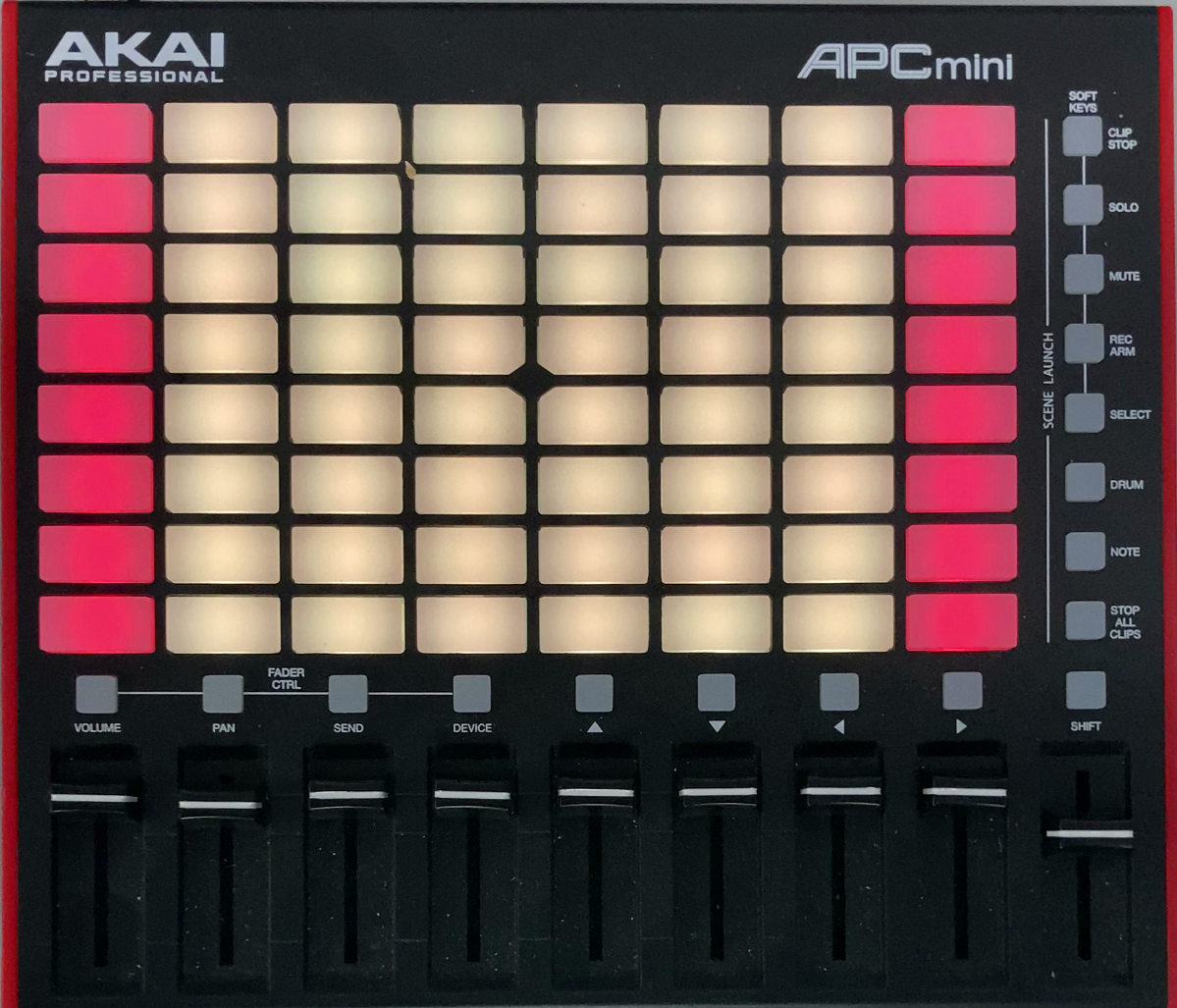
While it might look like something from math class or some kind of scoring tally, these numbers actually represent notes students were to play on their 64-pad MIDI controllers. The controllers look like what you see below, and the "Bb Aeolian" written at the top reminds students that these very flexible controllers are meant to be programmed for this exercise in rows of B-flat Aeolian, meaning the first and last note of each row is a B-flat (the tonic) and the notes are in the Aeolian Mode, which is basically the same thing as natural minor. [Restricting the pitches to the notes in a given mode simplifies playback for students, although this setup does not allow the use of pitches not in the key - so, in the key of A Minor, this would be like giving students only the white keys of a piano.]
The goal for the students in this Digital Music Production class was to play the very popular right-hand piano hook from Still D.R.E., a 1999 song by the rapper Dr. Dre. I honestly didn't even really know this music (at least by name) until the past few years when it became apparent that a lot of students enjoy learning to play it on the piano - perhaps a modern addition to the "I can sort of play piano" canon of "The Knuckle Song," "Chopsticks," and "Heart and Soul."
For reasons I don't really understand, this intro music has become very meme-able. I remember a few years ago when a student in my high school choir got up and played it spontaneously, and it was clear the whole room of students was more impressed with that than anything I'd ever done. You can find lots of videos where performers get a big reaction by transitioning into this. (A common trick seems to be to take the slow-moving arpeggios from Beethoven's Moonlight Sonata and then speed them up until they become the quickly rolled chords in Dr. Dre's song. Note that the sheet music below does not show the chords as rolled, but that's the way it's played.)

It's not that difficult to play on the piano, though the accidentals required for B-flat Minor make it a little trickier to teach/learn. (Lots of "easy" online versions put it in A Minor in which everything can be played on white keys.) But since our class mostly uses these pad-controllers, this was a nice way to give them something to play that requires some coordination and helps learn about modes and even voice-leading. I don't actually use the term "voice-leading," but the fact the chords change one note at a time with notes changing by step is part of what makes things sound smooth - and fairly easy to memorize. Anyway, here's a demo video I made that shows students how to play it. (My chords are a little out of sync because I tried to use my fingers in a way that makes it easy for students to see which pads to play.)
The next video shows how these chords sync with the simpler bass line - which was recorded separately into a different track. I just put the two videos side by side. You'll notice I did not start the bass line on the upbeat, as happens in the original song, because once the two-bar loop is recorded into MIDI, one can easily loop these two bars while also pulling out an upbeat to start if desired. If you're curious and don't know much about MIDI, the 64-pad controller doesn't make any sounds on its own. It is sending information to software (in this case, the educational platform Soundtrap) which routes the data through virtual instruments. Unfortunately, here my right-hand knuckles do block the camera view a bit.
A Facebook friend (and former student) made the insightful guess that the series of numbers I posted might be related to Chopin's famous Prelude in E Minor, for which the left hand has a series of slowly repeating three-note chords that are not unlike what's shown above. In this case as well, the pitches in the chords almost always change by step, though sometimes two at a time, and also using lots of chromatic notes. Although the controllers we use can be set to show the non-scale pitches, it wouldn't look as cool as the videos above because the chords would not all sit neatly on a single row.
DRE

In this case, the first eight chords would still be 3-5-8 (first inversion triads), with a switch to 2-4-8 in the next bar. In both the Chopin and Still D.R.E., the chord changes feature lots of suspensions - notes which lag behind changing harmonies, creating extra tension before the suspensions resolve. For example, the downbeat of the second complete bar of Still D.R.E. would be F Minor if the top note (Bb) would just go ahead and move straight to the Ab it's headed towards. But the delay in resolution adds drama and interest. A lot of the emotional power in Chopin's famous one-pager (in which the "melody" often stubbornly sticks to one note) comes from these suspensions and the eerily twisting harmonies they navigate.
And here's where...well, this is really what always seems to happen. I was writing this post (having prepared everything above), meaning simply to include a passing reference to the Chopin...but then I thought about how to show the connection...and...well...here you...go:
Honestly, I think it's pretty sweet. It's true that Chopin's music dominates, with the high, plunky arpeggios of Still D.R.E. brought into the same middle register as Chopin's chords. I shifted the timing of most of Chopin's mid-measure chord changes to reflect more of the Dr. Dre feel, and of course the octaves in the bass pay tribute there as well.
But to return to the series of numbers with which I started, I always marvel to realize musical sounds which seem so expressive and which can arouse such a strong emotional reaction, can so easily be reduced to numbers. And in this case, distancing a little from each work by viewing them as number patterns helped make the connection between two very different musical worlds clear. I think I may have thought of this Dr. Dre/Chopin connection before, but I love that it was a student's incorrect but insightful guess which led me down this unexpected path.
I would add that working with MIDI and the "Piano Roll" style way in which one interacts with notes and rhythms has also been reinforcing this math-music connection. Obviously, musical notation can easily be interpreted as representing numeral relationships once you know how to read it, but the numberiness gets a little lost in the mix with all the mysterious symbols. I could even compress the information above to make it more elegant: [{3-5-8} x 4 ] + [ {2-5-8} x 3 ] + [ {2-5-7} x 5 ]. But I don't suppose anyone is going to bop their head along to that....
UPDATE: In a blog which is obsessed with the principle of interconnected hyperlinks, I can't believe I forgot to mention my previous mashups of Still D.R.E. with music by Vivaldi. I do think there's a touch of the "classic" in this modern hip-hop beat which adds to its old-school appeal among the young. And note that the idea of interconnected thoughts/concepts (in a blog in which just about every post can be linked backwards or forwards to some other post) also played out in how my new Chopin/D.R.E. creation evolved from the interconnected back and forth that happens on Facebook. My former student's guess about Chopin functioned as a sort of hyperlink which led to new ideas which I can now connect back to even older ideas. It's the circle of links.
UPDATE #2 (5/8): I realized I was a little disappointed at how little the opening of this mashup sounds like the original Still D.R.E. - for two* likely reasons. 1) The key is transposed by a tritone (6 half-steps), so even someone without perfect pitch will likely notice a different feeling. 2) The distance between the Still D.R.E. left hand and right hand registers is compressed by two octaves. This a good reminder about how much register spacing can change the music's character. The wide expanse between treble and bass elements in the original Still D.R.E. sets up a particular kind of texture which allows the listener easily to hear each part as distinct. Because I decided I still wanted Chopin's melody on top, I dropped the triads an octave after the short intro, but the bass notes are still an octave lower (relationally) than in the first version I posted. I also began the intro by rolling the triads a bit before they settle into something more like Chopin's version.
* A third factor not addressed here is that the slower tempo also made it less Dre-like.
UPDATE #3 (5/8): And...just like that, a third option which is closer to the original Still D.R.E. tempo.

Sunday, May 4, 2025
May the Fourth Be With You in Five!
This should be pretty self-explanatory. I did have a nice, natural time limit to keep me from losing too much time investing in this. (I only thought to do it on May 4 and wanted it posted by May 4.) The other limit I put on myself is to create this almost purely by cutting and pasting the original audio, although I did add some timpani highlights as well to help clarify the 5/4 time. In retrospect, the opening title theme is probably a better choice for putting into 5/4 time. Curiously enough, I used to think that theme was notated at least partly in 5/4 time - although I was definitely mistaken!
Also, note that this is not my first post about "May the Fourth" and 5/4 time. See HERE.
Subscribe to:
Comments (Atom)