I'm OK with the result, but I feel like I could change lots of things and not change it so much; it definitely tends towards the meandering. I was intentional about using some mixed meter to give the sense of a varied, chant-like flow, but the harmonic structure also leans a lot on modal freedom, so here we are. To be totally honest, this is the kind of feeling I often get listening to Gregorian chant. Perhaps not an ideal choice for the genre, but I'm still intrigued by the challenge and might return to this one to see if I can find what's in my head....but I said I'd write a fugue every week, so here's this one.
Sunday, January 23, 2022
Epiphany Fugue 3/8
I set myself an interesting challenge for this week's Epiphany Fugue #3 (see previous post) by working with a Gregorian chant melody, the well-known Ubi caritas. (Our choir sang a simplified version of Duruflé's beautiful setting during this morning's service.) It's a beautiful melody, but the part I used moves entirely by step without any strong rhythmic profile (to be expected with chant), so it makes for an odd fugue subject since there's not an obvious hook melodically or rhythmically. For several days I imagined in my head something...that I never quite found on paper.

Monday, January 17, 2022
Don't you fughetta 'bout me
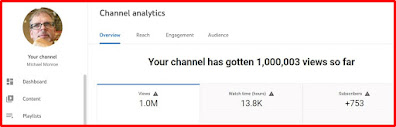
In my last post I mentioned I was about to top one million views of my YouTube videos. On Saturday, according to one set of stats, I did indeed pass the threshold, as you can see below:
In the meantime, I have a fun new project for 2022 (inspired by a need to write something) which gives me something to write about here. Here's what I wrote about this on Facebook:
When I couldn't come up with a topic idea for the January column in our church newsletter, I decided to kick the can down the road by announcing that I'd be writing a new hymn-based fugue for each of the eight Sundays in Epiphany. That gave me something to write about. [and a lot of work to do in the new year!]
This is sort of a follow-up project to my "Summer of Fugues" from 2018 when I wrote eleven short, hymn-based fugues for Sunday morning services. Although fugues have a reputation as being formally rule-bound, I've come to think of writing them as a quasi-improvisational process. I work out a subject, and then follow where it leads...more or less. Each subject presents its own challenges, and some subjects lend themselves to more liberal use of counterpoint rules than others. The great virtue of these projects is that I find these new little pieces quite useful and have repeated most of them more than once. (I purposefully have chosen hymn tunes which we sing with relative frequency.)
And so, I'm already on my way with two new fugues for the new year, one on an early American hymn and one on a lovely modal tune by Ralph Vaughan Williams:
For various reasons, it's not easy to produce ideal recordings yet, but these provide the basic idea. As with fugues I've posted in the past, I'm only including the opening of the score in the videos, though I'd be happy to share full scores on request.
I'm adding each new fugue to this playlist and to this little HYMN FUGUE ARCHIVE, which provides links to recordings of the original tunes. I also tracked down a few other little fugues I've written over the years (some are so short they really might better be called "fughetta") and have added them to the playlist. The notation/recording quality is pretty sketchy in some cases (one includes live crickets!). But the truth is, I'd almost forgotten about a couple of these, so this kind of archiving is a good way to keep track of what I've done.
It's also made me realize I'm only one fugue away from 20, and if I complete my planned Epiphany project, I'll top 25. (I also happen to have a couple of NON-hymn fugues out there, and I'm quite proud of each. This little fugue on the theme from Scheherazade is really beautiful, and it comes with a fun story. And this sports-inspired fugue on I'm Shipping up to Boston is just fun, and it comes with football highlights.)
Thursday, January 13, 2022
Rushing to one million...
This is perhaps an odd way to re-start the blog for 2022, but I recently noticed I'm within 300 of one million total views of my videos on YouTube.
 |
There are plenty of reasons that this is a fairly silly milestone, but I'm in too much of a hurry to worry about them. As it happens, I've recently been re-using a video I made a few years ago for teaching purposes. I'd never quite gotten it as smooth and polished as I'd like, but I realized this week both that it's still pretty useful as is and that I'm not likely to invest the time in working out all the kinks. I did do a little tweaking, but for now I'll just present this little video which features my own one-page (!) score of the first movement of Beethoven's Symphony No. 5, with audio played as fast as I could reasonably imagine without losing too much sense. Your mileage my vary.
Once I pass the arbitary one million mark, I hope to be back to say a little more about this!
Monday, November 29, 2021
Hats off to so many hats
Appreciations abound across the Internet in celebration of Stephen Sondheim, who passed away the day after Thanksgiving at the age of 91. I'm not sure how much I have to add, but I'll share a few observations from just out on the edges of musical theater fandom.
I was fairly late to the game in grasping Sondheim's genius, mostly because I was more focused on the world of classical music through pretty much all of my education. I grew up with a lot of Golden Age musicals, including West Side Story (for which Sondheim wrote the lyrics), but had somehow not quite tuned into the Sondheim sound/style. His elusive, indirect way of composing managed to sidestep me even when I would occasionally accompany a song of his here or there. This makes some sense as his songs are not as easily excised from their contexts as many Golden Age favorites.
As it happens, during a time in which I was mildly dismissive of Sondheim, I wondered often why there weren't more "serious" composers interested in musical theater and musical comedy in general. I'd fallen in love with the comic brilliance of Mozart's Marriage of Figaro and Britten's Albert Herring and thought it a shame that the typical modern opera composer seemed more interested in ultra-serious storytelling than (deceptively) simple silliness. (I know there are exceptions to that, but that's not the point for now.) Mozart and Britten had proven to me how effectively music can serve two essential elements of good comedy - precise comic timing and expressions of human frailty.
I suspect that the typical "serious" composer might find that a true stage show requires surrendering too much control of the overall product, but it seemed a price that could be worth paying for a composer interested in connecting with audiences. I was also curious to see how a classical composer might work with non-classical voices trained to focus more on text declamation than bel canto sound. And though I loved shows like Guys and Dolls, Camelot, and The Music Man, that Broadway tradition seemed inherently simpler and more formulaic than what a sophisticated classical composer might offer if given the chance. (Again, I know that's overly simplistic, but I'm just trying to give a sense of where my thinking was.)
My point, of course, is that I hadn't been paying attention to the incredibly sophisticated and endlessly creative work Sondheim had been doing all along. The music doesn't often sound like classical music, though there are definitely echoes of Ravel and Stravinsky and others to be found, and the singing often sounds even less classical, with exceptions here and there; so superficially, it was easy enough to miss just how much was going on. The fact that he was setting his own lyrics certainly helps explain his willingness to write in a way that doesn't always foreground the "pure" musical ideas, but skillful text-setting also demands a kind of artistry that has eluded many classical composers. Sondheim's songs generally provide more freedom for singing actors to find their voice than one finds in typical opera roles, and that might seem like a kind of musical compromise; but he generally manages to keep the words, the drama, and the music in a magical equilibrium on the same level as a Schubert or Schumann.
The question of which musical world (classical, opera, musical theater, jazz, pop, etc.) a composer belongs to might seem needlessly artificial and limiting, but it's a reality that practical experience tends to categorize things in these ways. One basic example of this is that, as a music major, I never heard Sondheim's name mentioned in a class - at least not that I recall. There's a lot of consternation about the way the classical music world fences itself off, some of it justified and some of it a little unfair, but a useful distinction might be this: classical composers tend to think of the composed music as the primary thing and thus the thing that develops and shapes a perceptive experience. Sondheim didn't choose to enter this arena.
In the same way, a film composer like John Williams may have all the necessary skills to be a classical composer, but he's chosen to work mostly in a world in which visuals and storytelling lead the way. Hearing his soaring melodies and brilliant orchestration accompany a film is quite a different thing than having Beethoven or Mahler firmly at the helm guiding our perceptive focus for 30-60 minutes (or more). Though Sondheim often blurs this distinction, a musical theater experience tends to be led by words and stories with songs as embellishments. In contrast, we tend to think of an opera as being led primarily by the composer's vision. One can listen to operas by Mozart, Wagner and Puccini and find deep satisfaction without even knowing what the words mean. (I know this from experience!)
There are lots of exceptions for sure, but though Sondheim surely had the skill to write sonatas and string quartets, he chose to do almost all of his composition in the service of words and stories on stage. A typical composer of symphonies or operas expects specific kinds of sonic sophistication from performers since the sound is, on some level, the thing. Sondheim's music can soar when sung by "character" voices like those of Elaine Stritch, Angela Lansbury, or Chip Zien. Though Sondheim has something of a reputation as a show-off (at least as lyricist), this willingness to serve the dramatic moment, at the expense of putting his composer chops on display, is one of his strengths.
I'll give three examples from my three favorite Sondheim shows. First of all, anyone with doubts about whether he could write great tunes should get to know "Not while I'm around." It's as gorgeous, and soaring, and heart-stirring a melody as anything by Rodgers, Loewe, Kern or even Gershwin. But it's also stuck in a rather creepy scene in Sweeney Todd, sung by a character who often has more of a "character" voice and who seems thoroughly unqualified to provide what he's so eloquently professing to offer. As if that weren't enough, there's some really unsettling accompanimental material when Mrs. Lovett takes a verse. This song can function as a relatively sweet lullaby - if you don't know too much about it (and if you don't mind a big emphasis on "Demons"), but Sondheim could certainly have saved it for a more traditionally comforting context and gotten more heartwarming mileage out of it. I'm not sure he wrote a more beautiful song, and though its beauty works beautifully in the scene, one couldn't blame him if he'd saved it for something less horrifying.
I also really admire Sondheim's willingness to write what I hear as purposefully bad music. Well, good bad. At the top of Act II in Into the Woods, various characters are singing about how they're "so happy." They sing it over and over, a shapely phrase that might've gone somewhere interesting - except we're not supposed to believe in this happiness, so it just keeps repeating without much development until finally a big crash sends the characters into chaos. I remember first being bothered by this music and this scene as it felt so static, until it dawned on me what was going on. This is a good example of how Sondheim's music doesn't always make a great first impression - but its impact often deepens on repeat listenings because it's serving deeper purposes.
Sweeney Todd and Into the Woods are among the composer's most approachable shows. The former has an immersive operatic appeal and, though grisly, its story is compelling; the latter has a wonderful child-like facade with relatable characters. I'm probably not supposed to say it, but I wish Sondheim had written a few more shows like these, even if I know it wouldn't be true to who he was to return to the same well over and over.
On the other hand, I'm surprised how much I love the more offbeat charms of Company. It has a dated '70s sound and a high concept structure that isn't as obviously gripping as shows about madmen and giants. Honestly, I think I could make a pretty strong case for why I should hate the opening title number of Company, but even though it sometimes sounds like manic refugees from Sesame Street hyping up their dinner parties, I find it irresistible. (I did hate it on first listen.) And though I never thought I'd find the big personality, non-singerly manner of Elaine Stritch engaging, every second she sings on the original cast recording is amazing. (Maybe especially some of the really flat notes.*)
The room Sondheim gives his performers shows admirable humility, but as with "Not while I'm around," the willingness to subvert beautiful music in the service of story really comes to the fore in "Getting married today." I can remember first listening to the cast recording and being almost repulsed by the shrill opening "Bless this day" solo. I'm not sure what the effect is supposed to be of this peculiar celebrant who coldly observes a bride falling apart; but at least on the original cast recording, the perfectly fine, but unusually high melody sounds claustrophobic, increasingly so as on subsequent hallucinogenic entries the backup singers buzzily hum along. Following the short opening, Paul sings passionately to Amy, his bride-to-be, a declaration of love which wouldn't be out of place in South Pacific or even Puccini, though it seems a little out of place in this show. It's a great tune.
But this is all setup for the main event: Amy's absurdly high-strung patter that makes Gilbert and Sullivan's Nightmare Song seem like a dirge. Somehow the creepy soprano blessing and the overripe tenor are the perfect frame for helping us understand how desperately Amy feels overmatched by her circumstances. Again, Sondheim could've saved Paul's music for a more classic romantic scene, but here its beauty is cause for a panic, so it becomes a kind of romantic self-parody. The last few pages of simultaneous singing are particularly stunning as Amy's manic unravelling makes Paul's melody seems lost at sea, and the chorus barks tone-deaf Amens into the mix. I'm not sure it's my favorite Sondheim song, but it packs an incredible punch.
I suppose my point is that one proof of Sondheim's brilliance as a composer is how effectively he uses his virtuoso songwriting skills to undermine his own songwriting - and thus lead us to unexpected places that resonate with our own interior experiences and frustrations. (I can almost directly connect the dots from how Amy feels to how my mind can spin in meetings listening to overly positive, promising-too-much presentations.) I don't love every one of his songs, and there are shows of his which I still haven't come to know well, but no one can say he took the easy path. Getting to know each show requires a commitment to listen into the oddities, to look for more than just good tunes (though there are so many), so it makes sense that it would take time. It's very sad that Stephen Sondheim is no longer with us, but I'm selfishly glad that I still have a lot more to learn from him.
==========================
* Seriously, the incredible held "LOVE" from Stritch starting just after 3:59 here is like nothing else. Or it's like a goat wandered into the studio. Seth Rudetsky does a great job breaking this down at 8:22 here.
Saturday, October 16, 2021
Augmented Reality
Although I believe I'm the inventor of AUG SIXTH DAY, that special occasion every August 6th when we *should* celebrate harmonies which exploit the interval of the augmented sixth, it still sneaks up on me every year. So I never give it the attention it deserves. Alas, on August 6, 2021, all I could find the time to do was hit re-play on this old celebration of a German Sixth Chord in a string symphony by a 12-year-old Felix Mendelssohn.
However, as I was also spending early August prepping to teach AP Music Theory for the first time this year, thinking about that wonderful Mendelssohn passage got me thinking about the whole 4-minute Andante and all the ways the young composer uses texture, register, and harmony (with melody emerging from a combination of those three elements) to create something truly magical. I played it for my students on the first day of class, using an analytical score I created, to show them some sense of where we were heading with our study of music theory. For me, at least, there's something deeply satisfying about seeing these under-the-hood structures and hearing how they enable the music to flow, to soar, and to surprise. You can see a video demo of this score analysis at the end of this post.
I suppose my main goal that day was to introduce the concepts of harmonic reduction and Roman Numeral Analysis. Most of what happens in this Andante is fairly conventional and thus easily reduceable; even the particularly beautiful details relate closely to that framework. I wanted to show the students that all those notes the young Mendelssohn wrote have a clear, internal logic which can help us hear and understand why certain notes are so effective and affecting. In other words, I wanted to show why it's worth taking the time to study music theory!
Although I do genuinely enjoy this kind of exploration, I'll admit I don't have the kind of ear which can instantly recognize and label harmonies as they go by. But it's been satisfying to realize that after years of looking for augmented sixth chords (in part because theory students often get tripped up by the seemingly convoluted way in which these "chords" arise and are labeled), my ear does sometimes intuitively notice what's going on before I see it in a score.
So it was that a few weeks after starting my re-exploration of Mendelssohn's augmented-sixth-based modulation in this Andante, I heard my 14-year-old cellist son play the extraordinary first movement of Brahms' first sextet at chamber music camp. (To be honest, this music was a bit over the heads of these campers musically and instrumentally, but they did a great job with the challenge, and managed to present it with confidence and a convincing overall shape.) It's music I've heard often enough, but didn't know super well, yet as the Recapitulation approached, I remembered that something special was going to happen. (Side Note: this kind of musical memory-based recognition/anticipation is one of the most satisfying things about listening to familiar music; this is surely one reason people who love classical music enjoy returning to old favorites.)
As the dramatic texture unfolded and suddenly the opening theme returned in a harmonically arresting way, it occurred to me that this sounded a lot like what happens in Mendelssohn's Andante. The two musical passages (Mendelssohn and Brahms) are different in so many ways, but that makes the analogical connection all the more meaningful. (I've been writing about my love for and fascination with analogical thinking since the blog began.) Hopefully I'll get around to writing about the Brahms sextet more in a future post as there is SO much to say, but for now just listen to the way the music moves from G-flat Major to the home key of B-flat Major. These are not closely related keys (they only share three common pitches), but Brahms uses a German Sixth chord as a sneaky way to get from one key to the next. The video below should begin at 6:35, where the cresc. is marked in the score.
The most important thing to listen for is that, in m.233, the first violin (highest instrument) goes from E-natural to F (up a half-step) at the same moment the 2nd cello (lowest instrument) goes from G-flat to F (down a half-step). G-flat and E-natural are an augmented sixth apart - not an interval that shows up if sticking to one key - and the resolution of those distant notes outward to an octave is the fundamental thing about how augmented sixth chords work. (There's something else unusual going on in this case which I'll get to in a later post.)

Also, as we'll see/hear in the Mendelssohn, the recapitulation of the main theme occurs over a dominant pedal tone F instead of the tonic B-flat we heard at the very beginning. This adds a heightened kind of tension to the otherwise stabilizing effect created by the return of the main theme in its home key.
Now, let's back up a little. This kind of modulation technique is where I find Augmented Sixth Chords are most powerful, but they can appear in other, sometimes simpler contexts in which the chromaticism (use of pitches outside the key) is just a means of heightening the approach to a cadence. Below are two such examples from works by Haydn which crossed my path this summer. (Remember, part of my point here is to focus on augmented sixth chords which I happened to notice without looking for them.) These nicely demonstrate the simple voice-leading origins of these harmonies.
The first movement of Haydn's well-known Piano Trio in G Major, which I coached in July, begins with a graceful theme in G Major which modulates to D Major in its second phrase. The modulation is intensified by the use of chromatic passing tones between G and A in treble and B and A in the bass. The G and B occur as part of a very standard IV chord leading to a I 6/4-V-I cadence, but the insertion of G-sharp leading to A above and B-flat leading to A below creates an augmented sixth chord (in this case, a German Sixth again). All of the harmony can be heard in just the piano part, so for simplicity, I just show that, but you can hear it played below, both without and with the German Sixth.

In a case likes this, it's almost silly to think of the sonority as a chord - the main point is the voice-leading created by the chromatic passing tones, but they do add an extra oomph to the cadential approach. (For the students I was coaching, I pointed this out as a rationale for leaning on those notes just a bit.) You can hear and see this passage both with German Sixth removed and then as written in this little demo video:
In my most recent blog post, I wrote about a Haydn quartet movement with which I'd fallen in love. My focus there was on a more unique cadential approach in the opening phrase, but that simple theme also includes a passage quite close in character to the trio excerpt shown above. In this case, the music is in C Major and approaching a cadence in C, so the destination for first violin and cello again is the 5th scale degree (G) which anchors the I 6/4 chord.

Again, you can hear and see this passage both with German Sixth removed and then as written in this little demo video:
Both Haydn examples of Augmented Sixth Chords are German Sixths because of the addition of one more chromatic note (F-natural in the trio and E-flat in the quartet), but the basic idea of intensifying the connection between the very conventional IV and I 6/4 is easy to see, and again, it would be tempting simply to call these chromatic passing tones and not even bother to attach a fancy name to the sonorities.*
In the Mendelssohn and Brahms examples, the German Sixth is used much more dramatically as a means of modulation which initiates a harmonically suspended recapitulation. In each case, the music has ended up in the distant "flat 6th" of the tonic key (A-flat in Mendelssohn's C Major and G-flat in Brahms' B-flat Major) as the music has reached a low ebb. Both composers then add an augmented 6th above that flat 6 - that means the addition of a sharp 4 - to push back to the I 6/4 chord of the home key which features a 5 in the bass. Flat 6 goes down to 5, while Sharp 4 goes up to 5. Whereas the two Haydn examples had the German Sixth pass quickly mid-phrase into a concluding cadence with no change of key, Mendelssohn and Brahms use the German Sixth to push us into a new key and a new (returning) phrase.
Technically, the new phrase - recognized as such because of the return of the main theme - becomes an extension of a longer cadential motion, so it's also a continuation of the distant key music that led into the Recap. (We generally think of a phrase ending as being defined by a cadence; here, the new phrase arrives mid-cadence.) We definitely hear the melody as beginning something new, but because the German Sixth naturally progresses to an unstable I 6/4 chord, the main theme begins over the fifth scale degree (Dominant) instead of the first (Tonic). This sleight of hand propels the music forward until the cadence in the home key is finally reached. Mendelssohn's cadence back in C Major happens as expected after eight bars. Brahms somehow manages to evade a cadence back in the home key of B-flat for a full 36 bars! Listen here starting at 10:38 until we finally get our resolution in the tonic over a minute later at 11:45.
There is so much more that could be said about each of these works, and I will devote future posts to a "running diary" account of all the little details that I love. (I already have thirty virtual sticky notes on my 3-page Mendelssohn score.) In the meantime, here is a draft of a scrolling score I've prepared for the Mendelssohn. It has a few special features:
- I've included a basic (hopefully correct) Roman numeral analysis below the score which shows the modulations to G Major and A-flat Major and return back to C. The German Sixth chord occurs exactly halfway through in m. 42. (more on these proportions in a post to come)
- A reduction of the harmonies to two staves below. Although register shifts play a big role in how Mendelssohn's music takes shape, I chose to set up this 4-voice reduction to emphasize where common tones occur between chords. Thus, you'll find that this reduction does not correspond exactly to where the pitches occur among the parts. (more on these registral shifts in a post to come)
- Perhaps most unusually, the recording I use is the one of my then 12-year old daughter's chamber orchestra playing this in a concert ten years ago. Though far from perfect, there are many elements (including my daughter's participation, of course) which make this my favorite recording I've found of this transcendent music. (This is my favorite professional recording.)
* Just to give Haydn his due, he does sometimes use Augmented Sixth chords in more dramatic structural ways as well. The suspenseful introduction to his "Oxford" Symphony ends with strings repeating the notes of a German sixth multiple times before the music resolves to the V7 chord of the tonic G major as the Allegro begins. In this case, Haydn does not resolve the Augmented Sixth in the usual way: while the bass E-flat does go down to D, the C-sharp which ought to resolve up to D moves down to C-natural instead. However, the effect is similar, and as with the Mendelssohn and Brahms examples described above, the fact that the cadence doesn't really end until four bars later makes this a most unusual opening for a symphonic main theme. You can see/hear all of this starting at 1:15 here.

P.S. If you're interested in more different contextual uses of Augmented Sixth chords, the Beethoven and Schumann examples I posted way back on the inaugural Aug 6th Day in 2012 are quite tasty as well.
Subscribe to:
Posts (Atom)