This perhaps belongs in my "Emptying the Desk Drawer" series, except that the material here has not been sitting around cluttering the desk for long at all - and a surprising coincidence last night made the content seem a little more purposeful. This journey began when a friend mentioned in a group chat that Grieg's oft-played Holberg Suite for strings began its life as a suite of piano pieces, although the string version is much better known. I commented that I had written program notes (p.4 here) about this music once, and there I had discussed 1) the work's origin as a nod to older musical styles, and 2) Grieg's added second-piano parts to Mozart piano sonatas which put a late 19th-century spin on late 18th century style. We'll start with #2 and get back to #1 a little later.
Sunday, November 23, 2025

Tuesday, August 19, 2025
Post #700: America the Beautifulish (Emptying the Desk Drawer #8)
Tuesday, September 24, 2024
Bach to Bach
Here's how I began an unfinished blog post back in 2017:
I'm slightly worried this blog is going to turn into a "Tales from the Organ Bench*" kind of thing, which really shouldn't happen until I've had at least two organ lessons in my life. But, much as my organ technique is kind of an improvised thing that has evolved in the context of real-time necessity, I take special delight in musical discoveries that happen under pressure.I was sick for much of the week leading up to this past Sunday and had missed Thursday choir rehearsal, so things were already feeling a bit less settled than ideal. I then discovered about 20 minutes before the service that the music for the scheduled prelude (based on Salzburg, the opening hymn tune) was not on the premises, so I got to make up something on the spot, for which the poor listed composer will have to take all the blame. I've actually been scheduling hymn tune improvisations as preludes fairly regularly in 2017, so that wasn't too disconcerting.The other place in the service where I'm most likely to do a bit of freestyling is at the end of Communion, depending on time needed. We generally have a choir anthem and a congregational hymn scheduled as the Eucharist is celebrated, but another 1-3 minutes of fill is often required. In such cases, I almost always just continue quietly with the hymn that's just been sung, sometimes noodling extra things here and there, slowing down, changing some harmonies, or making a fool of myself.As it happened, both the anthem and hymn were pretty short, and so I'm most appreciative for the soprano who, during pre-service rehearsal, asked if I was going to have to keep playing that hymn over and over when we ran out of verses. The hymn, "Jesu, Jesu," based on a Ghanian folk song, is quite simple and circular, and as I thought about it while the service was already going, I did start to worry that I was going to get trapped in a loop. And, this tune wouldn't be high on my list of "tunes in which to get stuck looping." [UPDATE FROM THE FUTURE: Here's a tune I don't mind getting lost in.]So, as the service progressed, I started thinking about this potential problem and wondered if I should just plan on having something else ready to play once the hymn ended. In some cases like this, I'd pick something to anticipate the recessional hymn that would soon follow, but remembering that the communion hymn was in E Major, I did my standard mental trip to The Well-Tempered Clavier to ponder what Kapellmeister Bach had ready-made for me in this key. Then I remembered that the E Major prelude from the WTC Book I is in the same sort of lilting 6/8 [technically, it's in 12/8] as the hymn above, and it's a piece I know well as we used to analyze it every year in a class I taught.
My WTC is always nearby, and as I had already chosen to play the folksy hymn on the piano, I was then able to segue right into the Bach. To my delight, it felt even more natural then I'd expected, and I'd also forgotten what a gratifying piece it is to play, fitting beautifully under the fingers and featuring lots of opportunity for dialogue between the hands. There are a couple of brief chromatic passages that made we sweat in the moment, but everything went smoothly. Because I did end up needing to fill time for a while, I played the Bach twice through (leaving out the brief coda the first time), and it could not have timed out more perfectly. If only every Sunday went this way.
I guess maybe I was waiting to make a recording to finish up the post, or maybe had some grander plan in mind, but that post never got published. Anyway, seven years later, I was thinking about this again since I recently made another unexpected Bach connection with a Sunday morning hymn. In this case, the processional hymn was to be the lovely, folksy Morning Has Broken, which is best known in a sweetly sung pop version by Cat Stevens. (That piano intro/interlude is famous, I guess, though it seems like an odd fit with the tune.) As this was a Sunday featuring a more relaxed musical style, with a couple of guitarists on hand, I knew I would be at the piano instead of the organ.
So, in looking for a prelude, I noticed I'd played Bach's well-known Prelude in C Major from Book I of The Well-Tempered Clavier as prelude last time we'd sung this hymn (with the associated fugue played as postlude that day). I'm not really sure why I'd chosen that other than that it was low-key summer Sunday and C Major fit with the version of the tune in our hymnal. In thinking about it, I wondered if I could combine Bach's iconic, flowing arpeggios with Morning Has Broken. After all, Bach's prelude was turned into the accompaniment for a beautiful setting of Ave Maria by Gounod. (That may be one of the most perfect examples of building a new work on top of a completely, self-contained work. It's always felt to me like Gounod discovered the solution to a puzzle Bach had left behind.) After a bit of time noodling around in Dorico (notation software I'm learning upon the news that Finale, my old friend/nemesis, is being put out to pasture), I had something that works pretty well.
Since I had about five minutes of time to fill, I ended up playing Bach's original prelude flowing directly into my new "Morning has broken chords" arrangement. Although the first four bars stay very close to Bach, from there, the broken chords are led more by the tune in the left hand so that the entire arrangement is less mashup than homage. However, the power of suggestion should not be underrated in cases like this. I've often found that the mere hint of a connection can make two different works seem like natural partners. (Sometimes, if I'm playing a postlude with no specific connection to the recessional hymn which precedes, I'll start off the postlude - with apologies to the poor composer - by incorporating some bit of the hymn tune - even just a few notes. In my mind at least, this can make the entire postlude seem as if it was inspired by the hymn, even if the actual connection vanishes within a bar or two. Perhaps I'll post some examples of this kind of thing in a future post. UPDATE: There's one example found in this post.)
The recordings posted below were made in a slightly unusual way. I recorded them by playing a full-size Kurzweil digital keyboard connected to my computer, but I wasn't loving the sound. So I looked around at various virtual pianos on hand and found a nice "American Home Grand" in a set I'd downloaded for free. I simply ran the MIDI data through that, and I have to say I really like the result. The piano has a tender but clear sound that works really well here. It's still missing things I love about the feel and sound of a real piano, but it was fun to experiment with this not quite the real thing. Though a sampled virtual piano like this is intended to replicate the sound of an acoustic piano as closely as possible, in some ways the most interesting thing is discovering something new in a sound because it's different.
To circle back to where I started, I also recorded the Ghanian hymn tune "Jesu, Jesu" transitioning into Bach's E Major Prelude using the same setup. The arrangement of the tune which I play here is worth a few words. Many hymnals publish the song with very simple, block chords, but this version (printed in F Major via that link) is written in a style that could be described as "Bachian," with active inner voices, countermelodies, and some subtle harmonic shadings. Though some might find the effect appropriative, I think it's a lovely meeting of two different styles that works quite well - and, of course, it makes the transition into Bach's prelude almost seamless. As for the prelude, I forgot how delightful and expressive it is. Though it looks conventional on the page, it's that perfect marriage of mechanical and magical that Bach does better than anyone.
Since hymn tunes played such a vital role in Bach's career with all his chorale harmonizations and chorale preludes, it's very satisfying to find how well his music can work alongside these more contemporary melodies. (And I tossed in a little surprise at the end of the "Bach.")
* See, from the past year (this footnote is from 2017 as well):
Saturday, August 6, 2022
An Aug 6 for Aug 6 in an August 6tet
Once again, Aug 6 has snuck up on me and I didn't get you anything. Well, at least not anything new or original, but I'll see if I can reignite the blog with a couple of observations. First of all, it happened to dawn on me that today is August 6 not long after dawn while on a long morning walk. And quite by coincidence, I had already listened to perhaps my favorite-ever Augmented 6th (Aug 6) chord while walking as I'd been revisiting a recording from last summer of the first movement of Brahms' Sextet No. 1 in B-flat. I even re-listened to the marvelous Aug 6 moment a couple of times while unaware that today is Aug 6.
Actually, let's back up and remember that I first "discovered" Augmented Sixth Day exactly ten years ago today when I saw that a student's harmonic analysis entered into an Excel spreadsheet had the abbreviation "Aug 6" automatically converted by Excel's internal logic to "8/6/12." The fact that this discovery happened on August 6 still blows my mind. This also reminds me of a clever bit of memery I saw just this past week online:
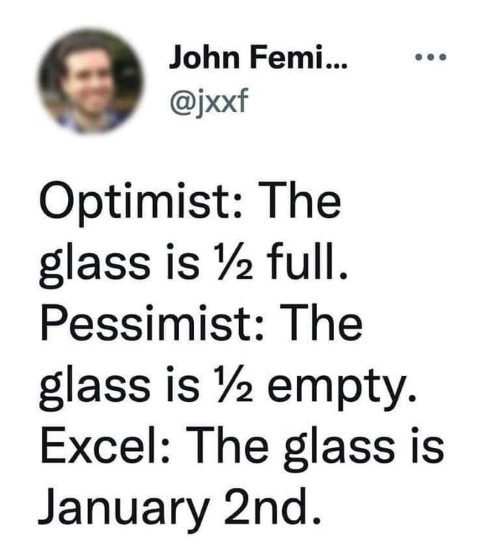
==========================
from the post Augmented Reality, 10/16/21, beginning after a discussion of an Augmented Sixth chord in an early Mendelssohn string symphony:
...So it was that a few weeks after starting my re-exploration of Mendelssohn's augmented-sixth-based modulation in this Andante, I heard my 14-year-old cellist son play the extraordinary first movement of Brahms' first sextet at chamber music camp. (To be honest, this music was a bit over the heads of these campers musically and instrumentally, but they did a great job with the challenge, and managed to present it with confidence and a convincing overall shape.) It's music I've heard often enough, but didn't know super well, yet as the Recapitulation approached, I remembered that something special was going to happen. (Side Note: this kind of musical memory-based recognition/anticipation is one of the most satisfying things about listening to familiar music; this is surely one reason people who love classical music enjoy returning to old favorites.)
As the dramatic texture unfolded and suddenly the opening theme returned in a harmonically arresting way, it occurred to me that this sounded a lot like what happens in Mendelssohn's Andante. The two musical passages (Mendelssohn and Brahms) are different in so many ways, but that makes the analogical connection all the more meaningful. (I've been writing about my love for and fascination with analogical thinking since the blog began.) Hopefully I'll get around to writing about the Brahms sextet more in a future post as there is SO much to say, but for now just listen to the way the music moves from G-flat Major to the home key of B-flat Major. These are not closely related keys (they only share three common pitches), but Brahms uses a German Sixth chord as a sneaky way to get from one key to the next. The video below should begin at 6:35, where the cresc. is marked in the score.
The most important thing to listen for is that, in m.233, the first violin (highest instrument) goes from E-natural to F (up a half-step) at the same moment the 2nd cello (lowest instrument) goes from G-flat to F (down a half-step). G-flat and E-natural are an augmented sixth apart - not an interval that shows up if sticking to one key - and the resolution of those distant notes outward to an octave is the fundamental thing about how augmented sixth chords work. (There's something else unusual going on in this case which I'll get to in a later post.)

Back here in 2022, I'll leave you with this glorious recording, and of course I recommend listening to the whole sextet, but the BIG MOMENT starts at around the 10:38 mark.
Thursday, February 24, 2022
15
- The Birth of Coulenc (2021)
- Chaconne at a glance (2020)
- Haydn a Surprise (2019)
- Barber: Guitar Concerto (2018)
- Alternative Facts (2017)
- Sundays at the Improv (2016)
- What it the great composers wrote the music for the closing credits of 80's TV shows, Part I (2015)
- The Luigi Rag (2014)
- Moonlight Mashup (2013)
- Ballade Blogging (2012)
- Atonality on Ice (2011)
- Reflections on a Two-Part Invention (2010)
- Name that bassoon (2009)
- Ambigramania (2008)
- Hyperspace (2007)
Saturday, October 16, 2021
Augmented Reality
Although I believe I'm the inventor of AUG SIXTH DAY, that special occasion every August 6th when we *should* celebrate harmonies which exploit the interval of the augmented sixth, it still sneaks up on me every year. So I never give it the attention it deserves. Alas, on August 6, 2021, all I could find the time to do was hit re-play on this old celebration of a German Sixth Chord in a string symphony by a 12-year-old Felix Mendelssohn.
However, as I was also spending early August prepping to teach AP Music Theory for the first time this year, thinking about that wonderful Mendelssohn passage got me thinking about the whole 4-minute Andante and all the ways the young composer uses texture, register, and harmony (with melody emerging from a combination of those three elements) to create something truly magical. I played it for my students on the first day of class, using an analytical score I created, to show them some sense of where we were heading with our study of music theory. For me, at least, there's something deeply satisfying about seeing these under-the-hood structures and hearing how they enable the music to flow, to soar, and to surprise. You can see a video demo of this score analysis at the end of this post.
I suppose my main goal that day was to introduce the concepts of harmonic reduction and Roman Numeral Analysis. Most of what happens in this Andante is fairly conventional and thus easily reduceable; even the particularly beautiful details relate closely to that framework. I wanted to show the students that all those notes the young Mendelssohn wrote have a clear, internal logic which can help us hear and understand why certain notes are so effective and affecting. In other words, I wanted to show why it's worth taking the time to study music theory!
Although I do genuinely enjoy this kind of exploration, I'll admit I don't have the kind of ear which can instantly recognize and label harmonies as they go by. But it's been satisfying to realize that after years of looking for augmented sixth chords (in part because theory students often get tripped up by the seemingly convoluted way in which these "chords" arise and are labeled), my ear does sometimes intuitively notice what's going on before I see it in a score.
So it was that a few weeks after starting my re-exploration of Mendelssohn's augmented-sixth-based modulation in this Andante, I heard my 14-year-old cellist son play the extraordinary first movement of Brahms' first sextet at chamber music camp. (To be honest, this music was a bit over the heads of these campers musically and instrumentally, but they did a great job with the challenge, and managed to present it with confidence and a convincing overall shape.) It's music I've heard often enough, but didn't know super well, yet as the Recapitulation approached, I remembered that something special was going to happen. (Side Note: this kind of musical memory-based recognition/anticipation is one of the most satisfying things about listening to familiar music; this is surely one reason people who love classical music enjoy returning to old favorites.)
As the dramatic texture unfolded and suddenly the opening theme returned in a harmonically arresting way, it occurred to me that this sounded a lot like what happens in Mendelssohn's Andante. The two musical passages (Mendelssohn and Brahms) are different in so many ways, but that makes the analogical connection all the more meaningful. (I've been writing about my love for and fascination with analogical thinking since the blog began.) Hopefully I'll get around to writing about the Brahms sextet more in a future post as there is SO much to say, but for now just listen to the way the music moves from G-flat Major to the home key of B-flat Major. These are not closely related keys (they only share three common pitches), but Brahms uses a German Sixth chord as a sneaky way to get from one key to the next. The video below should begin at 6:35, where the cresc. is marked in the score.
The most important thing to listen for is that, in m.233, the first violin (highest instrument) goes from E-natural to F (up a half-step) at the same moment the 2nd cello (lowest instrument) goes from G-flat to F (down a half-step). G-flat and E-natural are an augmented sixth apart - not an interval that shows up if sticking to one key - and the resolution of those distant notes outward to an octave is the fundamental thing about how augmented sixth chords work. (There's something else unusual going on in this case which I'll get to in a later post.)
Also, as we'll see/hear in the Mendelssohn, the recapitulation of the main theme occurs over a dominant pedal tone F instead of the tonic B-flat we heard at the very beginning. This adds a heightened kind of tension to the otherwise stabilizing effect created by the return of the main theme in its home key.
Now, let's back up a little. This kind of modulation technique is where I find Augmented Sixth Chords are most powerful, but they can appear in other, sometimes simpler contexts in which the chromaticism (use of pitches outside the key) is just a means of heightening the approach to a cadence. Below are two such examples from works by Haydn which crossed my path this summer. (Remember, part of my point here is to focus on augmented sixth chords which I happened to notice without looking for them.) These nicely demonstrate the simple voice-leading origins of these harmonies.
The first movement of Haydn's well-known Piano Trio in G Major, which I coached in July, begins with a graceful theme in G Major which modulates to D Major in its second phrase. The modulation is intensified by the use of chromatic passing tones between G and A in treble and B and A in the bass. The G and B occur as part of a very standard IV chord leading to a I 6/4-V-I cadence, but the insertion of G-sharp leading to A above and B-flat leading to A below creates an augmented sixth chord (in this case, a German Sixth again). All of the harmony can be heard in just the piano part, so for simplicity, I just show that, but you can hear it played below, both without and with the German Sixth.

In a case likes this, it's almost silly to think of the sonority as a chord - the main point is the voice-leading created by the chromatic passing tones, but they do add an extra oomph to the cadential approach. (For the students I was coaching, I pointed this out as a rationale for leaning on those notes just a bit.) You can hear and see this passage both with German Sixth removed and then as written in this little demo video:
In my most recent blog post, I wrote about a Haydn quartet movement with which I'd fallen in love. My focus there was on a more unique cadential approach in the opening phrase, but that simple theme also includes a passage quite close in character to the trio excerpt shown above. In this case, the music is in C Major and approaching a cadence in C, so the destination for first violin and cello again is the 5th scale degree (G) which anchors the I 6/4 chord.

Again, you can hear and see this passage both with German Sixth removed and then as written in this little demo video:
Both Haydn examples of Augmented Sixth Chords are German Sixths because of the addition of one more chromatic note (F-natural in the trio and E-flat in the quartet), but the basic idea of intensifying the connection between the very conventional IV and I 6/4 is easy to see, and again, it would be tempting simply to call these chromatic passing tones and not even bother to attach a fancy name to the sonorities.*
In the Mendelssohn and Brahms examples, the German Sixth is used much more dramatically as a means of modulation which initiates a harmonically suspended recapitulation. In each case, the music has ended up in the distant "flat 6th" of the tonic key (A-flat in Mendelssohn's C Major and G-flat in Brahms' B-flat Major) as the music has reached a low ebb. Both composers then add an augmented 6th above that flat 6 - that means the addition of a sharp 4 - to push back to the I 6/4 chord of the home key which features a 5 in the bass. Flat 6 goes down to 5, while Sharp 4 goes up to 5. Whereas the two Haydn examples had the German Sixth pass quickly mid-phrase into a concluding cadence with no change of key, Mendelssohn and Brahms use the German Sixth to push us into a new key and a new (returning) phrase.
Technically, the new phrase - recognized as such because of the return of the main theme - becomes an extension of a longer cadential motion, so it's also a continuation of the distant key music that led into the Recap. (We generally think of a phrase ending as being defined by a cadence; here, the new phrase arrives mid-cadence.) We definitely hear the melody as beginning something new, but because the German Sixth naturally progresses to an unstable I 6/4 chord, the main theme begins over the fifth scale degree (Dominant) instead of the first (Tonic). This sleight of hand propels the music forward until the cadence in the home key is finally reached. Mendelssohn's cadence back in C Major happens as expected after eight bars. Brahms somehow manages to evade a cadence back in the home key of B-flat for a full 36 bars! Listen here starting at 10:38 until we finally get our resolution in the tonic over a minute later at 11:45.
There is so much more that could be said about each of these works, and I will devote future posts to a "running diary" account of all the little details that I love. (I already have thirty virtual sticky notes on my 3-page Mendelssohn score.) In the meantime, here is a draft of a scrolling score I've prepared for the Mendelssohn. It has a few special features:
- I've included a basic (hopefully correct) Roman numeral analysis below the score which shows the modulations to G Major and A-flat Major and return back to C. The German Sixth chord occurs exactly halfway through in m. 42. (more on these proportions in a post to come)
- A reduction of the harmonies to two staves below. Although register shifts play a big role in how Mendelssohn's music takes shape, I chose to set up this 4-voice reduction to emphasize where common tones occur between chords. Thus, you'll find that this reduction does not correspond exactly to where the pitches occur among the parts. (more on these registral shifts in a post to come)
- Perhaps most unusually, the recording I use is the one of my then 12-year old daughter's chamber orchestra playing this in a concert ten years ago. Though far from perfect, there are many elements (including my daughter's participation, of course) which make this my favorite recording I've found of this transcendent music. (This is my favorite professional recording.)
* Just to give Haydn his due, he does sometimes use Augmented Sixth chords in more dramatic structural ways as well. The suspenseful introduction to his "Oxford" Symphony ends with strings repeating the notes of a German sixth multiple times before the music resolves to the V7 chord of the tonic G major as the Allegro begins. In this case, Haydn does not resolve the Augmented Sixth in the usual way: while the bass E-flat does go down to D, the C-sharp which ought to resolve up to D moves down to C-natural instead. However, the effect is similar, and as with the Mendelssohn and Brahms examples described above, the fact that the cadence doesn't really end until four bars later makes this a most unusual opening for a symphonic main theme. You can see/hear all of this starting at 1:15 here.

P.S. If you're interested in more different contextual uses of Augmented Sixth chords, the Beethoven and Schumann examples I posted way back on the inaugural Aug 6th Day in 2012 are quite tasty as well.
Wednesday, February 24, 2021
The Birth of Coulenc
First things first, today marks the 14th anniversary of the MMmusing blog! 14 is not a particularly interesting number, even though it's significantly larger than the flashier 5 and 10. 14 years is more years than I've spent in any single job, and longer than I've lived in any town, other than my hometown, and though there have been plenty of quiet months here, I'm proud of the unique body of work it represents - and the lively beginning to 2021.
A few numbers. This is post #633, although I should admit that more than half of that number came in 2007-2009. Those were different days when a blog might hope to function more as a place people would check regularly, as opposed to now when the best bet is to send readers to new posts via Facebook or Twitter. I don't have a strong public presence on either, so this blog really serves more as...well, a web log. A place to store ideas I've had and things I've created. Blogger is hardly the flashiest platform, but I enjoy the continuity of having all these posts in one place (even though many old posts need maintenance to keep up with various technical standards).
I've posted well over 200 videos to my closely linked YouTube channel, with more than 950,000 views. Hopefully I'll pass the 'ol million barrier this year. That's nothing for a mega-star, but that's a lot of clicks on strange mashups, score animations, and other idiosyncratic musical explorations. Speaking of which, let's get back to strange mashups, score animations, and other idiosyncratic musical explorations!
[But don't forget to spin the wheel at MMmusing's Magical Multimedia Musing Machine, which now leads to about 425 unique multimedia outcomes!]
In my last post, I wrote about the idea of splicing two works together not via simultaneous mashup, but rather by fast-paced alternation, beat-by-beat. For that first experiment, I intentionally chose works by Mozart and Chopin that clash vividly, so the result is more funhouse mirror than marriage of musical minds. In a few conversations that followed that post, I've been reminded of other ways in which Mozart's music can serve well as subject for further treatment.
I've already mentioned Grieg's second-piano additions to the same Mozart sonata, but a brilliant Twitter friend reminded me of a remarkable inversion of this sonata (which, as my Twitter friend says, "produces a modal color akin to Shostakovich's)". The pianist-composer Timo Andres has created his own mixed-up version of a Mozart piano concerto in which the orchestra and his right hand play Mozart, while his left jumps ahead a few centuries. And one of my own favorite blog projects links together three Mozart violin concertos in regular alternation.
But I was also interested in the kind of conversation that might result from two pieces with a more natural mutual affinity. Honestly, I can't remember exactly how I came to this next pairing, but I felt it had real potential from the start, bringing together two much-loved French keyboard works which are separated almost exactly by two centuries.
François Couperin's Les barricades mystérieuses, published in 1717, has a legendary reputation as music with special transcendental powers, all housed in a humble few pages and a regular interlocking texture created by constant suspensions (basically meaning the four voices tend to change out of sync with each other, creating chains of elegant dissonances). One probably has to really love and have lived with notated music to feel this, but I find it immensely satisfying just to look at these notes. The top line (with alto clef!) is from 1717 and the second version shown is more recent, but very elegantly engraved.


There are many available recordings, but I'll share my own from some years back when I was collaborating with an artist who live-sketched while I played. You have to do deal with a reverberant hall, possible over-pedaling (I pedal in contrapuntal music, so sue me), and the sounds of my friend Jim sketching on my tablet computer (this was pre-iPad!):
If that recording doesn't suit you, you easily can find dozens of different approaches on piano, harpsichord, guitar, and more.
Anyway, at some point my brain connected this with the first of Francis Poulenc's Trois mouvements perpétuels from 1918. These breezy miniatures were so popular that the composer ended up resenting them (much as Couperin might be annoyed how much his one little piece is so much better-known than the many, many others he wrote), although I don't get the sense they're played as much as they once were. They mean a lot to me because this was the first music I ever chose for myself, having heard my brother play them some years earlier. Saying "I want to play this" to my teacher was basically the point at which I turned from a kid who happened to take piano lessons to someone who fell in love with the instrument.
They are only of moderate difficulty, but the first piece has a uniquely intoxicating appeal reminiscent of Couperin's barricades. In this case, the bass line never changes from its bouncing 8th note ostinato, and though the right hand has some curiously dark diversions, the music keeps returning to its iconic opening, just as in Couperin. Again, I'll choose my own version to share because it includes one of my favorite animations ever, one of my rare forays into 3-D animation. I especially like the way the constant rise and fall of the left hand suggests carousel horses bobbing up and down.
It was convenient for me that Poulenc uses no key signature (there'd be no good place for it in my circular score design), but the music is clearly in the same B-flat Major of Couperin, and it's in 4/4 as well. Although a simultaneous mashup was not my ultimate goal, I couldn't resist starting that way. You'll notice here and elsewhere that I've reduced Couperin's little rondeau to its 8-bar A section, while Poulenc's 19 bars loop above. Poulenc loves quirky endings (a future blog post topic, perhaps?), so it turned out that after 4 times through, plus four looping coda bars, I could get things to end nicely.
The next step was to do the beat-by-beat alternation trick I did with Mozart and Chopin. One of the weird things about this process, a quirk which pops up a few times in both Mozart and Chopin, is how gestures that naturally cross beats get awkwardly chopped. Now, I enjoy awkward things, but I realized soon that Couperin's piece presented a particular challenge. Almost all of the primary two-note melodic groupings cross the beat lines which would mean that breaking this up into one-beat sections would conceal much of its charm. This little image shows how these groupings cross the dotted lines which group each bar into beats

On a lark, I decided to shift the Couperin back by a half-beat which I knew would create some syncopation as now the accented beats of Couperin would fall on off-beats with respect to Poulenc. But I tried it anyway, and the result was: really satisfying! It turns out the emphasis on the off-beats creates something like a tresillo rhythm, which is fundamental to Cuban and other Latin styles. (Think of the well-known habanera rhythm from Bizet's Carmen, but leaving out the third of the four notes). See what you think:
Although Couperin's music is admittedly reduced to a subsidiary role (especially as it keeps looping 8 bars while Poulenc gets its full 19), it definitely adds a wonderful kick that pairs well with the playfulness of Poulenc's original conception. A case could be made for just keep repeating the opening bar of Couperin, as the changing bass line otherwise clashes a bit, but I like the various rotations produced by this alignment. Each time through brings subtly new melodic/rhythmic relationships.
If you're curious, the tresillo rhythm I hear is created more or less in the following way. The first example below shows a simplified version of what the two pieces look like together, with the Couperin notes in red. The accents shown indicate where/how these patterns tend to create natural emphasis. (Remember that the top voice in Couperin puts a natural stress on beats 2 and 4, now displaced by an 8th note.)


And, for the record, I couldn't have told you what a tresillo rhythm was two days ago, but I wanted to know why this "found music" had this effect on me. Your mileage may vary.
P.S. I will mention briefly that a big part of the appeal of this project was creating these unique scores. Figuring out how best to show the Couperin-Poulenc (Coulenc!) alternating video, with the downbeats mis-aligned, took a lot of brain cells and....well, let's just say a lot of time! But it's the kind of time I find so rewarding.
There's much more I could say about Couperin's mysterious Les Barricades Mystérieuses, but for now I'll point you to this interesting post which catalogues more than a dozen composition inspired by the little character piece from 1717. Perhaps my Coulenc will find its way on to such lists in future....
And in addition to my performance of Couperin's piece shown above, I wrote briefly back in 2009 about how much it reminds me of Schumann's equally beguiling Arabeske. I see that the pianist Simone Dinnerstein has been touring with a program that opens with those two pieces!
Sunday, December 13, 2020
Magnificat
Today is the Third Sunday of Advent, a day on which Mary's Magnificat is part of the lectionary. As it happens, I composed a new setting of this text for our annual service of Advent Lessons and Carols last Sunday. Of course, there are many, many musical settings of the Song of Mary, including a very famous and brilliant multi-movement work by Bach. Because this text is part of the liturgies for Vespers and the Anglican Evensong services, there are regular opportunities for these words to be sung. Stanford apparently composed versions in every major key!
In many past years, I've written a new anthem for our choir for Lessons and Carols, but for this year, any choral offerings needed to be produced virtually; though I was mildly tempted by the idea of creating something specifically intended to be assembled online, I ultimately decided this would be a great year to write something for Emily, our outstanding soprano leader. She and three family members served as our in-house choir since they could safely sing next to each other. (Do I need to include a note here for future readers that this was during the Pandemic of 2020?)
I'm not an expert on the subject, but I have thought before that the grandeur and exuberance of so many Magnificat settings can seem a little out of proportion for words spoken by a simple young woman. I'm also not a big fan of breaking this kind of text up into so many sections, although I understand the temptation to mine each line for maximum effect.
But, since I was writing for solo soprano, my goal was more to communicate a sense of quiet, first-person wonder, with the words flowing by at a fairly regular pace - not quite like chant, but delivered with directness and simplicity. Also, I was a little slow getting notes on the page, and in fact, Emily didn't see a note of this until the Wednesday before the service. We ran it once on Friday night, and she sang it exactly as I'd hoped. The writing is indeed pretty straightforward, with an unobtrusive organ part providing support, and regular use of a bVI-bVII-I cadential pattern I tend to associate with wonder. (For the record, I didn't set out to use that pattern; it just kind of emerged as a unifying factor as I tried out this and that.)
Here's the performance from the livestreamed service last Sunday morning. Only a small number of people were in the sanctuary for social distancing reasons, and Emily was banished to the small chapel area in the back where singing can be done far from others. Given the distance and limited rehearsal, I'm pleased with how well we stayed together! Through the many wide open windows in the building, you can hear the leftovers of a Saturday night snow melting to the ground, especially over the quiet final chords.
Oh, I meant to add that I fell into a mostly King James English without really thinking too much about it. I'd actually been looking at a Purcell setting when I started putting notes on the page and was casually borrowing those words, taken from the 1662 Book of Common Prayer. I pivoted to the King James version in a few spots, but I guess I just find the beautifully archaic language helps evoke the past.
Saturday, March 9, 2019
Bach to the future?
A few days ago, Bruce posted a completely worked-out piano arrangement of the Bach in which the metrical groupings are shifted around quite a bit, with the left hand leading the way. You can hear a performance of Bruce's arrangement beginning at 1:18 in this video.
The other main restriction I decided on was to keep the "left hand" part as a single melodic line with no chords - this was mainly because introducing the possibility of chords would've made for a lot more work! Also, I put "left hand" in scare quotes because I also wasn't really thinking about writing this for a real performer, though I'm sure there are pianists who could play what I wrote. For my purposes, I was perfectly content to let my computer's internal pianist do all the fingerwork. Remember, Bach is durable! Or not. You be the judge. (You only get to see Bach's notes - my score isn't ready to be seen.)
The most I can say for now is that it pleases me, though the recording could use a lot of finessing and the arrangement could certainly use some tweaking. It's not nearly as sophisticated as the Bruce arrangement, but it has more of the kookiness that I love. There's a giddiness about my version that amuses me every time I listen to it. (Yes, I laugh at my own jokes.) It's reminiscent of the playfulness found in the flips and reverses to which I once subjected an innocent Bach invention.
I should add that, among the many other more honorable arrangements of this piece (including Bach's own setting for organ and orchestra), the real standout is Rachmaninoff's imaginative reworking:
But he probably spent more than one afternoon on it...
[UPDATE: When I originally posted this last night, the YouTube version I'd uploaded had some buzzy audio issues, so I've replaced it with a cleaner version. The only sad thing is that I'd already gotten one dislike on the original - great art always mystifies some - so I'll have to see if I can earn some fresh dislikes!]
=====================
POSTLUDE: As I've suggested, this Bach prelude has been arranged for all sorts of different contexts. I've made a playlist here including versions for lute, guitar, Bach's own version for organ and orchestra, an arrangement of that arrangement for solo organ, arrangements for piano by Saint-Saens (based on on Bach's cantata version) and Rachmaninoff, and the version with Schumann's accompaniment with soloists on both violin and sax. If you go out into the wild, you can easily find versions on viola, cello, and who knows what else.
The ubiquity of these arrangements also reminds me that David Bruce's version (and mine, perhaps) falls into a fun category: futurized works in which a well-known classical work is given an accompaniment or reworking that intentionally adds a modernist twist on the original. I've made a very short playlist here which includes three takes on Mozart (by Grieg, the virtuoso pianist Arcadi Volodos, and the Timo Andres piece I mentioned) and Lutoslawski's 20th century variations on Paganini's famous variations. Obviously, there are many more works that could be added here, but the spirit of these pieces was on my mind while I was vandalizing Bach...
Saturday, August 18, 2018
Fugue State: Day 5
To be honest, I'm not such a big fan of Azmon, best-known as O for a thousand tongues to sing. It is about as square as a tune in three can be, though I have a soft spot for it because of how Ives uses the hymn in the opening movement of his "Camp Meeting" symphony. In fact, I once used Ives' movement as source for a kind of very free, half-improvised prelude, which I wrote about towards the end of this blog post. Perhaps I was subconsciously influenced by Ives to imagine this tune being distorted by a musical funhouse mirror.
This fugue isn't really built on Azmon, but rather on a 12-tone row that borrows Azmon's rhythm and general melodic shape, while avoiding the repetition of pitches. (The fragment of the tune I've borrowed only uses six distinct pitches among its first twelve notes.) Strangely enough, the rhythm is quite close to that of the 12-tone theme*of my unfinished string quartet, which I wrote about here. (Creepy synth recording here.) So perhaps this whole O for a dozen tongues to sing result was inevitable.
I suppose I should say a little about my method, especially as I'm not necessarily a 12-tone true believer. However, I've always thought 12-tone rows (and their various permutations) work better for counterpoint, when their melodic/intervallic shapes can be perceived, than for building lots of vertical sonorities (chords). I understand that a well-constructed row can yield some interesting possibilities for chord combinations, but I'm not convinced...oh, who has time for this?
Anyway, this three-part fugue simply unfurls one permutation of the row after another in an imitative style that is definitely fugal. I actually played it as prelude (with O for a thousand tongues following as the opening hymn) and no one threw anything sharp at me. So there's that. I have really enjoyed playing it, and I think it does have a satisfying tone and structure, but your mileage may vary. Schoenberg supposedly imagined a future in which "grocers' boys would whistle serial [12-tone] music on their rounds." It's true that this hasn't happened yet, and we may be running out of grocers' boys, but maybe the problem is that these 12-tone tunes need to be brought to the people. So, we start with church and build from there...
* Interestingly, at least to me, I chose to repeat pitches in my string quartet theme. That theme was based on an abandoned choral setting of "When Jesus Wept," and I allowed the words 'Jesus' and 'falling' to be intoned as one-pitch units with articulated syllables. Like so:

Friday, February 24, 2017
10 Years
That's right, on a blog which has featured a wide range of multimedia creations, I'm celebrating in style with my first full-blown [very short] opera aria. It's true!
Our story begins right around the tumultuous election back in November with a Facebook discussion. (Mozart and Da Ponte did a lot of collaborating on Facebook back in the day.) My composer friend Wesley (who's actually been partly responsible for several of my strange experiments) and I had the following exchange as the election news rolled in:

And indeed, I think that the classical music world, with its tendency to be too serious about just about everything, has neglected the wonderful world of comic opera.* As if Mozart (or Sondheim, for that matter) couldn't address serious societal concerns with silliness and wit.
Anyway, in fairly short order, I'd churned out a perfectly ridiculous little demo, with "libretto" inspired by a Youtube clip. Trump's China Aria:
Then, the villain Wesley struck again and wondered which aria from this imaginary opera would feature overuse of the "Dies irae" (a Gregorian chant tune from the Requiem mass that was exploited by many 19th century composers for melodramatic effect). Well, of course I couldn't resist that challenge, and I'm actually kind of proud of this little partial aria, mainly because the "Dies irae" motif (first heard in bass and then in Trump's melody on p.2) is turned into something lighthearted.
And then, mercifully, I put the idea away. I did imagine at the time that an imaginary Trump opera would cast the First Lady as a mezzo, but of course I'd need to write a Michelle Obama aria first before I could start on Melania's (rimshot). However, in late January when the "alternative facts" saga began to unfold, I couldn't help but think that Kellyanne would make a great coloratura character. A few words came to mind, and suddenly I'd written something more substantial than I had for the Donald - and I honestly kind of liked it. It is operatic in style, though I hope it has some of the feel of musical theater, a la my heroes Britten and Bernstein. (The lyrics also owe a bit to George Costanza.)
Whereas I'd been more than happy to let Trump be personified by a synthesized voice, I knew I'd need an actual human to pull this off, so I sent the music off to a wonderful soprano, Julia Nelson, and she agreed to give it a whirl. We had hoped to meet and record it live, but couldn't make our schedules work, and in the end, she had to record it alone without even an accompaniment track due to some technical difficulties. I then spent this morning assembling an "orchestra" around her, and here we are, just before the blog-iversary is over. (Of course, late Friday is supposed to be the worst possible time to drop news. Oh well.)
It's all very much in beta form, though I don't know how much further I'd go with any of this. This aria, for example, is probably missing a couple of sections. I'm not likely to write anything like a full opera, but a song cycle of arias could be fun. But I do intend to go on blogging. In fact, I had a few items in the works this week in hopes of building a little anniversary momentum before circumstances (sickness, car trouble) intervened. At least that means I've got more content for the near future.
In the meantime, if you've missed anything these ten years, you might start here, or even here if you'd like to sample a wider range of creations. Or, be really brave and SPIN THE WHEEL!
* I know there are exceptions, but they don't tend to get as much attention as the SERIOUS things.
Tuesday, September 27, 2016
This just popped up
Well, to me this actually seemed perfectly profound and on point (especially because of the way 32nd notes are gradually introduced to quicken the texture), so I started thinking about how to play with the concept. Since my piano tuner has advised against pouring hot oil into the piano, I decided to head back to the world of Scratch, MIT's marvelous graphical programming environment for kids (and kids at heart). I've actually learned enough "grown-up" programming since I last posted Scratch projects (see: here, here, and here) that I should really start learning how to do animations in JavaScript; but I wanted to see Bach popping right away, so I started scratching.
Scratch does have some limited MIDI capabilities (basically, you can tell it to play notes at a given pitch, for a given length, by a given "instrument"), but getting it to play a three-part fugue in which the beats stay synchronized, even as the tempo changes, meant I got to experience what it's like to build a MIDI system almost from the ground up. As I'll discuss more in a future post, this kind of problem-solving provides an interesting vantage point from which to think about how music works. Mundane functions like pausing, restarting, and jumping around within the music all required procedures that had to be thought through and executed. (In my programming experience, the latter is always much harder than the former!)
As for the popcorn animation, my first instinct turned out to be the best - nothing but a simple skillet in which each note "played" causes a kernel to jump up and then get randomly popped around the pan. I got to revisit my long dormant trigonometry skills as a way of ensuring that the randomly distributed kernels end up falling in a circular pattern. (Simply sending kernels to random values of X and Y resulted in a square distribution that looked silly with the round skillet.)
[The only nod to the actual musical structure is at 1:16 when the alto voice states the subject in augmentation (longer note values); if you look closely, you'll see especially emphatic pops for those four notes.]
Then, like kernels popping randomly in all directions, I found the project also started sprouting outwardly in unexpected ways. I spent a good bit of time trying to design a pop sequence that somehow shows the melodic shape of the three parts. This took a lot of work - and, frustratingly, resulted in something less elegant and realistic-looking than the simple random approach. The kernels that (for reasons unknown to reality) shoot popping kernels into the bowl look a bit too much like little bugs; perhaps a "bug" in the program. But I'm pleased with having met the challenge, although this version exists as an unfinished side curiosity for now. (Those are bass kernels in lower left, alto in upper left, and soprano in upper right.)
Other features crept in, including the fairly rudimentary functionality of being able to change instruments, tempo, volume balance, and key on the fly. Changing key (which, in a way, is how I got myself "into this fugue" in the first place) gave me the idea of allowing the user to change the key for each voice part individually. This led to the idea of a feature in which the music changes key randomly every beat, which creates a kind of 12-tone fantasy effect. (We all have different fantasies.) Then, it occurred to me that the integers I was inputting for pitches don't have to be integers, and suddenly a microtonal option was on the menu. (Unfortunately, "viola" is not one of the instrument options in Scratch's soundfont.) For the user who finds the popping kernels are inducing hunger, this microtonal option might help to erase any appetite.
Finally, because I already have the music entered into Lilypond, and because Lilypond is wonderfully flexible about output options, I converted the score into 35 one-bar systems which allow the user to view the score two bars at a time in the small window. It's not the most practical way to follow along, but it's nice for reference, and one can easily switch back and forth between staves and stovetop.
After I'd made it this far in writing this very post, I realized I needed to add a feature which inverts the music. Rather than simply invert each part within its own range, the parts are completely flipped so that the bass becomes soprano and the soprano becomes bass. Although it wouldn't have been so difficult to produce a nice elegant engraving of this new "score," I decided it's more fun to flip the existing measures upside down like so*:

Here's a quick demo of most of these functions**:
That gets a little insane at the end as I flew to close to the sun in choosing a tempo that would get me to the end more quickly. All the more reason for you to try these fun features out on your own. Just go here or click the image below, which surrounds the embedded "game" within all the instructions you'll need.

Unfortunately, Scratch uses Flash technology which is becoming more and more outdated, so this program won't work on most mobile devices, and might not work on some computers, depending on what your browser thinks of Flash. This is why I'm not going to keep trying to iron out all the leftover kinks. (Sometimes, for reasons I don't feel like fixing, the kernels will suddenly grown enormous and overtake the entire screen - which is actually kind of a nice bug.) Time to move on and learn how to do this more elegantly and efficiently.
I have much more to say about "playing with" Bach in this way, and will post more soon. For now, I'll just say that the line between "playing Bach" (as in, performing it "respectfully" on a keyboard instrument) and "playing with Bach" perhaps shouldn't be so clear. Although there's no clear aesthetic purpose in inverting a fugue with microtonal distortions, I like to think of this program as a way of holding the music in virtual hands and turning it around to inspect like one would a snow globe.
In my last post, I quoted the great Charles Rosen about the satisfying way in which Bach's counterpoint fits the fingers. In the larger context, he's discussing the fact that this music was never intended to be performed publicly, but rather for more private encounters in which following the score (by performer and possibly by a few other listeners) is part of the experience of the music. Rosen writes:
Playing Bach for oneself or for a friend or pupil looking at the score...raises few problems; nothing had to be brought out, the harpsichordist experienced the different voices through the movement of the hands, the listener saw the score and followed all the contrapuntal complexity disentangling the sound visually while listening. Bach's art did not depend on hearing the different voices and separating them in the mind, but on appreciating the way what was separate on paper blended into a wonderful whole. [pp. 199-200]Rosen goes on to suggest that modern performance in concert necessitates having the performer "bring out" the contrapuntal details more pointedly. I'm not sure I agree with that, especially because we know Bach loved secrets and hidden meanings, so he might enjoy the idea that various kinds of thematic connections are buried under a euphonious surface; but for now, I'm more interested in the idea that encountering this music can happen in lots of ways. And, yes, I'd agree that the best such encounters happen at the keyboard. Here again is my humble effort at playing this prelude and fugue shortly after learning them in my D-flat "version." (Fugue begins at 1:45).
* Flipping the music upside-down distorts a lot of the tonal function, though the vague major-to-minor effect is cool.
** One feature I decided not to include, though I toyed around with it, is to have the notes played backwards. It's very easy to reverse the note/rhythm sets and that sounded cool in places, but running notation backwards also raises the question of whether notes should begin where they ended going forward (so that a whole note would begin right at the beginning of a backwards bar) or where they started going forward (so that a whole note wouldn't be played until the very, very end of a backwards bar), which aligns note attacks more often with the other voices but produces odd collisions going the other direction. If that didn't make sense, just think of how a record sounds played backwards. Assuming you're not trying to recreate that whooshing effect caused by reversing a note's sustain, then you're basically going to end up with significantly different rhythmic relationships among the parts.
Sunday, September 4, 2016
Sundays at the Improv
As I've written before, my first real efforts at composition came from my experiences working as a church musician, where I wasn't being evaluated from an academic perspective. Whereas the "lesson and recital" context I knew well was defined almost entirely by the idea of performing existing works as nearly as possible to the way their composers intended, and given that there seemed to be an almost infinite repertoire of music better than I could imagine writing, it was striking to come to a Sunday morning and realize that Piece X by Great Composer Z didn't quite meet the liturgical needs. Meanwhile, I'd also come across a repertoire of chorale preludes (old and new) that were much more functional than great, so I started to see where I might get the best results by 1) creating my own functional pieces and, 2) tinkering with existing works. [I suppose that years of "faking" as an accompanist and adapting on the fly to whomever I'm accompanying has helped nudge me past the idea that my job is always and ever to play things exactly as written.]
The most basic kind of tinkering might just involve cutting and pasting and repeating some generic prelude by Bach or Handel, but pretty soon I'd also find it useful to flip something major into minor or, most fun of all, recompose the opening to a chorale prelude by the likes of Pachelbel so that it seemed like a postlude based on the closing hymn that had just been sung. In some cases, this would involve changing as few as 3-4 notes, which essentially created a bridge from hymn to a "piece actually based on a different hymn tune." In other cases, I'd try to keep the new tune going against Pachelbel's figuration as much as possible.
Perhaps in a future blog post, I'll provide a more subtle example, but I happen to have a recording of an extreme instance of this kind of segueway. A couple of years back, the morning service was to be followed that afternoon by the parish's biennial variety show, in this case a 50's themed "Rock Around the Clock" celebration of the church's 1950's founding. Rather than picking up from the final hymn, I decided to anticipate what was to follow with the cryptically listed "Concerto in D Major, Vivaldi, arr. by W. Haley." Clearly, I didn't spend a lot of time on it, but it basically begins with Haley in the style of Vivaldi, transitions into Haley in the L.H. with Vivaldi figuration above, and finally into Bach's keyboard transcription of Vivaldi.
That's hardly a real improvisation though it was very unrehearsed, but in the past couple of years, when I've been playing organ regularly for the first time, I've experimented more and more with improvising freely for preludes, simply taking phrases from a hymn tune and "playing with it" over various pedal tones (easy to do on organ!), re-harmonizations, etc. Sometimes it goes better than others. Playing softly and slowly almost always helps in this regard as it's easier to hide in a haze. I'll admit I can't always hear in my head exactly how things are going to come out, although every now and then I end up with a total accident that works out (the kind of thing that has long since stopped surprising me).
For the Independence Day-adjacent July 5th Sunday, the opening hymn was "O for a thousand tongues to sing," and as I didn't have handy any prelude based on the tune (Azmon), I thought first about freely improvising. Then I remembered that this tune is the basis for the first movement ("Old Folks Gatherin'") of Charles Ives' Pulitzer-winning Symphony No. 3: "The Camp Meeting." A few months back, I had very loosely used the finale of Ives' Violin Sonata No. 2 as a prelude since "Come, thou fount of every blessing" was the opening hymn. On that occasion, I'd basically read more or less from beginning to end at the piano, bringing in the violin part as best I could, but also generally playing more slowly and softly than Ives had instructed. A sort of dream-like walk-through intended to minimize the revivalistic ecstasy of the original.
So, I went ahead and submitted "Improvisation on Azmon based on Charles Ives' Symphony No. 3" as the title for Sunday's prelude without really knowing what I'd do. Although I can do a passable job of reading from an open score (the Ives symphony is pretty lightly scored), I didn't want to rely on those skills for Sunday, especially as it would involve a lot of page-turning, a couple of transposing instrumental parts, and some kooky Ivesian accidentals.
I was actually on vacation, away from any keyboard for the end of the week, but I spent time when I could inputting parts of the score into the computer. When I got home Saturday night, I used Finale's quick and dirty "piano reduction" tool to squish Ives' ideas onto two staves, simplifying a bit by leaving out some octave doublings and the like. The "piano reduction" tends to over-simplify and obscure some of the voice-leading, but oh well, time was running out.
Sunday morning, I arrived nice and early and just started trying stuff. I went back and forth between piano and organ, and though I'm much more comfortable voicing unusual harmonies and contrapuntal textures on a piano, I decided the organ gave me more of the vibe I wanted. Part of my inexperience as an organist means I don't love making lots of registration changes on the fly when playing, so I knew I'd be limited in the range of colors available, but I'd pretty much decided to avoid the more harmonically adventurous sections of the movement where the problem of notes sticking out awkwardly is more likely. Here's the original:
And here's what one of my practice run-thrus sounded like. Unfortunately, by putting my phone right on top of the console, there are a lot of extraneous sounds from the keys, the pedals, the bench creaking, and the like.
Basically, what took shape is that I play through the first 41 seconds of the Ives, more slowly, repeating the progression introduced by brass/bassoon, and then (departing briefly from Ives) alternating the first few phrases of the tune against several repetitions of the last brass/bassoon bar. Then I skip over a more chromatic/dramatic bit to Ives' first clear intro of the tune against a walking bass line around 1:01. This also continues until things started getting too "interesting," at which point I jump (rather clumsily) to Ives' coda [5:51], once again bypassing a big climax. At the Adagio cantabile, Ives introduces a lovely, meandering, gently out-of-synch flute descant, which meanders a bit differently in my "version," (less off-kilter oboe material). To wind things down, I (sort of) repeat that descant over a pedal and then fade back to the brass/bassoon progression to end things.
My performance as rendered here is far from perfect, especially in terms of registration, but as a "piece," I think it works really well, with a satisfying structure that ends up being quite different from what Ives wrote, even though most of the musical material is his. So, it's hard to say exactly what this is. It's part cut-and-paste transcription, part improvisation, and part "cast your fate to Finale's algorithm." As it happens, Ives' symphony is actually based on three now-lost organ works, with the inspiration for this movement having been a prelude the composer played at New York City's Central Presbyterian Church around the turn of the century. Maybe I channeled Charles and found my way back to 1901....