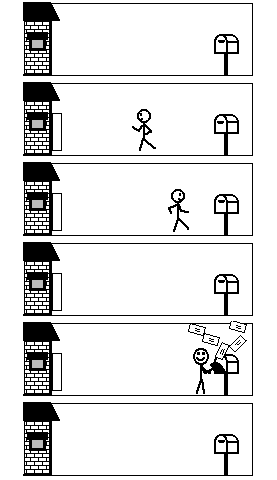
There's an old saying that's worth repeating: "There's humor in repetition." It's hard to say if this is more or less true depending on how humorous the source material is. For example, the quoted statement above isn't particularly funny, but it can become meta-humorous if repeated. There's humor in repetition.
Philosophies of humor aside, there was a play in the Thanksgiving Day Patriots-Jets game that was hysterically funny, and as far as I can tell, it just gets funnier with each viewing. (It might help that I'm a Patriots fan.) Jets quarterback Mark Sanchez was trying to make the best of a broken play and boldly careened towards the line of scrimmage, hoping to follow his linemen to daylight. Instead, one of his blockers got pushed backwards directly into Sanchez and the rest...well, you can view it as many times as you like below. (If you didn't see the game, it's worth noting that the collision caused Sanchez to fumble, which led directly to a Patriots return for a touchdown, one of three such scores in a dazzling 52 seconds of game time.)
As enjoyable as it is to watch the play, it only seemed natural to add a soundtrack. But what to add? Well, this being a very lowbrow vacation weekend project, I didn't expend too much energy on the question, and opted instead to offer a series of possibilities. Here you go (music changes at 0:58, 1:50, 2:03, 2:36, 3:20, 3:33, and 3:36; I started out with a couple of soundtrack warhorses, then got a little more creative).
I think they all work pretty well, although I'm sure there are many other excellent possibilities. As ever with these kinds of semi-random mashups, the delight is in seeing unintended synchronizations between the music and the video. Even synchronization with silence (as at 3:27) can seem right. It's the perfect ballet.
Happy Thanksgiving.
Sunday, November 25, 2012

Tuesday, October 23, 2012
Differently Similar
Once upon a time, I devoted a lot of blogging energy to charting notable examples of "tune theft." Although it's fun to suggest that composers are lazy plagiarists, I don't really believe that's what's usually going on when tunes align across the centuries, and what's really more interesting is how a similar set of pitches can sound so different according to context. (This point is beautifully made in Leonard Bernstein's wonderful "How Dry I Am" lecture, a.k.a. "The Infinite Variety of Music.")
A tune connection I noticed just yesterday has captured my attention because there's so little similarity of actual pitches, to the point that these really aren't close to being the same tune - but, at a slightly higher structural level, they are closely related. It's a gestalt thing. And, as is always most interesting, it's not a connection that came to me because I looked for it (I'm too lazy to do research), but rather that dawned on me slowly and, at first, subconsciously. This theme from the finale of Mozart's "Dissonance" Quartet, ambled by...

...and as I listened, I kept thinking that those staccato 8th notes in the 2nd half of the phrase reminded me of...something. Eventually, the theme from the finale of Brahms' Clarinet Sonata No.1 (the piano part of which I've played many times) raised its hand in some corner of my mind (here transposed from F to C to make comparisons easier).

Of course, neither phrase is particularly unusual in terms of phrase construction - each begins with two upbeats, then longer notes and a slow-ish harmonic rhythm followed by harmonic acceleration towards a half cadence. It's definitely those pairs of staccato 8ths notes that connect the two tunes, even though Mozart goes up where Brahms goes down. The openings of the two phrases don't share so much in common other than a general twisty-ness, but each leads into the staccato 8ths with the same melodic pattern (see circled notes below): three 8ths descending stepwise, then a drop of a 3rd to introduce the "paired staccato motif" which jumps up a 4th heading into the next bar. It's striking to me how similar the tunes sound even as they then head in opposite directions; and, because the circled sequences below begin a 4th apart, the parting of ways leads each to arrive on D at the same time.

So, that's really about it. The two good-natured tunes are clearly quite different, but what makes each memorable (to me, at least) are those bouncy 8th notes. I don't know if Brahms was somehow inspired by Mozart, but I love hearing this kind of kinship. As I've said many times before, there's an obvious analogy to puns and other types of linguistic references, and just as I can't seem to avoid looking for wordplay possibilities when words are in play, my listening ear loves to play pattern-matching games. Surely, on some level, listening to music is basically about pattern-matching, although no one wants to think about that too much.
By the way, since we're on the subject, my favorite moment in this Mozart movement comes a bit later in an exquisitely Schubertian chromatic mediant modulation. The music has been cruising along in the Dominant key, G Major, and the first violinist seems to get stuck/lost in a maze of 16th notes; abandoned by the other instruments, the violin tentatively hangs onto a D (Dominant of G) and then suddenly the violin sneaks up a half-step as we drop by a third into the distant key of E-flat Major. The lovely scoring for violins in octaves somehow complements this shape-shifting perfectly as the music gradually finds its way back, but as ever, it's the searching that we (I) remember.

Passages like this one fascinate me because when I'm listening to a piece like this, I've found that much of my pleasure comes from anticipating and then enjoying these very small moments; much of the rest of such a movement will often strike me (dodging lightning bolt) as rather formulaic. It may not be fair to Mozart to say this (quantifying pleasure is risky business), but I if I'm honest, it's as if 50% of my interest in this piece takes place within about 5% of its discourse. But that's a difficult topic for another day... (I have written about it before, with passing reference to the famously "dissonant" introduction to this same quartet.)
A tune connection I noticed just yesterday has captured my attention because there's so little similarity of actual pitches, to the point that these really aren't close to being the same tune - but, at a slightly higher structural level, they are closely related. It's a gestalt thing. And, as is always most interesting, it's not a connection that came to me because I looked for it (I'm too lazy to do research), but rather that dawned on me slowly and, at first, subconsciously. This theme from the finale of Mozart's "Dissonance" Quartet, ambled by...

...and as I listened, I kept thinking that those staccato 8th notes in the 2nd half of the phrase reminded me of...something. Eventually, the theme from the finale of Brahms' Clarinet Sonata No.1 (the piano part of which I've played many times) raised its hand in some corner of my mind (here transposed from F to C to make comparisons easier).

Of course, neither phrase is particularly unusual in terms of phrase construction - each begins with two upbeats, then longer notes and a slow-ish harmonic rhythm followed by harmonic acceleration towards a half cadence. It's definitely those pairs of staccato 8ths notes that connect the two tunes, even though Mozart goes up where Brahms goes down. The openings of the two phrases don't share so much in common other than a general twisty-ness, but each leads into the staccato 8ths with the same melodic pattern (see circled notes below): three 8ths descending stepwise, then a drop of a 3rd to introduce the "paired staccato motif" which jumps up a 4th heading into the next bar. It's striking to me how similar the tunes sound even as they then head in opposite directions; and, because the circled sequences below begin a 4th apart, the parting of ways leads each to arrive on D at the same time.

So, that's really about it. The two good-natured tunes are clearly quite different, but what makes each memorable (to me, at least) are those bouncy 8th notes. I don't know if Brahms was somehow inspired by Mozart, but I love hearing this kind of kinship. As I've said many times before, there's an obvious analogy to puns and other types of linguistic references, and just as I can't seem to avoid looking for wordplay possibilities when words are in play, my listening ear loves to play pattern-matching games. Surely, on some level, listening to music is basically about pattern-matching, although no one wants to think about that too much.
By the way, since we're on the subject, my favorite moment in this Mozart movement comes a bit later in an exquisitely Schubertian chromatic mediant modulation. The music has been cruising along in the Dominant key, G Major, and the first violinist seems to get stuck/lost in a maze of 16th notes; abandoned by the other instruments, the violin tentatively hangs onto a D (Dominant of G) and then suddenly the violin sneaks up a half-step as we drop by a third into the distant key of E-flat Major. The lovely scoring for violins in octaves somehow complements this shape-shifting perfectly as the music gradually finds its way back, but as ever, it's the searching that we (I) remember.

Passages like this one fascinate me because when I'm listening to a piece like this, I've found that much of my pleasure comes from anticipating and then enjoying these very small moments; much of the rest of such a movement will often strike me (dodging lightning bolt) as rather formulaic. It may not be fair to Mozart to say this (quantifying pleasure is risky business), but I if I'm honest, it's as if 50% of my interest in this piece takes place within about 5% of its discourse. But that's a difficult topic for another day... (I have written about it before, with passing reference to the famously "dissonant" introduction to this same quartet.)
Friday, October 19, 2012
Random Acts of Mindness
It's been said (right here in this post, to be precise) that "random" is literally the most oft misused word in the English language. Let's see what I can do to contribute further to the problem. If this lengthy blog post seems unappealing to you, why not spin the "MM's Multimedia Musing Machine" wheel over there in the right margin? It's just been updated with more than 50 new possible outcomes.
I'm going through one of my Shuffle phases on iTunes, partly because I only recently discovered that one can now automatically re-download all past purchases, which spurred me to realize there were literally days of music that had never made it to my laptop from iTunes, from Amazon, from eMusic, from ripped CDs. My digital music collection has always been split/shared awkwardly across two or three computers and an iPod. The iPod died last year and since then I’ve mainly just been using iTunes in class, often wondering why I couldn't find this or that – until now.
Once I'd gone to the trouble of collecting most of my digital music into one place, it seemed like a good idea to start shuffling through it to see what I'd been missing. A couple of points about that: 1) I've made a habit of excluding the following from shuffle lists: just about anything with short recitative tracks, such as operas, oratories, cantatas, etc. I just find 31 seconds of random recitative to be more annoying than enticing. So, the list skews pretty strongly towards the instrumental side. 2) I still have a yet bigger collection of music on an ancient medium known as the "compact disc." (Let’s not even talk about the 500 or so LP’s in my basement.) Although I'm sure I've forgotten about many potentially interesting CDs that I own, I think the bulk of that collection is bread-and-butter repertoire that I've known for a long time. But, the digital downloads tend to feature music I don't know as well - impulse buys from the likes of eMusic and Amazon inspired by thoughts like "I really should get to know more of [Composer X]'s music."
So, shuffling through myTunes is a great way to start realizing those oft-forgotten goals. I’m not sure how unusual I am in this respect, but I find I tend to listen more openly when music comes to me this way – unbidden, unexpected and seemingly destined to be heard. It's almost like being seduced. Almost. That’s quite irrational, but I’m not sure there’s much about listening to music that’s rational anyway. My experience is that if I consciously "put on" those new [Composer X] downloads, I'm likely to begin with all sorts of prejudices or even false hopes about what I'm about to hear and how I'm about to hear it. Whether the music is unexpectedly lovely or strange or disturbing, there's something about the "name that tune" context that makes me listen more curiously and less judgmentally. Maybe I have issues.
Nevertheless, I often find this the most pleasurable way to listen to music - kind of like listening to the radio, except there's no banter, the selections are stacked in my favor, and I can skip ahead at will. Perhaps it's the anxiety of choice that otherwise gets in the way. I don't mind admitting that I love watching Frasier re-runs many evenings to usher me off to sleep. Frasier is a great show at its best, but it's often not at its best, so I could easily go to Netflix and choose the best episodes each night, but I prefer just letting the Hallmark Channel (!) do the choosing. This really makes no sense; not only am I stuck with whatever episode happens to be on, but there are inevitably little cuts in syndicated showings, cuts needed to make room for all those commercials for Hallmark programs and Hallmark-oriented products that have no appeal. (I've probably seen at least 50 promos for Hallmark movies and have never watched one.) Nonetheless, when a truly great episode comes on, it always seems more special that it "just comes on" without me doing the choosing. Maybe I have issues.
My iTunes "Super Shuffle" playlist has 15+ days worth of music at the ready, and yet anyone who's ever dealt with shuffling knows how often the resulting playlist seems less than random. Here are a few recent tweets on the subject:
Shuffling also leads to all sorts of surprising encounters, of course. I blogged several years ago about realizing that Strauss's early and flashy Don Juan segues perfectly into his late and mellow Metamorphosen, a discovery brought to me by iTunes. Or, I once found that some Stravinsky cadenced perfectly into a Beatles song. This morning, while working on a syllabus, I heard something shuffle by that I instantly recognized as Bach/Stokowski, but Stokowski's romanticization was so complete I failed for almost a minute to realize that this:
is this:
even thought I teach the latter piece twice a year and love it. Not sure I would ever have selected that Stokowski track on my own, but I'm glad it was handed to me.
Followers of this blog will know that I love a good mashup, partly because there's always an element of randomness involved in smashing two separate entities together. This morning, while testing out the newest version of the Musing Machine, I stumbled on a marvelous synchronicity between an unknown song, brought to me via shuffling, and a pre-existing mashup that had started up unexpectedly. That's confusing, huh? So, iTunes had chosen a single-voice a cappella song from a collection of Shaker Songs that I never get around to listening to when the Musing Machine fired up this pairing of a Britten oboe piece with some random marimba piece. (That pairing first debuted in a music class where I asked two students to play their two pieces simultaneously.) So, if you're keeping score, we now have: solo Shaker song, solo Britten oboe, solo marimba, all joining together, for a moment at least, as if they belonged together:
...or maybe you disagree. But for me, that intersection doesn't seem at all random (especially the way the oboe seems to echo the singer). Pretty random, huh?
Anyway, if you have a taste for random, perhaps you've noticed that I keep mentioning my newly updated "Musing Machine" in this post. I continue to be proud of this distinctive feature, which escorts you to an MM multimedia creation of its choice; I don't know of another blog that has anything like it, and I'm not sure there's another blog that could have anything like it, although that's not necessarily a good thing.
Still, why not give it a spin or two?


NOTE: There are more than
200 425 possible outcomes.
.................
I'm going through one of my Shuffle phases on iTunes, partly because I only recently discovered that one can now automatically re-download all past purchases, which spurred me to realize there were literally days of music that had never made it to my laptop from iTunes, from Amazon, from eMusic, from ripped CDs. My digital music collection has always been split/shared awkwardly across two or three computers and an iPod. The iPod died last year and since then I’ve mainly just been using iTunes in class, often wondering why I couldn't find this or that – until now.
Once I'd gone to the trouble of collecting most of my digital music into one place, it seemed like a good idea to start shuffling through it to see what I'd been missing. A couple of points about that: 1) I've made a habit of excluding the following from shuffle lists: just about anything with short recitative tracks, such as operas, oratories, cantatas, etc. I just find 31 seconds of random recitative to be more annoying than enticing. So, the list skews pretty strongly towards the instrumental side. 2) I still have a yet bigger collection of music on an ancient medium known as the "compact disc." (Let’s not even talk about the 500 or so LP’s in my basement.) Although I'm sure I've forgotten about many potentially interesting CDs that I own, I think the bulk of that collection is bread-and-butter repertoire that I've known for a long time. But, the digital downloads tend to feature music I don't know as well - impulse buys from the likes of eMusic and Amazon inspired by thoughts like "I really should get to know more of [Composer X]'s music."
So, shuffling through myTunes is a great way to start realizing those oft-forgotten goals. I’m not sure how unusual I am in this respect, but I find I tend to listen more openly when music comes to me this way – unbidden, unexpected and seemingly destined to be heard. It's almost like being seduced. Almost. That’s quite irrational, but I’m not sure there’s much about listening to music that’s rational anyway. My experience is that if I consciously "put on" those new [Composer X] downloads, I'm likely to begin with all sorts of prejudices or even false hopes about what I'm about to hear and how I'm about to hear it. Whether the music is unexpectedly lovely or strange or disturbing, there's something about the "name that tune" context that makes me listen more curiously and less judgmentally. Maybe I have issues.
Nevertheless, I often find this the most pleasurable way to listen to music - kind of like listening to the radio, except there's no banter, the selections are stacked in my favor, and I can skip ahead at will. Perhaps it's the anxiety of choice that otherwise gets in the way. I don't mind admitting that I love watching Frasier re-runs many evenings to usher me off to sleep. Frasier is a great show at its best, but it's often not at its best, so I could easily go to Netflix and choose the best episodes each night, but I prefer just letting the Hallmark Channel (!) do the choosing. This really makes no sense; not only am I stuck with whatever episode happens to be on, but there are inevitably little cuts in syndicated showings, cuts needed to make room for all those commercials for Hallmark programs and Hallmark-oriented products that have no appeal. (I've probably seen at least 50 promos for Hallmark movies and have never watched one.) Nonetheless, when a truly great episode comes on, it always seems more special that it "just comes on" without me doing the choosing. Maybe I have issues.
My iTunes "Super Shuffle" playlist has 15+ days worth of music at the ready, and yet anyone who's ever dealt with shuffling knows how often the resulting playlist seems less than random. Here are a few recent tweets on the subject:
My iTunes Super Shuffle playlist has 4452 tracks, 411 from Haydn symphonies. Yet, I'm getting Haydn symphonies about 35% of time. Weird.
Well, my spooky iTunes Super Shuffle playlist just picked 4 Bach tunes in a row. Would be stranger if 4 Blochs in a row, but still...
OK, now iTunes Shuffle is really going hipster (after so much Haydn and Bach a few days ago): Boulez - Cage - Webern.Yes, it always seems as if there's something intentional going on...except, when it doesn't:
I've been tweeting fun iTunes shufflings, but I can now tell you that mvt 5 of Bartok's 4th Quartet does NOT work following Siegfried Idyll.
...oh I see, iTunes shuffle; from Wagner to Bartok to Vivaldi, huh? Anyone who thinks all classical music is the same should walk this path.My experiences updating Mr. Stravinsky's Random Accent Generator and the Multimedia Musing Machine have just confirmed how un-random random processes can seem. The Musing Machine now has more than 200 options, but I've seen the same result show up 3 times within about 10 chances. So, it stands to reason that I'll be getting Haydn 35% of the time and then not at all for hours, even though this seems unreasonable. Why should we expect randomness to be reasonable?
Shuffling also leads to all sorts of surprising encounters, of course. I blogged several years ago about realizing that Strauss's early and flashy Don Juan segues perfectly into his late and mellow Metamorphosen, a discovery brought to me by iTunes. Or, I once found that some Stravinsky cadenced perfectly into a Beatles song. This morning, while working on a syllabus, I heard something shuffle by that I instantly recognized as Bach/Stokowski, but Stokowski's romanticization was so complete I failed for almost a minute to realize that this:
is this:
even thought I teach the latter piece twice a year and love it. Not sure I would ever have selected that Stokowski track on my own, but I'm glad it was handed to me.
Followers of this blog will know that I love a good mashup, partly because there's always an element of randomness involved in smashing two separate entities together. This morning, while testing out the newest version of the Musing Machine, I stumbled on a marvelous synchronicity between an unknown song, brought to me via shuffling, and a pre-existing mashup that had started up unexpectedly. That's confusing, huh? So, iTunes had chosen a single-voice a cappella song from a collection of Shaker Songs that I never get around to listening to when the Musing Machine fired up this pairing of a Britten oboe piece with some random marimba piece. (That pairing first debuted in a music class where I asked two students to play their two pieces simultaneously.) So, if you're keeping score, we now have: solo Shaker song, solo Britten oboe, solo marimba, all joining together, for a moment at least, as if they belonged together:
...or maybe you disagree. But for me, that intersection doesn't seem at all random (especially the way the oboe seems to echo the singer). Pretty random, huh?
Anyway, if you have a taste for random, perhaps you've noticed that I keep mentioning my newly updated "Musing Machine" in this post. I continue to be proud of this distinctive feature, which escorts you to an MM multimedia creation of its choice; I don't know of another blog that has anything like it, and I'm not sure there's another blog that could have anything like it, although that's not necessarily a good thing.
Still, why not give it a spin or two?
NOTE: There are more than
Thursday, October 18, 2012
Mr. Stravinsky's Random Accent Generator 2.0 - Now With More Random!
For what it's worth, I've fiddled around with one of my stranger creations, Mr. Stravinsky's Random Accent Generator. I'm afraid it's not much less strange, but 1) I think the recordings sound better now, 2) there are more "random" options, and 3) the audio doesn't cut out so abruptly at the end of 8 bars. (You can sample the previous version here. Read more about it here and here.)

As before, those patient enough to try out enough patterns will be treated to a couple of surprises, although I'm not trying to encourage hours spent idly refreshing the page. Minutes, perhaps...
I will admit that the accent patterns aren't truly random. I "designed" each potential outcome, though I intentionally went about this quickly and tried not to "compose" too much. However, with many of them, I would find myself tinkering here and there to get things to sound more "right," whatever that might mean. Certainly Stravinsky's version sounds the most "right," though it doesn't hurt that I've heard it approximately 4,637 times.

So that got me to thinking about the possibility of generating a truly random sprinkling of accents, and I thus managed to create a little spreadsheet formula that accomplishes this task handily. I decided that since Stravinsky's original (see above; hear here) only accents 6 of the 32 chords, it made sense to average something like 6/32 rather than just go 50/50 on each chord, so each chord basically has an 18.75% chance of being accented. Here are some of the first patterns I generated this way (with 1's standing in for accents).
[I'll wait while you clap through them.] I especially like the third one from the end. Of course, I understand that Stravinsky's accents are not necessarily intended to sound random, though they are supposed to be unpredictable (random ≠ unpredictable). Still, it's kind of interesting to see the different ways in which this process can unfold.
If you're interested in investigating further, I've uploaded my little spreadsheet to Google Docs, with the added attraction that accents are added directly over the chords right in the spreadsheet. (Doesn't perform it though.) To use the document, you need to sign in to Google Docs, open this document, then choose "Make a Copy" from the file menu. Once you've got your own copy, you can give yourself an infinite supply of clapping exercises.
(Or, I suppose, you could just go here.)
More random-y stuff coming tomorrow on the blog, including an update of "MM's Magical Multimedia Musing Machine."
As before, those patient enough to try out enough patterns will be treated to a couple of surprises, although I'm not trying to encourage hours spent idly refreshing the page. Minutes, perhaps...
I will admit that the accent patterns aren't truly random. I "designed" each potential outcome, though I intentionally went about this quickly and tried not to "compose" too much. However, with many of them, I would find myself tinkering here and there to get things to sound more "right," whatever that might mean. Certainly Stravinsky's version sounds the most "right," though it doesn't hurt that I've heard it approximately 4,637 times.

So that got me to thinking about the possibility of generating a truly random sprinkling of accents, and I thus managed to create a little spreadsheet formula that accomplishes this task handily. I decided that since Stravinsky's original (see above; hear here) only accents 6 of the 32 chords, it made sense to average something like 6/32 rather than just go 50/50 on each chord, so each chord basically has an 18.75% chance of being accented. Here are some of the first patterns I generated this way (with 1's standing in for accents).
0100 0000 0100 0100 0000 0000 0000 0000
0000 0001 0000 1000 0000 1010 1000 0000
1000 0010 0000 0000 0000 0010 1011 0101
0000 0000 1000 0011 0000 0110 0001 0000
0010 1000 0100 1010 0100 0100 1000 0000
1000 0100 0000 0000 0100 1000 0001 0000
0100 0000 0000 1010 0100 0001 0000 0010
1000 0000 0001 1000 0110 0001 0100 1000
0100 1101 1000 1000 0000 0000 0010 0101
0010 0000 0000 0000 0000 0000 0100 0000
0000 0010 0000 0000 1001 0000 0000 0001
0100 0000 0010 0001 0000 0000 1000 0000
[I'll wait while you clap through them.] I especially like the third one from the end. Of course, I understand that Stravinsky's accents are not necessarily intended to sound random, though they are supposed to be unpredictable (random ≠ unpredictable). Still, it's kind of interesting to see the different ways in which this process can unfold.
If you're interested in investigating further, I've uploaded my little spreadsheet to Google Docs, with the added attraction that accents are added directly over the chords right in the spreadsheet. (Doesn't perform it though.) To use the document, you need to sign in to Google Docs, open this document, then choose "Make a Copy" from the file menu. Once you've got your own copy, you can give yourself an infinite supply of clapping exercises.
(Or, I suppose, you could just go here.)
More random-y stuff coming tomorrow on the blog, including an update of "MM's Magical Multimedia Musing Machine."
Tuesday, October 9, 2012
A Splendid Sunrise
I've gone on record before as not being the biggest fan of Haydn, but it's certainly not that I don't appreciate his genius. I've also gone on record as not being a big fan of Haydn's widely adored creation, The Creation, but I do love some things about it, including the beautiful recitative passage that precedes the work's most famous chorus, "The Heavens are Telling." (Notice I'm not saying what I think of that chorus, although this, this, and this might provide some evidence.)
As is so often the case with Haydn, I could only wish this passage were longer. I've written before about how both Haydn and Mozart will often "save their best stuff for first." Still, I think it's even better than that other famous sunrise passage. (No, not this one.) So, while sitting in a dentist's chair today, I had this idea of visualizing the way the music rises from the orchestra, and there you go (although I'd like to make the animation look smoother).

I could write at length about the amazing seventh bar, when we hear E, F#, G, B, and C# simultaneously. (The B and G are just suspensions over a V7/vi chord, but they are wonderful.) But, I think the remarkable fact that this is beautiful even when "played" by the synthesized orchestra inside my computer is saying enough. Listen to how different that D Major scale sounds when it radiates outward this way.
If you'd like to hear what comes next (performed by humans, no less (although the sun was created before humans)), go to 2:50 of this video:
The part about the moon rising is perhaps even more beautiful, by the way...
So I've come not to bury Haydn, but to praise him. Just the other day in Music History, I was playing the orchestral intro to this beautiful recitative passage for my class and realized something that should've been obvious to me before: it's just a D major scale! Well, it's just a D Major scale that is harmonized and orchestrated exquisitely. This rising scale in the most brilliant of keys is appropriate for a passage that celebrates the first rising of the sun: "In splendour bright is rising now the sun and darts his rays; an am’rous joyful happy spouse, a giant proud and glad, to run his measur’d course." (We're just not going to discuss this poetry now, OK?)
So, a D Major scale (plus two extra notes for free):

But here's what Haydn does with it:
So, a D Major scale (plus two extra notes for free):

But here's what Haydn does with it:
As is so often the case with Haydn, I could only wish this passage were longer. I've written before about how both Haydn and Mozart will often "save their best stuff for first." Still, I think it's even better than that other famous sunrise passage. (No, not this one.) So, while sitting in a dentist's chair today, I had this idea of visualizing the way the music rises from the orchestra, and there you go (although I'd like to make the animation look smoother).

I could write at length about the amazing seventh bar, when we hear E, F#, G, B, and C# simultaneously. (The B and G are just suspensions over a V7/vi chord, but they are wonderful.) But, I think the remarkable fact that this is beautiful even when "played" by the synthesized orchestra inside my computer is saying enough. Listen to how different that D Major scale sounds when it radiates outward this way.
If you'd like to hear what comes next (performed by humans, no less (although the sun was created before humans)), go to 2:50 of this video:
The part about the moon rising is perhaps even more beautiful, by the way...
In splendour bright is rising now the sun and darts his rays; an am’rous joyful happy spouse, a giant proud and glad, to run his measur’d course. With softer beams and milder light steps on the silver moon through silent night. The space immense of th’ azure sky innum’rous host of diant orbs adorns. And the sons of God announced the fourth day in song divine, proclaiming thus his power: The heavens are telling the glory of God...
Subscribe to:
Posts (Atom)